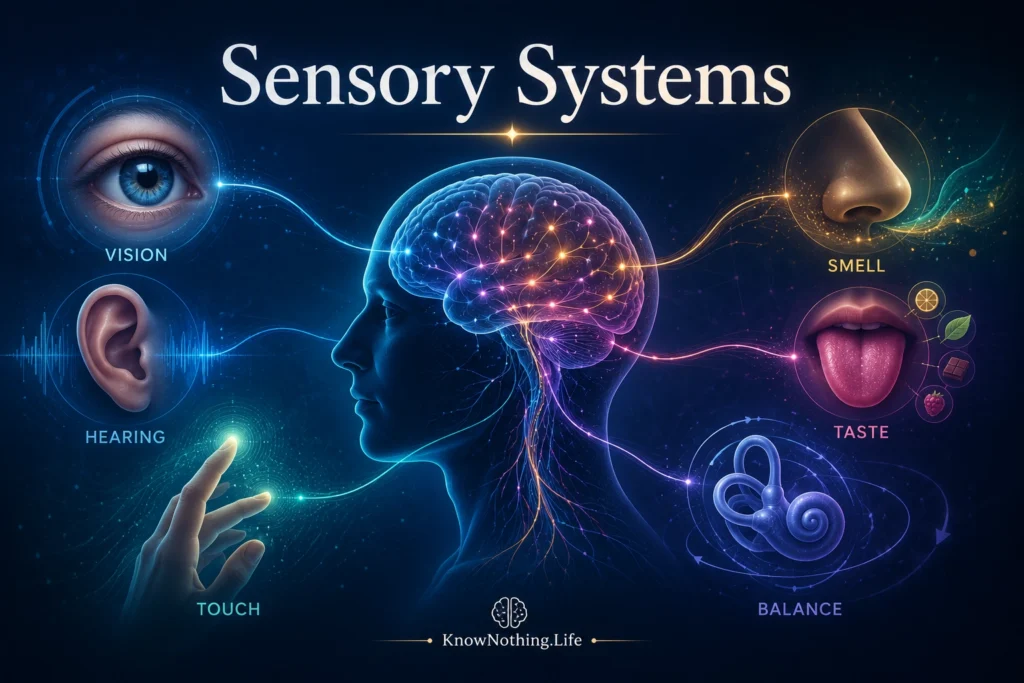
Sensory systems are the biological pathways that allow the nervous system to detect information from the body and the outside world. They include vision, hearing, touch, taste, smell, balance, body position, temperature, and pain. Each sensory system begins with specialized receptors that convert a particular kind of stimulus into neural signals. Light activates photoreceptors in the retina. Sound bends hair cells in the inner ear. Pressure activates mechanoreceptors in the skin. Chemicals activate smell and taste receptors. Head movement activates vestibular hair cells. Tissue damage or dangerous heat activates nociceptors. This conversion of physical or chemical energy into nervous-system activity is called sensory transduction. Sensory receptors are specialized structures that detect stimuli from the environment or internal organs and convert them into electrical signals for the nervous system.
Sensory systems do not simply deliver raw data to the brain. They organize, filter, amplify, suppress, and interpret information. The world that a person experiences is not a direct copy of reality entering the skull. It is a constructed perception built from receptor activity, neural pathways, thalamic relays, cortical maps, attention, memory, emotion, and action. The brain must decide what a stimulus is, where it is, how intense it is, whether it matters, and what should be done about it. Sensory systems therefore form the beginning of perception, but perception is always an active brain process.
Sensory Receptors and Transduction
The first step in sensation is receptor activation. Sensory receptors are specialized for particular forms of energy. Photoreceptors respond to light, mechanoreceptors respond to pressure or movement, chemoreceptors respond to molecules, thermoreceptors respond to temperature, and nociceptors respond to damaging or potentially damaging stimuli. This specialization allows the nervous system to divide the world into usable channels. The same physical world contains light waves, sound waves, chemicals, textures, temperatures, gravity, and pressure, but the body needs different biological detectors for each kind of information.
Transduction is the process that turns a stimulus into neural activity. In the eye, light changes photopigments and ultimately alters signaling from retinal cells. In the ear, sound waves cause mechanical movement in the cochlea, bending hair-cell stereocilia and changing electrical activity. In the skin, pressure deforms receptor endings or specialized receptor structures. In the nose and tongue, chemicals bind to receptors and trigger cellular signaling. Sensory receptors therefore act as translators. They convert the language of the physical world into the electrical and chemical language of the nervous system.
Vision: Light Into Form, Color, and Motion
Vision is one of the most studied sensory systems because it shows how complex perception becomes after transduction. Visual processing begins in the retina, where rods and cones respond to light. Signals then pass through retinal circuits and travel through the optic nerve toward the brain. Much visual information reaches the lateral geniculate nucleus of the thalamus before moving to the primary visual cortex in the occipital lobe. From there, visual information spreads into broader pathways that help identify objects, detect motion, judge depth, recognize faces, guide eye movements, and support visually guided action.
David Hubel and Torsten Wiesel transformed neuroscience by showing that neurons in the visual cortex respond selectively to features such as line orientation and are organized in columns. Their work helped establish that the cortex does not passively receive visual images; it actively analyzes features of the visual world. The Nobel Prize committee recognized Hubel and Wiesel for discoveries concerning information processing in the visual system, and Eric Kandel later wrote that their work laid the foundation for later studies across sensory systems.
Hearing: Sound Into Neural Patterns
Hearing begins when sound waves enter the ear and produce vibrations that reach the cochlea. Inside the cochlea, the organ of Corti contains hair cells that convert mechanical movement into neural signals. The basilar membrane is organized so that different regions respond best to different sound frequencies, creating a frequency map known as tonotopy. Auditory signals then travel through brainstem nuclei, the inferior colliculus, the medial geniculate body of the thalamus, and finally the auditory cortex in the temporal lobe. NCBI’s Neuroscience text describes the primary auditory cortex as located on the superior temporal gyrus and organized with a precise tonotopic map.
Hearing is not only the detection of sound. The brain must analyze pitch, loudness, rhythm, location, speech, music, emotional tone, and background noise. This is why hearing in a crowded room is so difficult: the auditory system must separate one voice from many competing signals. Tonotopic organization helps preserve frequency information, but understanding speech or music requires higher-level interpretation. The auditory system therefore turns vibration into meaning, allowing sound to become language, warning, memory, music, and social connection.
Touch, Body Position, Temperature, and Pain
The somatosensory system includes touch, pressure, vibration, proprioception, temperature, and pain. It allows the brain to monitor both the outside surface of the body and the body’s internal position. Touch and proprioceptive information often travel through pathways that eventually reach the somatosensory cortex in the parietal lobe, where the body is represented in an organized map. StatPearls describes the somatosensory pathway as the conduit that sends information from the periphery to the postcentral gyrus and associated cortices.
Pain and temperature use partly different pathways. The spinothalamic tract carries nociceptive, temperature, crude touch, and pressure information toward the thalamus and somatosensory regions. Pain is especially important because it is not merely a sensation; it is a protective experience shaped by attention, emotion, memory, context, and higher brain centers. NCBI’s pain pathway overview notes that nociceptive signals are relayed through spinal pathways to higher centers including the brainstem, thalamus, somatosensory cortex, and limbic system.
Smell and Taste: Chemical Senses
Smell and taste are chemical senses. Smell begins when odor molecules bind to receptors in the nasal epithelium. These signals travel to the olfactory bulb and then to primary olfactory cortical regions and limbic structures. The olfactory system is unusual because it reaches primary cortical processing without the same kind of initial thalamic relay used by most other sensory systems. NCBI’s Neuroscience text describes the olfactory system as unique because it does not require a thalamic relay on the way to primary cortical processing and also projects to regions such as the hypothalamus and amygdala.
Taste begins with taste receptor cells in taste buds distributed across the tongue, soft palate, pharynx, and upper esophagus. Taste signals travel through cranial nerves and brainstem pathways before reaching higher centers involved in taste perception. The gustatory cortex is especially associated with the anterior insula and frontal opercular region. Smell and taste are closely linked in everyday experience, which is why flavor depends heavily on olfaction. A meal is not built from taste alone; it combines smell, taste, texture, temperature, memory, and expectation.
Balance, Motion, and the Vestibular System
The vestibular system gives the brain information about head movement, balance, orientation, and acceleration. It is located in the inner ear and includes the semicircular canals and otolith organs. The semicircular canals detect rotational movement, while otolith organs help detect linear acceleration and head position relative to gravity. StatPearls describes the vestibular system as supporting proprioception and equilibrium, including orientation, acceleration, eye movement compensation, and posture.
Balance is one of the least noticed senses until it fails. The vestibular system works closely with vision, proprioception, cerebellar circuits, brainstem reflexes, and spinal pathways. It helps stabilize gaze when the head moves, maintain posture, coordinate walking, and orient the body in space. Disorders of vestibular function can produce dizziness, vertigo, nausea, imbalance, and visual instability. This shows that sensory systems are not only for conscious perception. They also support automatic control of the body.
Sensory Integration and Perception
No sensory system works completely alone. The brain constantly integrates information across modalities. Seeing a person speak helps the brain understand their words. Touch helps confirm what vision suggests. Smell changes taste. Balance depends on vestibular, visual, and proprioceptive input. Pain is shaped by attention, fear, memory, and expectation. Multisensory integration allows the nervous system to build a more stable and useful model of reality than any single sense could provide by itself. NCBI’s chapter on multisensory pathways emphasizes that cortical and thalamic pathways contribute to multisensory integration.
This integration also reveals why perception is constructive. The brain does not experience isolated light, sound, pressure, chemicals, and motion as separate data streams. It binds them into objects, bodies, places, events, and meanings. A barking dog is not perceived as independent light patterns, sound frequencies, fur texture, and motion signals. It appears as one animal in one place doing one thing. Sensory systems create the ingredients, but the brain creates the experienced world.
Why Sensory Systems Matter
Sensory systems matter because they are the nervous system’s gateway to reality. They allow the body to detect danger, find food, communicate, move through space, recognize people, enjoy music, feel touch, taste meals, smell smoke, and maintain balance. Without sensory systems, the brain would be isolated from the world and the body. Sensation is the beginning of perception, action, learning, and survival.
The deeper lesson is that sensing is not passive. The brain does not merely receive the world; it interprets it. Sensory systems filter reality into usable forms, and the brain combines those signals with memory, attention, emotion, and movement. To understand sensory systems is to understand how biological receptors and neural pathways become lived experience: light becomes vision, vibration becomes sound, pressure becomes touch, chemicals become flavor, gravity becomes balance, and bodily threat becomes pain.