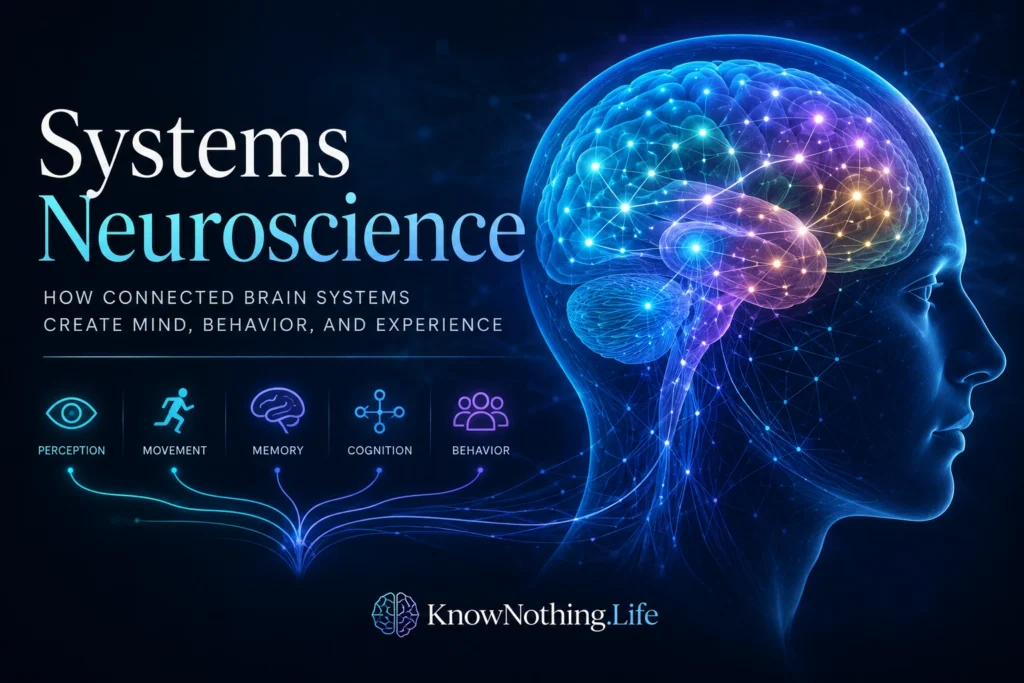
Systems neuroscience is the study of how groups of neurons, brain circuits, and large-scale networks produce perception, movement, emotion, cognition, and behavior. Instead of focusing only on single molecules, individual synapses, or isolated neurons, systems neuroscience asks how many parts of the nervous system work together. It studies sensory systems, motor systems, attention networks, memory circuits, sleep rhythms, decision-making pathways, and the relationship between neural activity and behavior. A systems-neuroscience approach treats the brain as an organized network of interacting elements rather than a collection of separate parts.
This field matters because most real behavior cannot be explained by one neuron or one brain region alone. Seeing a face, reaching for a cup, recognizing a voice, navigating a room, solving a problem, or feeling fear involves coordinated activity across many levels. The retina, thalamus, cortex, basal ganglia, cerebellum, hippocampus, amygdala, brainstem, spinal cord, and body can all participate in a single meaningful act. Systems neuroscience tries to understand that coordination: how neural signals are routed, transformed, synchronized, selected, and turned into action.
Circuits, Networks, and Levels of Analysis
A neural circuit is a group of connected neurons that performs a function. Some circuits are relatively small, such as spinal reflex circuits that withdraw the body from danger. Others are distributed across the brain, such as networks for memory, language, visual recognition, or attention. Systems neuroscience studies both kinds. It asks how local circuits process information, how distant regions communicate, and how activity patterns in the nervous system relate to observable behavior. The goal is not just to name brain areas, but to understand how activity flows through them.
David Marr’s work remains important because it gave neuroscience a way to think across levels. Marr argued that information-processing systems should be understood at the computational level, the algorithmic level, and the implementation level. In brain science, this means asking what problem the nervous system is solving, what representations or operations it uses, and how those operations are physically realized in neurons and circuits. Marr’s framework became especially influential in vision research and computational neuroscience because it encouraged scientists to connect behavior, computation, and biology rather than reducing one level to another.
Sensory Systems and Perception
Sensory systems are classic subjects in systems neuroscience because they show how the brain transforms raw input into meaningful experience. Vision, hearing, touch, smell, taste, balance, and pain all begin with specialized receptors, but perception is built through circuits. Visual information, for example, travels from the retina to the thalamus and then into visual cortex, where neurons respond to features such as edges, orientation, motion, color, depth, and object shape. From there, information moves into temporal and parietal pathways that support recognition, spatial awareness, and visually guided action.
David Hubel and Torsten Wiesel’s work on the visual cortex is one of the landmark achievements in systems neuroscience. Their experiments showed that neurons in primary visual cortex respond selectively to visual features such as line orientation and are organized in structured cortical columns. Eric Kandel later wrote that their work did more than open the study of primary visual cortex; it laid the foundation for what followed in all sensory systems. Their research showed that perception is not a passive recording of the world. It is a layered neural process in which circuits extract, organize, and interpret information.
Movement, Action, and Motor Control
Systems neuroscience also studies how the nervous system controls movement. A voluntary action, such as picking up a glass, depends on far more than the motor cortex sending a command to muscles. The frontal lobe helps plan the action, the parietal lobe helps locate the object in space, the basal ganglia help select and initiate the action, the cerebellum helps correct timing and coordination, the brainstem helps regulate posture, and the spinal cord helps execute motor patterns. Movement is therefore not a simple top-down command. It is a distributed process involving planning, feedback, prediction, and correction.
Motor systems also reveal why behavior must be studied in real time. The nervous system must constantly compare intended movement with actual sensory feedback. When the hand reaches too far, the cerebellum helps adjust future movement. When posture shifts, spinal and brainstem circuits help maintain balance. When a person learns to play tennis, dance, type, or speak a new language, motor circuits change through practice. Systems neuroscience studies these loops because action is one of the clearest places where brain, body, and world meet.
Brain Rhythms, Networks, and Cognition
Systems neuroscience is deeply concerned with brain rhythms and large-scale coordination. Neurons do not simply fire randomly. They often organize into rhythmic patterns, including theta, alpha, beta, gamma, and slow-wave activity. These rhythms are linked with sleep, attention, perception, memory, movement, and cognition. György Buzsáki is especially known for work on brain rhythms, internally generated cell assemblies, neural syntax, and memory consolidation. His work helped emphasize that the brain is not merely reactive to outside stimuli; it also generates internal patterns that structure thought and behavior.
Cognition depends on networks rather than isolated centers. Working memory involves prefrontal and parietal systems. Episodic memory involves the hippocampus, cortex, thalamus, and prefrontal regulation. Emotion involves amygdala, hypothalamus, insula, prefrontal cortex, brainstem, and bodily feedback. Attention depends on networks that amplify some signals while suppressing others. Systems neuroscience therefore moves beyond the older idea of one function living in one spot. A mental ability is usually a coordinated pattern of activity across multiple systems.
Methods in Systems Neuroscience
Systems neuroscience uses many tools because no single method can explain the whole brain. Electrophysiology can record spikes and local field potentials from neurons and circuits. Functional MRI can measure large-scale patterns of brain activity in humans and animals. Calcium imaging can track activity in many neurons. Lesion studies reveal what happens when a region or pathway is damaged. Computational modeling tests whether a proposed circuit could actually produce a behavior. Each method has strengths and limits, so systems neuroscience often advances by combining them.
Optogenetics has become especially important because it allows researchers to control selected neurons with light. Reviews of optogenetic methods describe how these tools allow investigators to manipulate defined neuronal populations and study causal roles in circuits and behavior. This is a major step beyond merely observing brain activity. If activating or silencing a particular pathway changes behavior, scientists gain stronger evidence that the pathway contributes causally. Modern systems neuroscience increasingly depends on this combination of reading neural activity, manipulating circuits, and measuring behavior.
Systems Neuroscience and Brain Disorders
Many brain disorders are best understood as circuit or network disorders. Parkinson’s disease involves abnormal basal ganglia-thalamocortical circuits. Epilepsy involves abnormal synchronized activity in neural networks. Depression, anxiety, schizophrenia, addiction, chronic pain, autism spectrum conditions, dementia, and traumatic brain injury can all involve disruptions in communication among brain regions. These conditions are not always explained by one damaged area or one chemical imbalance. They often involve altered dynamics across systems.
This systems perspective matters for treatment. Deep brain stimulation, neurofeedback, brain stimulation techniques, rehabilitation, psychotherapy, pharmacology, and behavioral training all work partly by changing circuit activity. A stroke patient may recover movement by strengthening alternative pathways. A person with anxiety may improve by changing fear-learning and prefrontal regulation circuits. A patient with Parkinson’s disease may benefit when stimulation changes abnormal circuit rhythms. Systems neuroscience helps medicine move from describing symptoms to understanding the networks that produce them.
Why Systems Neuroscience Matters
Systems neuroscience matters because it explains how the brain becomes behavior. Molecules, genes, synapses, and neurons are essential, but perception and action emerge from organized systems. The visual system turns light into perception. The motor system turns intention into movement. Memory systems connect experience across time. Emotional systems assign value and bodily urgency. Attention systems decide what matters. These functions depend on interaction, not isolation.
The deeper lesson is that the nervous system is relational. A neuron matters because of the circuit it belongs to. A brain region matters because of the networks it joins. A behavior matters because it links brain activity with the body and environment. Systems neuroscience gives us the bridge between cellular neuroscience and human life. It shows how biological signals become coordinated patterns, how patterns become perception and action, and how the living brain creates behavior moment by moment.