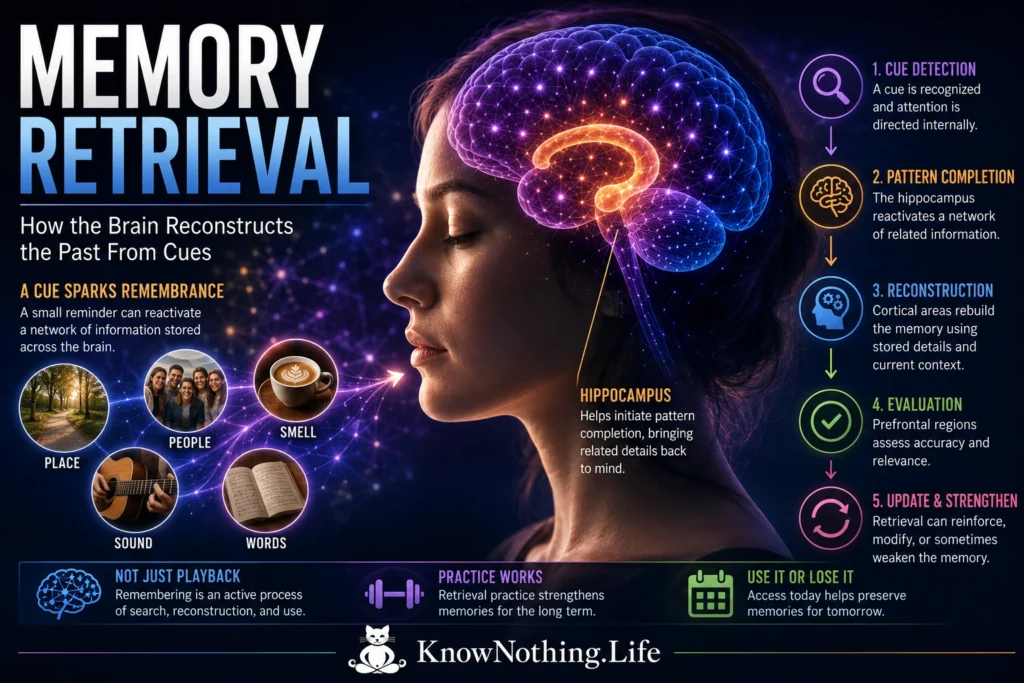
Memory retrieval is the process through which previously encoded information becomes available to thought, recognition, decision-making, or action. It may occur deliberately, as when someone tries to remember a name, or automatically, as when a smell brings back a childhood experience. Retrieval does not involve locating a complete recording stored in one brain region. Memories are represented across networks involved in sensation, emotion, language, space, movement, and meaning. Remembering requires these distributed elements to become active again and to be assembled into an experience that can guide current behavior.
This reconstruction can be vivid without being perfectly accurate. Functional imaging has shown that recollection partially reinstates activity associated with the original encoding experience. Jeffrey Johnson and Michael Rugg found that words learned through visual imagery later reactivated regions involved in visual processing, while words learned through sentence generation reactivated areas associated with the original semantic task. The remembered event is therefore rebuilt through patterns resembling those used when it was first experienced. Because reinstatement is partial and influenced by the present context, retrieval can preserve the general meaning of an event while altering or omitting specific details.
Retrieval Cues and Encoding Specificity
A retrieval cue is any piece of information that helps reactivate a stored representation. A cue may be a word, location, face, emotion, smell, question, bodily state, or fragment of an earlier event. Endel Tulving and Donald Thomson developed the encoding-specificity principle to explain why a cue’s effectiveness depends on its relationship to the original learning episode. A cue that appears weak in isolation may be highly effective when it was uniquely connected to the target during encoding. Conversely, a seemingly obvious cue may fail when it was not incorporated into the original representation.
Context-dependent memory provides a familiar example. In the classic experiment by Duncan Godden and Alan Baddeley, divers learned words either underwater or on land and later recalled more when the testing environment matched the learning environment. A modern preregistered replication found evidence for the same interaction, although the effect was smaller than the original estimate. The broader lesson is not that people should always study in the room where they will be tested. Environmental context is only one source of retrieval information, and strong learning can become less dependent on a particular setting. However, mentally reinstating the original situation, thoughts, or associations can sometimes provide access to information that initially seems unavailable.
Retrieval also improves when cues distinguish one memory from its competitors. A general cue such as “animal” may activate dozens of possible answers, while a more specific cue such as “animal seen beside the red barn” narrows the search. Experiments manipulating cue–target relationships show that unique associations support more effective cued recall. This is why meaningful examples, distinctive images, personal connections, and organized categories can be useful during learning: they create multiple routes through which the information may later be recovered.
The Hippocampus and Pattern Completion
The hippocampus is especially important for retrieving episodic memories containing relationships among people, objects, places, actions, and contexts. A complete event does not need to be presented again for recollection to occur. A partial cue can sometimes restore several associated details through a process known as pattern completion. Hearing the first notes of a song may reactivate the place where it was heard, the people who were present, and the emotions associated with the occasion. Computational accounts have long proposed that recurrent connections within hippocampal area CA3 are suited to restoring a larger representation from incomplete input.
Human imaging and electrophysiological studies support this model. Bernhard Staresina and colleagues found that successful associative recollection was accompanied by reinstatement of event-specific patterns in the hippocampus, together with changes in gamma- and alpha-frequency activity. Xiang-Zhen Grande and colleagues later reported that activity in hippocampal area CA3 was associated with the holistic recovery of multiple event elements when participants were given only one part of the original episode. These findings suggest that the hippocampus helps use a partial reminder to coordinate the reactivation of a more complete memory across the cortex.
Pattern completion must be balanced with pattern separation, the process that keeps similar experiences distinct. Remembering where a car was parked today requires retrieving the current location without confusing it with yesterday’s location. When retrieval becomes biased too strongly toward completion, a familiar cue may activate the wrong but similar event. Memory errors can therefore arise not because the brain has stopped functioning, but because an adaptive completion process reconstructs the most likely event from incomplete information.
Prefrontal Control and Memory Search
Retrieval is often effortless when a cue has a strong, unique relationship with its target. More difficult remembering requires cognitive control. The prefrontal cortex helps establish what information is being sought, select useful cues, suppress irrelevant associations, and evaluate whether the recovered information answers the current question. Anthony Wagner and colleagues found that activity in the left inferior prefrontal cortex increased when people had to recover semantic information through a more controlled search. The region appeared to provide a top-down signal that guided access to meaning when automatic retrieval was insufficient.
Several prefrontal processes may operate during episodic retrieval. One system helps specify the memory search, while others monitor whether the result contains the appropriate source, context, or level of detail. Imaging studies have identified different left prefrontal activity patterns during cue specification, recollective monitoring, and the maintenance of retrieved information. The dorsolateral prefrontal cortex becomes especially important when a memory feels familiar but must be checked against additional evidence. This monitoring helps distinguish whether a person actually saw an event, imagined it, heard about it, or inferred it afterward.
Recognition is usually easier than free recall because the item itself serves as a retrieval cue. Yet recognition can arise from different experiences. Recollection involves recovering contextual details, while familiarity is the sense that something was encountered before without remembering when or where. Researchers continue to debate whether these are separate neural processes or different strengths of one memory signal. Studies of hippocampal patients and intracranial recordings indicate that the hippocampus can contribute to both, particularly when familiarity is strong, although detailed contextual recollection places especially heavy demands on hippocampal processing.
Retrieval Strengthens and Reshapes Memory
Retrieving a memory does more than reveal whether it is available. The act of retrieval can strengthen later access. Henry Roediger and Jeffrey Karpicke asked students to study prose passages and then either study them again or practice recalling them. Repeated study produced better performance after a very short delay, but retrieval practice produced substantially better retention after longer delays. This testing effect shows that attempting to reconstruct knowledge can create more durable learning than repeatedly exposing oneself to the same material.
Effective retrieval practice requires effortful recall rather than simply rereading an answer. Short quizzes, flash cards, practice questions, and explaining a concept without notes all require the brain to rebuild the information from cues. Feedback is important when retrieval fails or produces an incorrect response, because mistakes can otherwise be reinforced. Retrieval is particularly powerful when attempts are spaced across time. Each successful reconstruction after some forgetting strengthens access under slightly different conditions, making the memory less dependent on the original study context.
Retrieving one memory can also make related memories temporarily harder to access. Michael Anderson, Robert Bjork, and Elizabeth Bjork demonstrated retrieval-induced forgetting by having participants practice some category members while leaving related items unpracticed. Practiced items became easier to recall, but competing items from the same categories became less accessible on a later test. This effect may reflect inhibitory control that suppresses competing information so the intended memory can be selected efficiently. Retrieval therefore reorganizes the relative accessibility of memories rather than strengthening every related representation equally.
Reconsolidation, Error, and the Changing Past
A retrieved memory can enter a temporary period of instability during which it may be strengthened, weakened, or updated. Karim Nader, Glenn Schafe, and Joseph LeDoux demonstrated this process in rats trained to associate a tone with danger. When the established fear memory was reactivated, blocking protein synthesis in the amygdala impaired its later expression. Administering the same treatment without reactivation, or several hours afterward, did not produce the same effect. The researchers concluded that a consolidated memory can require reconsolidation after being returned to an active state.
Reconsolidation does not mean that every act of remembering completely rewrites a memory. Whether updating occurs depends on factors such as the strength and age of the memory, the presence of new or surprising information, and the conditions under which retrieval occurs. Nevertheless, reactivation creates an opportunity for present knowledge, emotion, and suggestion to become connected with the earlier event. This flexibility allows memories to remain useful as circumstances change, but it also helps explain why repeated retellings can gradually modify details and confidence.
Memory retrieval is therefore both an act of recovery and an act of construction. Cues initiate the search, the hippocampus coordinates pattern completion, cortical regions reinstate parts of the original experience, and the prefrontal cortex guides and evaluates the result. Retrieval can strengthen knowledge, suppress competitors, reveal forgotten information, and modify the memory itself. The brain does not preserve the past as an untouched archive. It repeatedly reconstructs past experience so it can serve the needs of the present.