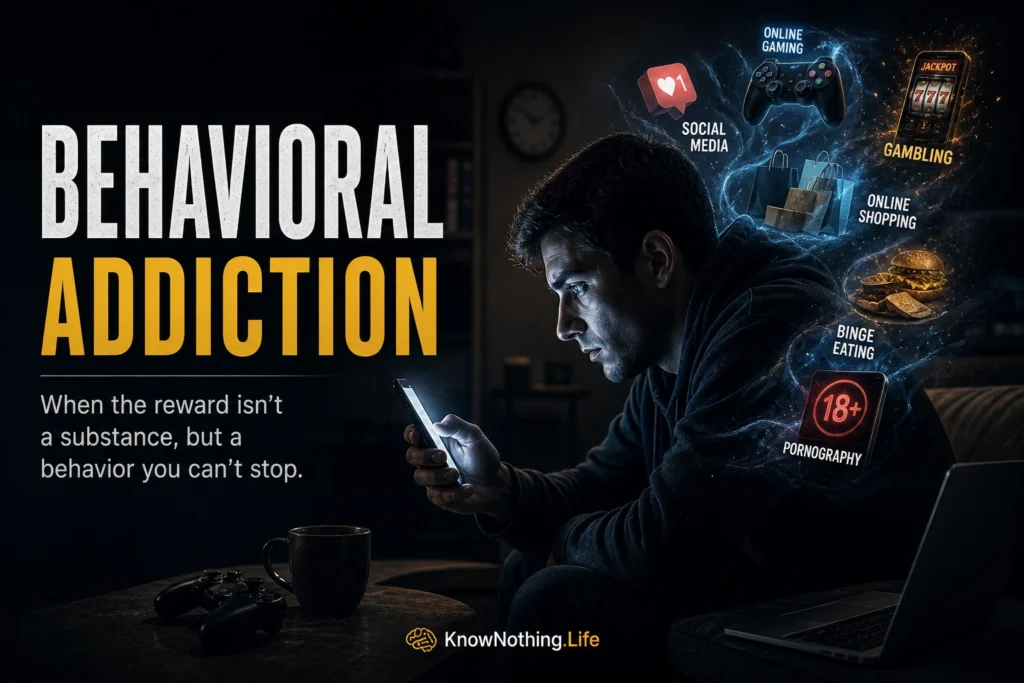
Behavioral addiction refers to a pattern of compulsive engagement in a rewarding behavior despite harmful consequences. Unlike substance addiction, it does not require the ingestion of alcohol, nicotine, opioids, stimulants, or other psychoactive drugs. Instead, the addictive process develops around behaviors such as gambling, gaming, internet use, pornography, shopping, exercise, food-related behaviors, social media, or work. The central issue is not that the behavior is always harmful in itself. Many of these activities can be normal, pleasurable, useful, or even healthy. The problem begins when the behavior becomes difficult to control, increasingly central to emotional regulation, and damaging to relationships, health, finances, work, or identity.
The psychology of behavioral addiction draws from learning theory, neuroscience, cognitive psychology, psychiatry, and social psychology. B. F. Skinner’s work on reinforcement explains how rewards strengthen behavior, Ivan Pavlov’s conditioning research explains why cues trigger urges, and Daniel Kahneman’s work on fast and slow thinking helps clarify why immediate rewards can overpower long-term judgment. In the clinical field, Mark Griffiths has been especially influential in defining behavioral addiction through components such as salience, mood modification, tolerance, withdrawal, conflict, and relapse. Behavioral addiction shows that addiction is not only about chemicals entering the body. It is also about how reward, anticipation, habit, emotion, and environment can organize behavior into compulsive loops.
Defining Behavioral Addiction
A behavioral addiction occurs when a behavior that produces reward or relief becomes excessive, repetitive, and difficult to stop despite negative consequences. The behavior becomes psychologically central. It occupies attention, organizes routines, influences mood, and begins to crowd out other sources of meaning. A person may continue gambling after serious financial loss, gaming despite academic or occupational decline, shopping despite debt, or scrolling despite sleep disruption and emotional distress. In each case, the behavior continues not because it is harmless, but because it has become strongly connected to reward, escape, or self-regulation.
Mark Griffiths, in his work on behavioral addictions, proposed a widely cited “components model” that includes salience, mood modification, tolerance, withdrawal, conflict, and relapse. Salience means the behavior becomes one of the most important activities in the person’s life. Mood modification means it changes emotional state, often producing excitement, numbness, relief, or escape. Tolerance means increasing amounts are needed to achieve the same effect, while withdrawal refers to irritability, restlessness, or distress when the behavior is stopped. Conflict appears when the behavior damages relationships or responsibilities, and relapse occurs when attempts to stop repeatedly break down. This model helps distinguish addiction from ordinary enthusiasm, passion, or habit.
Reward, Reinforcement, and the Behavioral Loop
Behavioral addictions are built around reinforcement. A behavior is more likely to repeat when it produces a rewarding consequence. Skinner’s Science and Human Behavior remains foundational here because it shows how consequences shape future action. His statement that “the consequences of behavior determine the probability that the behavior will occur again” applies directly to gambling wins, social media likes, gaming achievements, online sexual stimulation, shopping pleasure, and other reward-based behaviors. When the reward is immediate, emotionally intense, or unpredictable, the behavior can become especially difficult to resist.
Intermittent reinforcement is particularly important. Gambling is the classic example because rewards are unpredictable. A person does not win every time, but the possibility of winning keeps the behavior alive. Slot machines, loot boxes, variable social media feedback, dating app matches, and notification systems can all operate through similar principles. The uncertainty itself becomes motivating. The person keeps checking, playing, betting, or scrolling because the next reward might arrive at any moment. Behavioral addiction often grows from this combination of anticipation and uncertainty, where wanting becomes stronger than satisfaction.
Conditioning, Cues, and Craving
Behavioral addiction is also shaped by conditioning. Pavlov’s classical conditioning research showed that neutral cues can become powerful triggers when repeatedly paired with rewarding experiences. In behavioral addiction, cues may include a phone vibration, casino lights, a gaming console, a shopping app, a sports betting advertisement, boredom after work, loneliness at night, or the sound of a notification. These cues can activate craving before the person has consciously decided to engage in the behavior.
This cue-driven process helps explain why behavioral addictions are difficult to interrupt. A person may genuinely intend to stop, but the environment repeatedly invites relapse. A phone on the bedside table, saved payment information, targeted advertising, autoplay, endless scrolling, and algorithmic recommendations all reduce the distance between impulse and action. The modern digital environment is especially powerful because it surrounds users with cues and removes friction. In earlier eras, a person might have needed to travel to a casino or store. Today, many potentially addictive behaviors are available instantly, privately, and continuously.
Gambling Addiction and the Model of Behavioral Compulsion
Gambling disorder is the best-established behavioral addiction in modern psychiatry and is often used as the model for understanding other behavioral addictions. Gambling combines risk, reward, uncertainty, fantasy, and near-miss experiences. A person may continue gambling not only because of wins, but because of the emotional arousal surrounding the possibility of winning. Losses can also intensify the behavior when the person begins “chasing” losses, believing that one more bet may repair the damage already done.
Cognitive distortions are central to gambling addiction. People may believe they can predict random outcomes, that a win is “due,” or that personal skill has more influence than it really does. Kahneman and Amos Tversky’s work on heuristics and biases helps explain these errors in judgment. The mind is not naturally skilled at reasoning about probability under emotional pressure. The gambler may understand odds in the abstract yet behave as if the next outcome carries personal meaning. Gambling addiction reveals how reward, hope, loss aversion, and distorted probability can combine into a powerful cycle of compulsion.
Gaming, Internet Use, and Digital Reward
Gaming and internet-related behavioral addictions have become increasingly important as digital life has expanded. Video games can provide achievement, mastery, social connection, identity, competition, and escape. For most people, gaming is recreational. For some, however, it becomes excessive and harmful. Gaming disorder has been recognized by the World Health Organization in the International Classification of Diseases, reflecting growing concern about patterns of impaired control, priority given to gaming over other activities, and continued use despite negative consequences.
Digital platforms are psychologically powerful because they are designed around engagement. Games use leveling systems, rewards, rankings, social pressure, novelty, and intermittent reinforcement. Social media uses likes, comments, shares, notifications, and infinite feeds. These systems can produce repeated checking and compulsive use, especially when they become tied to identity, social approval, loneliness, boredom, or stress relief. Sherry Turkle’s work, including Alone Together, warns that digital connection can sometimes create the feeling of companionship while leaving deeper emotional needs unmet. Behavioral addiction in digital life often involves not only pleasure, but the fear of disconnection, invisibility, or missing out.
Mood Modification and Emotional Regulation
A major function of behavioral addiction is mood modification. People often repeat addictive behaviors because those behaviors quickly change how they feel. Gambling may create excitement, gaming may create competence, shopping may create pleasure, pornography may create escape, social media may create validation, and overwork may create a sense of worth. The behavior becomes a tool for emotional regulation. It may reduce anxiety, numb sadness, distract from shame, or fill emptiness.
This does not mean behavioral addiction is merely a lack of discipline. It often reflects a shortage of healthier coping mechanisms or a deeper emotional problem that has not been addressed. Gabor Maté’s writing on addiction emphasizes the role of pain and emotional suffering, captured in his question: not “Why the addiction?” but “Why the pain?” Although Maté often discusses substance addiction, the principle applies to behavioral addiction as well. A compulsive behavior may begin as an attempted solution to distress. The tragedy is that the solution eventually becomes another source of distress.
Habit, Compulsion, and Loss of Control
Behavioral addiction often develops through the gradual transformation of voluntary behavior into habit and then compulsion. At first, the person chooses the behavior because it is enjoyable or useful. Over time, repeated engagement in similar contexts creates automatic routines. Charles Duhigg’s popular model in The Power of Habit describes habit as a loop of cue, routine, and reward. A person feels bored, opens an app, receives stimulation, and repeats the cycle. A person feels stressed, shops online, feels temporary relief, and strengthens the loop.
Compulsion appears when the behavior continues even after the person no longer fully wants it. The individual may feel split: one part wants to stop, while another part reaches for the behavior automatically. This is the psychological heart of addiction. Loss of control does not mean the person has no agency at all; it means reflective intention is repeatedly overpowered by craving, cue exposure, emotion, and habit. Behavioral addiction narrows freedom by making one response feel urgently necessary, even when the person knows it will create harm.
The Debate Over Behavioral Addiction
Behavioral addiction is a useful concept, but it must be applied carefully. Not every intense interest, repeated habit, or excessive behavior should be called addiction. Someone can be passionate about gaming, fitness, work, or collecting without being addicted. The key difference is impairment and loss of control. A behavior becomes clinically concerning when it produces significant distress or harm, when attempts to stop repeatedly fail, and when the behavior becomes more important than health, relationships, responsibilities, and long-term goals.
Scholars such as Stanton Peele have warned against expanding the addiction label too broadly. If every strong desire or repeated behavior becomes an addiction, the concept loses precision. This concern is important because behavioral addiction exists on a spectrum. Some people have mild compulsive patterns that can be changed through self-monitoring and environmental adjustments. Others experience severe impairment requiring professional treatment. A strong theory of behavioral addiction must preserve both insights: behaviors can become genuinely addictive, but the term should not be used casually for every pleasure or habit.
Treatment and Recovery
Treatment for behavioral addiction often involves identifying triggers, changing routines, building emotional regulation skills, restructuring distorted thoughts, and developing alternative sources of reward. Cognitive behavioral therapy is commonly used because it helps people recognize the thoughts, cues, and emotions that drive the addictive pattern. For gambling addiction, CBT may focus on correcting distorted beliefs about odds, randomness, and control. For digital addiction, treatment may involve reducing cues, setting boundaries, rebuilding offline relationships, and addressing anxiety, depression, or loneliness.
Motivational interviewing, developed by William R. Miller and Stephen Rollnick, is also valuable because people with behavioral addictions often feel ambivalent. They may want to stop because of consequences but still feel attached to the behavior’s rewards. Recovery requires more than restriction. It requires replacing the function the behavior served. If gambling provided excitement, life must regain meaningful challenge. If gaming provided competence, the person needs real-world mastery. If social media provided validation, recovery must build healthier connection and self-worth. Behavioral addiction fades most effectively when life becomes larger than the addictive loop.
Stigma, Responsibility, and Compassion
Behavioral addiction is often misunderstood because the behavior may appear voluntary from the outside. Others may ask why the person does not simply stop gambling, stop scrolling, stop shopping, or stop playing. This misunderstanding can create shame, secrecy, and isolation. Shame is especially harmful because it often intensifies the emotional pain that addictive behaviors temporarily relieve. A person who feels weak or defective may return to the behavior to escape those feelings, reinforcing the cycle.
Compassion does not mean removing responsibility. It means understanding the forces that make change difficult so responsibility can become realistic. People recover better when they are supported in building structure, accountability, emotional skills, and meaningful alternatives. Behavioral addiction should be approached neither as moral failure nor as destiny. It is a learned and reinforced pattern that can become deeply entrenched, but because it is learned, it can also be interrupted, weakened, and replaced.
Conclusion
Behavioral addiction shows that addiction is not limited to substances. Human beings can become compulsively attached to behaviors that provide reward, relief, identity, escape, or stimulation. Gambling, gaming, shopping, social media, pornography, and other behaviors can become addictive when they produce loss of control, distress, impairment, tolerance-like escalation, withdrawal-like discomfort, and repeated relapse. The underlying psychology involves reinforcement, conditioning, habit, emotion, distorted judgment, and environmental design.
The study of behavioral addiction is increasingly important in a world where rewarding behaviors are available instantly, privately, and continuously. Digital platforms, gambling systems, shopping apps, and entertainment technologies are often built to capture attention and encourage repetition. Understanding behavioral addiction helps distinguish ordinary pleasure from harmful compulsion and offers a path toward recovery based on awareness, structure, support, and healthier sources of meaning. At its core, behavioral addiction is a disorder of narrowed life. Recovery is the process of widening life again—restoring choice, connection, purpose, and self-control beyond the addictive loop.