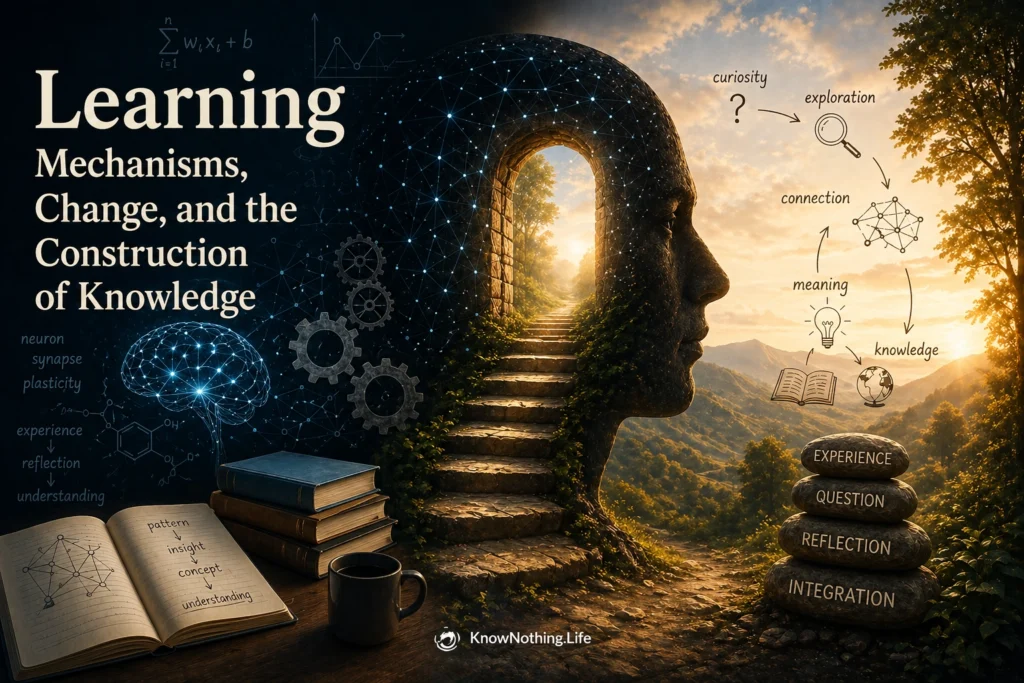
Learning is the process through which experience produces relatively lasting changes in behavior, knowledge, or cognition. It is the foundation of adaptation, allowing individuals to acquire skills, form memories, and adjust to new environments. From infancy through adulthood, learning shapes perception, thought, and action, enabling the development of complex abilities such as language, reasoning, and problem-solving. It is not confined to formal education but occurs continuously, often outside conscious awareness, as individuals interact with their surroundings.
At its core, learning reflects the brain’s capacity for change. This capacity, known as plasticity, allows neural systems to reorganize in response to experience. Learning involves both the acquisition of new information and the modification of existing knowledge, creating a dynamic system that evolves over time. While often associated with deliberate effort, learning can also occur implicitly, through repeated exposure and interaction. Understanding learning therefore requires examining a wide range of processes, from basic associative mechanisms to higher-level cognitive strategies.
Historical Foundations and Major Theories
The scientific study of learning has been shaped by several influential theoretical traditions, each offering a distinct perspective on how change occurs. Early research focused on behaviorism, which emphasized observable behavior and the role of environmental stimuli. One of the foundational figures in this tradition was Ivan Pavlov, whose work on classical conditioning demonstrated how associations between stimuli can produce learned responses. Pavlov’s experiments showed that organisms can learn to anticipate events based on predictive cues, illustrating a fundamental mechanism of learning.
Building on this work, behaviorists such as B. F. Skinner developed the concept of operant conditioning, which focuses on how behavior is shaped by consequences. According to this framework, behaviors followed by reinforcement are more likely to be repeated, while those followed by punishment are less likely to occur. This approach highlighted the role of feedback in learning and provided a basis for practical applications in education and behavior modification.
The cognitive revolution introduced new perspectives that emphasized internal mental processes. Researchers began to explore how individuals acquire, store, and use information, leading to the development of cognitive theories of learning. These approaches consider factors such as attention, memory, and problem-solving, offering a more comprehensive view of how learning occurs. Contemporary theories often integrate behavioral and cognitive insights, reflecting the complexity of learning as both a behavioral and mental process.
Associative Learning: Classical and Operant Conditioning
Associative learning refers to the process by which connections are formed between stimuli or between behavior and its consequences. Classical conditioning, as demonstrated by Pavlov, involves learning to associate a neutral stimulus with a meaningful one, resulting in a conditioned response. This form of learning is fundamental to many automatic and emotional reactions, such as fear responses or preferences.
Operant conditioning, in contrast, involves learning through the consequences of behavior. Reinforcement strengthens behavior by providing a positive outcome or removing a negative one, while punishment decreases behavior by introducing an unfavorable outcome or removing a positive one. This framework emphasizes the active role of the learner, who interacts with the environment and adjusts behavior based on feedback.
Both forms of associative learning illustrate how experience shapes behavior through relatively simple mechanisms. However, they also reveal limitations, as they do not fully account for complex cognitive processes such as reasoning and insight. Despite these limitations, associative learning remains a foundational concept, providing insight into how habits, preferences, and emotional responses are acquired.
Cognitive Learning: Information Processing and Understanding
Cognitive theories of learning focus on the internal processes that underlie the acquisition and use of knowledge. These theories emphasize that learners are active participants who interpret, organize, and integrate information. Learning is not merely a response to stimuli but involves the construction of mental representations that guide behavior.
One key concept in cognitive learning is the role of schemas, which are frameworks that organize knowledge and facilitate understanding. Schemas allow individuals to interpret new information in the context of existing knowledge, making learning more efficient. However, they can also lead to biases or misconceptions when new information does not fit existing structures.
Another important aspect of cognitive learning is the process of problem-solving and insight. Unlike associative learning, which relies on gradual reinforcement, cognitive learning can involve sudden realizations or restructuring of information. This highlights the flexibility and creativity of the human mind, demonstrating that learning can occur through both incremental and transformative processes.
Observational Learning and Social Influence
Learning does not occur in isolation; it is often shaped by social interaction and observation. Observational learning, also known as social learning, involves acquiring new behaviors or knowledge by watching others. This process allows individuals to learn without direct experience, expanding the range of possible learning opportunities.
A key figure in this area was Albert Bandura, whose research demonstrated that individuals can learn by observing models and the consequences of their actions. His work highlighted the importance of attention, memory, and motivation in observational learning, showing that individuals are more likely to imitate behaviors that are rewarded or performed by admired models.
Social factors play a crucial role in shaping learning, influencing not only what is learned but also how it is interpreted. Cultural norms, communication, and collaboration all contribute to the learning process, making it a shared and interactive experience. Observational learning underscores the importance of context and social dynamics in understanding how knowledge and behavior are acquired.
Neural Basis of Learning
The biological foundation of learning lies in the brain’s capacity for change, known as neural plasticity. Learning involves the strengthening and weakening of synaptic connections between neurons, allowing for the storage and modification of information. These changes occur at multiple levels, from molecular processes within neurons to large-scale networks across the brain.
The hippocampus plays a central role in the formation of new memories, particularly those related to declarative knowledge. Other regions, such as the basal ganglia and cerebellum, are involved in procedural learning and the acquisition of skills. The interaction between these systems allows for the integration of different types of learning, supporting both conscious and unconscious processes.
Neuroscientific research has also identified mechanisms such as long-term potentiation, which enhances the strength of synaptic connections following repeated activation. These processes provide a biological basis for learning, linking cognitive changes to physical changes in the brain. Understanding the neural basis of learning bridges the gap between psychological theory and biological reality.
Factors Influencing Learning
Learning is influenced by a wide range of factors, including attention, motivation, and prior knowledge. Attention determines what information is processed, while motivation influences the effort and persistence applied to learning tasks. Without sufficient attention and motivation, learning is unlikely to occur effectively.
The structure and presentation of information also play a significant role. Well-organized and meaningful material is easier to learn than information that is disorganized or irrelevant. Strategies such as repetition, elaboration, and practice enhance learning by reinforcing connections and facilitating retrieval.
Environmental and individual differences further shape learning outcomes. Factors such as stress, fatigue, and emotional state can affect the ability to learn, while differences in cognitive capacity and experience influence how individuals process information. Understanding these factors is essential for optimizing learning in both educational and everyday contexts.
Applications in Education and Everyday Life
The study of learning has significant implications for education, where understanding how individuals acquire knowledge can inform teaching practices. Techniques such as spaced repetition, active learning, and feedback are grounded in research on learning and have been shown to improve retention and understanding. These approaches emphasize the importance of engagement and meaningful processing.
In everyday life, learning supports the acquisition of skills and adaptation to new situations. From mastering a new technology to developing interpersonal skills, learning is a continuous process that shapes behavior and decision-making. Recognizing the principles of learning can help individuals become more effective learners, improving both personal and professional outcomes.
In applied settings, such as workplace training and therapy, insights from learning research are used to design interventions that promote behavior change and skill development. These applications demonstrate the practical value of understanding learning processes and their impact on human performance.
Future Directions and the Evolving Science of Learning
The study of learning continues to evolve, incorporating advances in technology and interdisciplinary research. New methods, such as brain imaging and computational modeling, are providing deeper insights into how learning occurs at both cognitive and neural levels. These tools allow researchers to explore learning in more naturalistic settings, capturing its complexity in real-world contexts.
Emerging research is also examining the interaction between learning and other cognitive processes, such as memory, attention, and emotion. These interactions highlight the integrated nature of cognition, where multiple systems work together to support behavior. Understanding these relationships is essential for developing comprehensive models of learning.
As the demands on individuals continue to grow in an increasingly complex world, the importance of effective learning strategies becomes more evident. Cognitive psychology provides a framework for understanding how learning occurs and how it can be enhanced. By examining the mechanisms and influences of learning, the field continues to offer valuable insights into one of the most fundamental aspects of human experience.