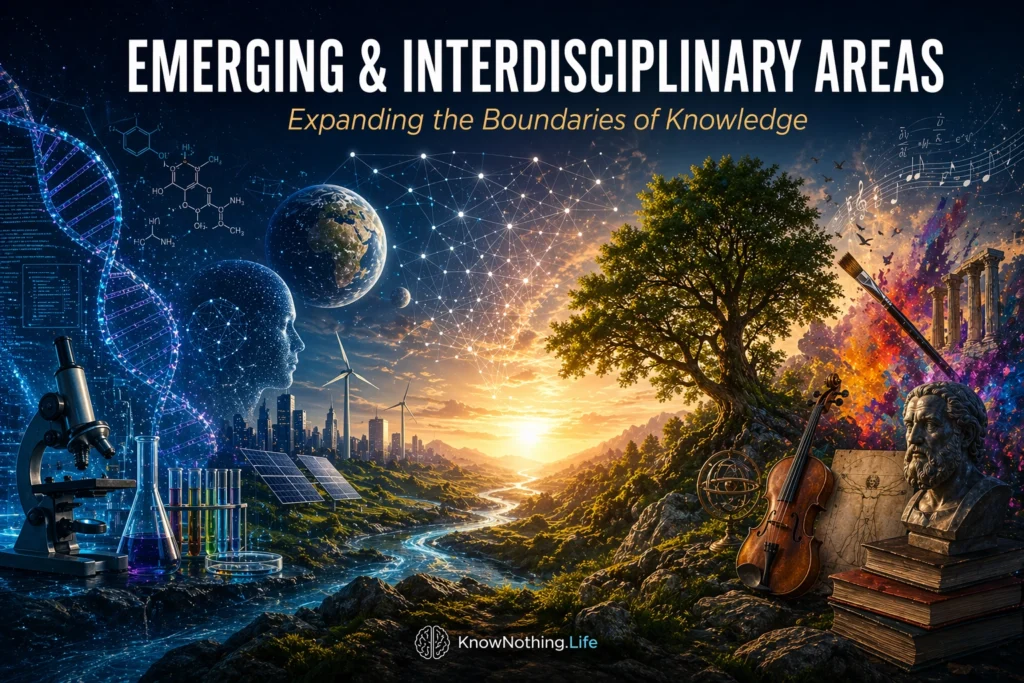
Philosophy has never existed in isolation. From its earliest formulations, it has drawn upon and contributed to other fields of inquiry, shaping and being shaped by developments in science, art, politics, and culture. In the modern era, this interconnectedness has intensified, giving rise to emerging and interdisciplinary areas that blur traditional boundaries. These fields reflect a growing recognition that complex questions about reality, knowledge, and human life cannot be fully addressed within the confines of a single discipline.
Emerging and interdisciplinary areas represent both an expansion and a transformation of philosophical inquiry. They integrate methods, concepts, and insights from diverse domains, creating new frameworks for understanding. Whether examining the ethical implications of artificial intelligence, the nature of consciousness through neuroscience, or the relationship between environment and value, these areas highlight the dynamic and evolving nature of philosophy. They demonstrate that philosophy remains not only relevant but essential in navigating the challenges of a rapidly changing world.
Philosophy and Cognitive Science
One of the most significant interdisciplinary developments is the integration of philosophy with cognitive science. This field brings together philosophy, psychology, neuroscience, linguistics, and computer science to explore the nature of the mind. Philosophers have long been concerned with questions about consciousness, perception, and thought, but cognitive science provides empirical tools for investigating these phenomena in new ways.
The collaboration between philosophy and cognitive science has reshaped traditional debates about the mind. Questions about the nature of consciousness, once largely speculative, are now informed by studies of brain activity and cognitive processes. This has led to new perspectives on issues such as the relationship between mind and body, the nature of mental representation, and the possibility of artificial intelligence. Philosophers engage with these findings to interpret their implications, ensuring that empirical discoveries are integrated into broader conceptual frameworks.
At the same time, philosophy plays a critical role in cognitive science by clarifying concepts and addressing foundational questions. Issues such as the definition of consciousness or the nature of intentionality cannot be resolved solely through empirical observation; they require philosophical analysis. This mutual influence highlights the importance of interdisciplinary collaboration, where each field contributes to a more comprehensive understanding of the mind.
Philosophy of Technology and Artificial Intelligence
The rapid advancement of technology has given rise to new philosophical questions about the nature and impact of artificial systems. The philosophy of technology examines how technological developments shape human life, influencing everything from communication and work to identity and ethics. Within this broader field, the philosophy of artificial intelligence has emerged as a particularly significant area of inquiry.
Philosophers in this domain explore questions about the nature of intelligence and the possibility of machine consciousness. Can artificial systems truly think, or are they merely simulating cognitive processes? What distinguishes human intelligence from machine intelligence, and does this distinction matter ethically? These questions challenge traditional assumptions about the uniqueness of human cognition and the boundaries between natural and artificial systems.
Ethical considerations are central to this field. The development of autonomous systems raises questions about responsibility, decision-making, and the potential consequences of technological power. Philosophers examine how to design and regulate these systems in ways that align with human values, addressing issues such as bias, privacy, and accountability. The philosophy of technology thus plays a crucial role in guiding the responsible development and use of emerging technologies.
Environmental Philosophy and Sustainability
As global environmental challenges become increasingly urgent, philosophy has expanded to address questions about the relationship between humans and the natural world. Environmental philosophy examines the ethical and metaphysical dimensions of this relationship, exploring issues such as the value of nature, the responsibilities of human beings, and the concept of sustainability.
This field integrates insights from ecology, economics, and political theory, reflecting the complexity of environmental problems. Philosophers debate whether nature has intrinsic value or whether its value is derived from human interests. This distinction has significant implications for how environmental policies are formulated and justified. If nature is valuable in itself, then protecting it becomes a moral obligation independent of human benefit.
Environmental philosophy also addresses the concept of sustainability, examining how societies can balance economic development with ecological preservation. This involves not only technical solutions but also ethical considerations about intergenerational justice and global responsibility. By integrating diverse perspectives, environmental philosophy contributes to a more holistic understanding of one of the most pressing issues of our time.
Bioethics and the Philosophy of Life Sciences
Advances in medicine and biotechnology have created new ethical challenges, giving rise to the interdisciplinary field of bioethics. This area examines questions related to health, life, and the human body, drawing on philosophy, medicine, law, and social science. Issues such as genetic engineering, end-of-life care, and medical decision-making raise complex ethical dilemmas that require careful analysis.
Bioethics explores the principles that should guide medical practice and research, including autonomy, beneficence, and justice. These principles must be balanced in situations where they may conflict, such as decisions about life-sustaining treatment or the allocation of limited resources. Philosophers contribute by clarifying these principles and examining their implications in specific contexts.
The philosophy of life sciences also addresses broader questions about the nature of life and the boundaries of human intervention. As technologies enable greater control over biological processes, questions arise about what it means to be human and how far such control should extend. These inquiries highlight the importance of ethical reflection in guiding scientific progress, ensuring that advancements are aligned with human values.
Philosophy, Culture, and Social Identity
Emerging interdisciplinary areas also include the intersection of philosophy with cultural studies and social theory. These fields examine how identity, language, and power shape human experience, exploring issues such as race, gender, and social justice. By engaging with sociology, anthropology, and critical theory, philosophy expands its scope to address the complexities of contemporary society.
Philosophers in this area analyze how social structures influence individual identity and experience. Concepts such as intersectionality highlight the ways in which different aspects of identity interact, creating unique forms of advantage and disadvantage. This perspective emphasizes the importance of understanding social context in philosophical analysis, recognizing that abstract theories must be grounded in lived experience.
The integration of philosophy with cultural and social studies also raises questions about the role of philosophy itself. Should philosophy remain detached and universal, or should it engage directly with social and political issues? Many contemporary thinkers argue for a more engaged approach, where philosophical inquiry contributes to addressing real-world challenges and promoting social change.
Philosophy of Science and Interdisciplinary Method
The philosophy of science has long examined the methods and assumptions underlying scientific inquiry, but it has taken on new significance in the context of interdisciplinary research. As scientific fields become increasingly specialized, the need for integration and coordination grows. Philosophy provides tools for analyzing the structure of scientific theories, the nature of explanation, and the criteria for evaluating evidence.
Interdisciplinary research often involves combining methods and concepts from different fields, raising questions about compatibility and coherence. Philosophers explore how these diverse approaches can be integrated, addressing issues such as reductionism and emergence. These questions are particularly relevant in fields like climate science and systems biology, where complex phenomena cannot be understood through a single perspective.
By examining the foundations of scientific practice, the philosophy of science contributes to the development of more robust and effective research methods. It ensures that interdisciplinary work is not only innovative but also conceptually sound, providing a framework for integrating knowledge across domains.
The Future of Interdisciplinary Philosophy
The growth of emerging and interdisciplinary areas reflects a broader shift in the nature of knowledge. As global challenges become more complex, the need for integrated approaches becomes increasingly apparent. Philosophy, with its emphasis on critical thinking and conceptual analysis, is uniquely positioned to contribute to this integration.
Future developments are likely to involve even greater collaboration between philosophy and other disciplines. Fields such as data ethics, neurophilosophy, and environmental humanities are already expanding the scope of philosophical inquiry. These areas address questions that are both theoretical and practical, highlighting the relevance of philosophy in addressing contemporary issues.
At the same time, interdisciplinary work presents challenges. Differences in methods, terminology, and priorities can create barriers to collaboration. Overcoming these challenges requires openness and adaptability, as well as a willingness to engage with diverse perspectives. By embracing these challenges, philosophy can continue to evolve and contribute to a deeper understanding of the world.
Conclusion
Emerging and interdisciplinary areas represent a dynamic and evolving frontier in philosophy. By integrating insights from diverse fields, these areas expand the scope of philosophical inquiry, addressing complex questions that cannot be confined to a single discipline. They demonstrate the adaptability and relevance of philosophy, showing how it can engage with contemporary challenges in meaningful ways.
The exploration of these areas highlights the importance of collaboration and integration in the pursuit of knowledge. It reveals that understanding the world requires not only specialized expertise but also a broader perspective that connects different domains. Philosophy plays a crucial role in this process, providing the tools and frameworks needed to navigate complexity.
Ultimately, the growth of interdisciplinary philosophy reflects a deeper recognition of the interconnectedness of knowledge. It invites continued exploration and dialogue, encouraging new ways of thinking about the world and our place within it.