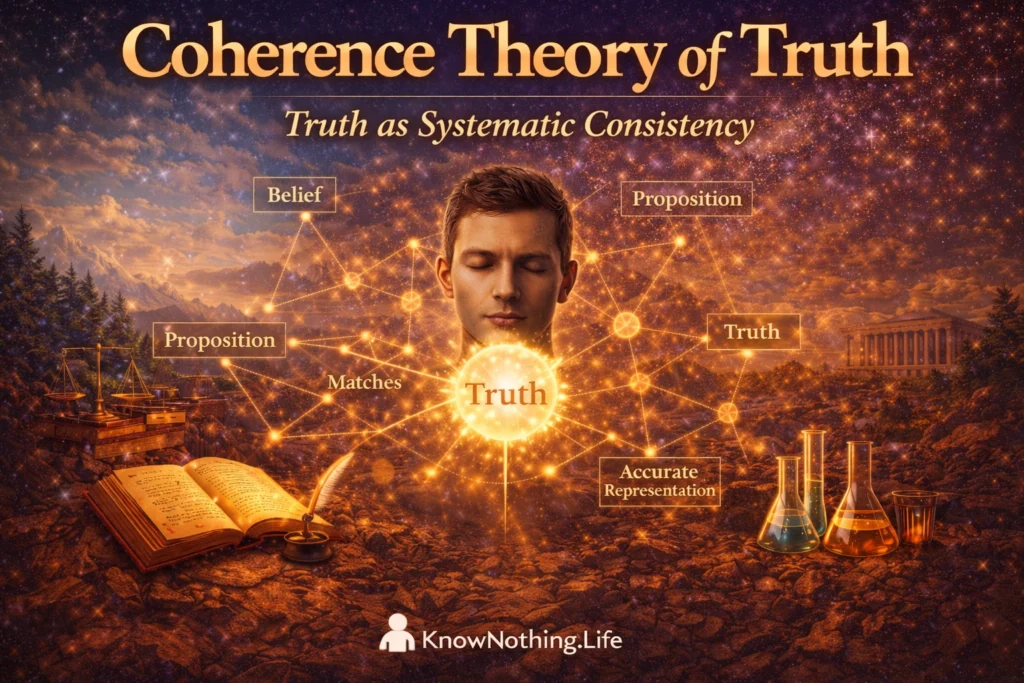
The coherence theory of truth offers a fundamentally different approach to understanding truth than the traditional correspondence model. Rather than defining truth as a relationship between statements and an external reality, coherence theory locates truth within a system of beliefs. According to this view, a proposition is true if it coheres with a set of beliefs that are logically consistent, mutually supportive, and integrated into a unified whole.
This perspective arises from dissatisfaction with the idea that truth can be understood as a simple matching relation between language and the world. Coherence theorists argue that our access to reality is always mediated by beliefs, concepts, and interpretations. As a result, truth cannot be evaluated in isolation but must be understood within the context of an entire system of thought.
The coherence theory has been developed by philosophers such as G. W. F. Hegel, Brand Blanshard, and Laurence BonJour. Their work emphasizes the interconnected nature of knowledge and the role of systematic unity in determining truth. By examining coherence theory, we gain insight into an alternative way of understanding truth that prioritizes consistency and integration over direct correspondence.
The Core Idea of Coherence
At its foundation, the coherence theory asserts that truth is a property of a system rather than of individual statements considered in isolation. A belief is true if it fits within a coherent network of beliefs—one that is free of contradictions and exhibits strong explanatory relationships among its components.
Coherence involves more than mere consistency. A set of beliefs could be consistent without being coherent if the beliefs do not support or explain one another. True coherence requires integration, where beliefs contribute to a unified understanding of the world. This includes explanatory depth, logical harmony, and completeness within the system.
This holistic approach reflects the complexity of human cognition. Our beliefs are rarely isolated; they form interconnected webs in which each belief influences and is influenced by others. Coherence theory captures this interconnectedness, suggesting that truth emerges from the overall structure of the system rather than from any single element.
Hegel and the System of Absolute Knowledge
The philosophical roots of coherence theory can be traced to G. W. F. Hegel, whose work Phenomenology of Spirit presents a vision of truth as the unfolding of a complete and self-consistent system. For Hegel, truth is not static but dynamic, emerging through the development of ideas within a comprehensive framework.
Hegel’s dialectical method emphasizes the resolution of contradictions through synthesis, leading to increasingly coherent and unified systems of thought. In this process, individual beliefs are evaluated not in isolation but in relation to the whole. Truth, for Hegel, is ultimately found in the totality of a fully developed system of knowledge.
This approach highlights the importance of context and development in understanding truth. Rather than seeking fixed truths that correspond to reality, Hegel emphasizes the evolving nature of knowledge and the role of coherence in achieving a complete understanding. His work laid the foundation for later coherentist theories, which adopt a more analytic and less metaphysical framework.
Blanshard and the Coherence Ideal
Brand Blanshard provides one of the most detailed defenses of the coherence theory in his work The Nature of Thought. Blanshard argues that truth consists in belonging to a completely coherent system of beliefs, where every element is logically connected to every other.
According to Blanshard, the ideal of coherence involves not only consistency but also completeness and comprehensiveness. A fully coherent system would leave no questions unanswered and no contradictions unresolved. While such a system may be difficult to achieve in practice, it serves as a guiding ideal for the pursuit of truth.
Blanshard’s account emphasizes the rational structure of knowledge, suggesting that truth is ultimately a matter of logical integration. This perspective reinforces the idea that truth is not something external to thought but is inherent in the organization of beliefs themselves. However, it also raises questions about whether such an ideal system can ever be realized.
BonJour and Epistemic Coherentism
In contemporary philosophy, Laurence BonJour has played a key role in developing coherence theory within epistemology. In The Structure of Empirical Knowledge, BonJour argues that justification—and by extension truth—is grounded in the coherence of a belief system.
BonJour’s approach emphasizes the role of coherence in justifying beliefs, suggesting that a belief is justified if it fits within a coherent system that maximizes explanatory power and consistency. This epistemic version of coherence theory focuses on how beliefs are supported rather than on their direct relation to reality.
BonJour also addresses the relationship between coherence and experience, arguing that empirical input must be integrated into the belief system in a coherent way. This allows coherence theory to account for the role of observation while maintaining its holistic framework. His work represents a modern and refined version of coherence theory, bridging the gap between traditional metaphysical accounts and contemporary epistemology.
Coherence and Truth vs. Correspondence
One of the central debates in philosophy of truth is the contrast between coherence and correspondence theories. While correspondence theory defines truth in terms of alignment with reality, coherence theory defines truth in terms of consistency within a system of beliefs.
Coherence theorists argue that correspondence is problematic because it assumes a direct relationship between language and reality that may not be accessible. Since our understanding of reality is always mediated by beliefs, they contend that coherence provides a more practical and internally consistent account of truth.
Critics of coherence theory, however, point out that a system of beliefs could be perfectly coherent yet entirely disconnected from reality. For example, a fictional story can exhibit coherence without being true. This challenge raises the question of how coherence relates to truth and whether it can serve as a sufficient criterion.
Critiques and Limitations
Despite its strengths, the coherence theory faces several important criticisms. One major concern is the problem of multiple coherent systems. It is possible for different sets of beliefs to be internally coherent yet mutually incompatible. If coherence alone determines truth, then it becomes unclear how to choose between competing systems.
Another criticism involves the issue of isolation. A coherent belief system could be detached from empirical reality, raising doubts about whether coherence can ensure truth. Without some connection to experience or the external world, coherence may be insufficient as a criterion for truth.
Additionally, critics argue that coherence theory may struggle to account for the role of perception and evidence. While it emphasizes the integration of beliefs, it must also explain how new information is incorporated into the system. These challenges have led some philosophers to adopt hybrid approaches that combine elements of coherence and correspondence.
Contemporary Relevance of Coherence Theory
Despite these criticisms, coherence theory continues to play a significant role in contemporary philosophy. Its emphasis on the interconnected nature of knowledge aligns with developments in fields such as cognitive science, where understanding is seen as a network of interconnected representations.
Coherence also plays an important role in scientific theory evaluation. Scientific theories are often judged based on their coherence with existing knowledge, their explanatory power, and their ability to integrate diverse observations. This practical application highlights the relevance of coherence theory beyond purely philosophical debates.
Furthermore, coherence theory has influenced discussions of justification, particularly in coherentist epistemology. By focusing on the relationships between beliefs, it provides a framework for understanding how knowledge is structured and maintained.
Conclusion
The coherence theory of truth offers a rich and compelling alternative to traditional correspondence accounts. By defining truth in terms of systematic consistency and integration, it highlights the interconnected nature of knowledge and the importance of coherence in understanding the world.
From the philosophical vision of G. W. F. Hegel to the analytical work of Laurence BonJour, coherence theory has evolved into a sophisticated framework for thinking about truth. While it faces significant challenges, its emphasis on unity, consistency, and explanatory power continues to shape philosophical inquiry.
As Brand Blanshard suggested, truth is not found in isolated statements but in the harmony of a complete system. This insight captures the essence of coherence theory, offering a vision of truth as an achievement of intellectual integration rather than a simple reflection of reality.