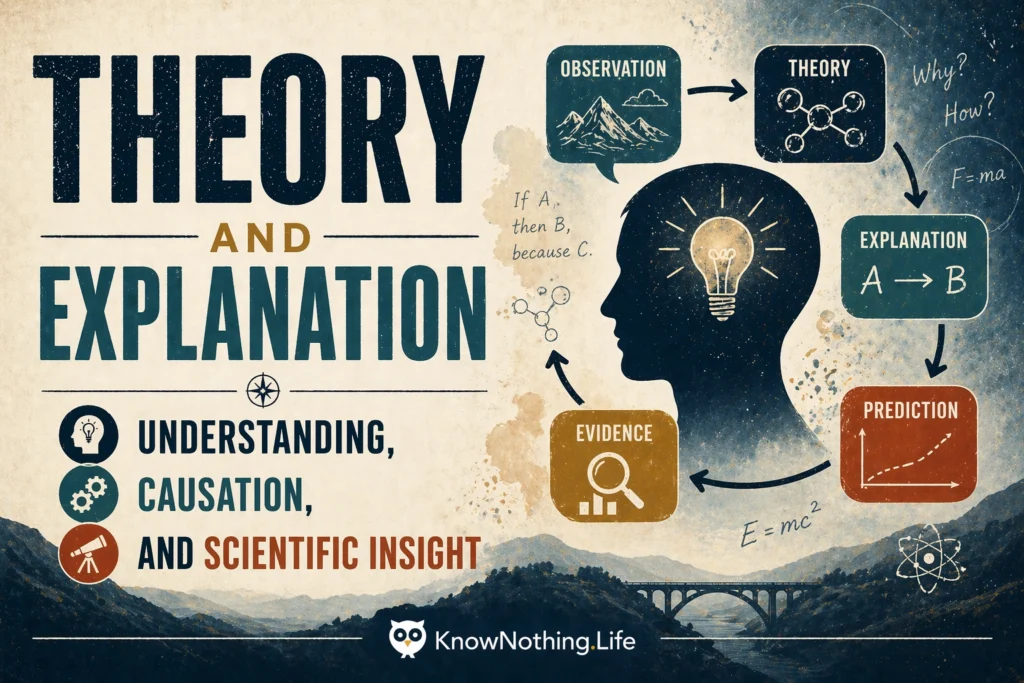
The concepts of theory and explanation are central to both philosophy and science. A theory provides a structured framework for understanding phenomena, while an explanation seeks to make sense of why those phenomena occur. Together, they form the backbone of intellectual inquiry, allowing us to move beyond mere observation to deeper understanding. Yet what counts as a good explanation, and how theories achieve explanatory power, are questions that have long been debated.
At a basic level, explanation involves answering “why” questions, while theory offers the conceptual tools needed to construct those answers. However, the relationship between the two is complex. Not all theories explain equally well, and not all explanations rely on formal theories. Philosophers have explored different models of explanation, examining how theories function and what makes them successful in illuminating the world.
The Nature of Scientific Theories
Scientific theories are more than collections of facts; they are systematic accounts that organize knowledge into coherent frameworks. A theory typically includes general principles, laws, and models that explain a wide range of phenomena. For example, the theory of evolution explains the diversity of life, while the theory of relativity reshapes our understanding of space and time.
The strength of a theory lies in its ability to unify disparate observations under a common framework. By identifying underlying patterns and relationships, theories provide a deeper level of understanding than isolated facts. They also enable prediction, allowing scientists to anticipate outcomes in new situations. This predictive power is often taken as a sign of explanatory success.
Philosophers have debated whether theories should be understood as true descriptions of reality or as useful instruments for organizing experience. Some, such as scientific realists, argue that successful theories are likely to reflect the structure of the world. Others maintain that theories are tools for prediction and control, without necessarily revealing underlying truths. This debate highlights the interpretive dimension of theory in scientific practice.
Models of Explanation
One of the most influential accounts of explanation is the deductive-nomological model, associated with Carl Hempel. According to this model, an explanation consists of showing how a phenomenon follows logically from general laws and initial conditions. For example, explaining why a metal rod expands when heated involves applying laws of thermodynamics to specific circumstances.
This model emphasizes the role of general laws in explanation, suggesting that understanding comes from subsuming particular events under universal principles. However, it has been criticized for being too restrictive, as not all explanations fit this pattern. In fields such as biology and history, explanations often involve complex causal mechanisms rather than simple laws.
Alternative models have been proposed to address these limitations. Causal-mechanical explanations focus on identifying the processes that produce a phenomenon, while statistical explanations account for events in terms of probabilities. These approaches broaden the scope of explanation, reflecting the diversity of scientific practices.
Causation and Mechanism
Causation is a central component of many explanations. To explain an event is often to identify its causes, tracing the chain of interactions that led to its occurrence. This approach aligns with our intuitive understanding of explanation, which typically involves answering questions about why something happened.
Philosophers such as David Hume famously questioned the nature of causation, arguing that we do not observe causal connections directly but infer them from patterns of regularity. This raises questions about whether causation is a real feature of the world or a conceptual tool used to organize experience.
In response, contemporary philosophers have developed more robust accounts of causation, often focusing on mechanisms. A mechanistic explanation identifies the components and interactions that produce a phenomenon, providing a detailed account of how it occurs. This approach has been particularly influential in fields such as biology and neuroscience, where understanding processes is key to explanation.
Explanation and Understanding
Explanation is closely linked to understanding, but the two are not identical. An explanation may provide information about a phenomenon, but it does not always lead to genuine understanding. Conversely, a simple explanation may enhance understanding even if it lacks detailed accuracy.
Philosophers have explored what it means to understand something, often emphasizing the role of coherence and integration. Understanding involves seeing how different pieces of information fit together within a broader framework. It is not merely about knowing facts but about grasping relationships and patterns.
This perspective highlights the importance of explanatory depth. A deeper explanation reveals underlying structures and connections, enabling a more comprehensive understanding of a phenomenon. Theories play a crucial role in this process, as they provide the frameworks within which explanations are constructed and evaluated.
The Role of Idealization
Scientific theories often rely on idealizations—simplified models that abstract away from the complexities of the real world. For example, physicists may treat objects as frictionless or assume perfectly rational agents in economic models. These assumptions are not strictly true, but they can be useful for developing explanations.
Idealization raises questions about the relationship between theory and reality. If a theory relies on unrealistic assumptions, how can it provide accurate explanations? Philosophers have argued that idealizations can capture essential features of a system, even if they omit details. By focusing on key variables, they allow for clearer and more tractable explanations.
However, the use of idealization also introduces limitations. Simplified models may fail to account for important factors, leading to incomplete or misleading explanations. Balancing simplicity and accuracy is a central challenge in the development of theories and explanations.
Explanation Beyond Science
While much of the discussion of theory and explanation focuses on science, these concepts also play a role in other domains. In everyday life, we seek explanations for events, behaviors, and experiences, often drawing on informal theories and assumptions. These explanations may not have the rigor of scientific theories, but they still serve to organize understanding.
In the social sciences, explanation often involves interpreting human behavior in terms of intentions, beliefs, and social structures. These explanations differ from those in the natural sciences, as they must account for meaning and agency. Philosophers have debated whether a unified model of explanation can apply across different domains or whether distinct approaches are needed.
The study of explanation thus extends beyond science, encompassing a wide range of intellectual activities. It reflects a fundamental human desire to make sense of the world, whether through formal theories or everyday reasoning.
Critiques and Contemporary Debates
The philosophy of theory and explanation continues to evolve, with ongoing debates about the nature and scope of explanation. Some philosophers question whether explanation should be understood in purely objective terms, while others emphasize the role of context and perspective. What counts as a satisfactory explanation may vary depending on the audience and the purpose.
Another area of debate concerns the relationship between explanation and prediction. While predictive success is often taken as evidence of a good theory, some argue that explanation and prediction are distinct goals. A theory may predict accurately without providing a deep understanding, or it may offer insight without precise predictions.
These debates reflect the complexity of theory and explanation, highlighting that they are not fixed concepts but evolving tools for understanding. As scientific and philosophical inquiry advances, new models and approaches continue to emerge.
Conclusion
Theory and explanation are fundamental to our understanding of the world, providing the frameworks and tools needed to make sense of complex phenomena. From the law-based models of Carl Hempel to contemporary accounts of causation and mechanism, philosophers have explored a wide range of approaches to explanation.
While no single model captures all aspects of explanation, the interplay between theory and explanation remains central to intellectual inquiry. By examining how we construct and evaluate explanations, philosophy deepens our understanding of knowledge, causation, and the nature of understanding itself.