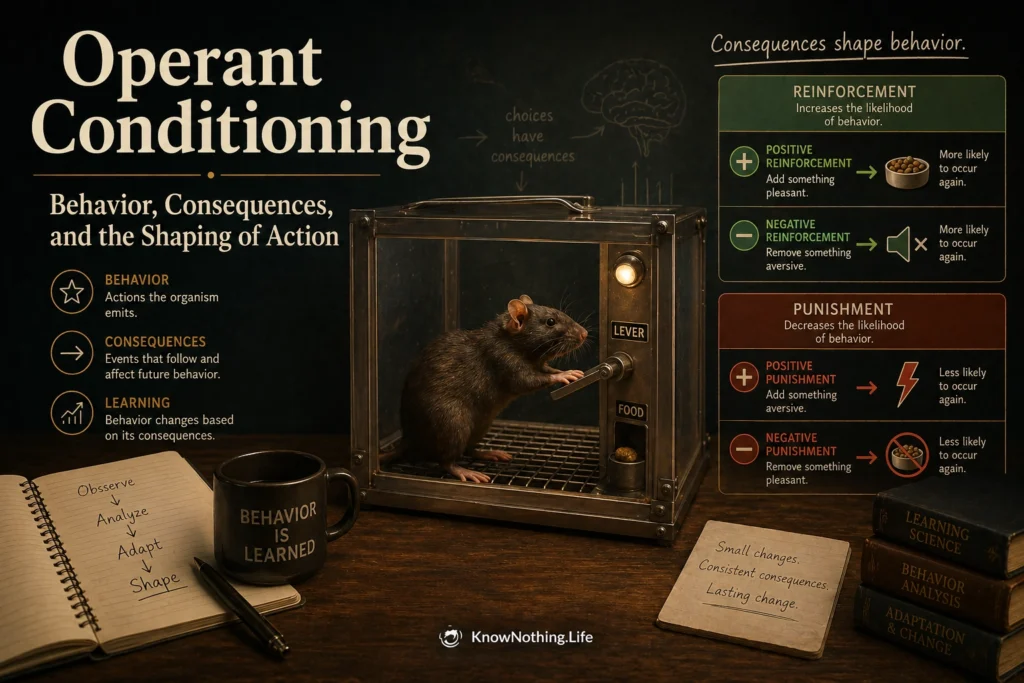
Operant conditioning is a fundamental form of learning in which behavior is shaped and maintained by its consequences. Rather than focusing on associations between stimuli, as in classical conditioning, operant conditioning emphasizes the relationship between actions and outcomes. Behaviors that produce favorable consequences are more likely to be repeated, while those that lead to unfavorable outcomes tend to diminish. This process reflects a basic adaptive principle: organisms learn to act in ways that maximize rewards and minimize costs.
At its core, operant conditioning highlights the active role of the learner. Individuals are not merely passive recipients of environmental input but agents who interact with their surroundings and adjust their behavior accordingly. This interaction creates a continuous feedback loop, where actions influence outcomes and outcomes influence future actions. Through this process, complex patterns of behavior can emerge, ranging from simple habits to sophisticated skills.
Historical Foundations and Behaviorist Origins
The development of operant conditioning is closely associated with the work of B. F. Skinner, who built on earlier research in behaviorism to create a systematic framework for understanding behavior. Skinner was influenced by predecessors such as Edward Thorndike, whose law of effect proposed that behaviors followed by satisfying outcomes are more likely to be repeated. This principle laid the groundwork for the study of reinforcement and its role in learning.
Skinner extended these ideas through carefully controlled experiments, often using devices known as operant chambers, or “Skinner boxes.” In these settings, animals such as rats or pigeons could perform specific actions, such as pressing a lever or pecking a key, to receive rewards like food. By manipulating the conditions under which rewards were delivered, Skinner demonstrated how behavior could be systematically shaped and maintained.
These experiments provided a powerful demonstration of the principles of operant conditioning, showing that behavior is not random but influenced by its consequences. Skinner’s work emphasized observable behavior and environmental factors, aligning with the broader goals of behaviorism. Although later developments in psychology introduced cognitive perspectives, operant conditioning remains a foundational concept in understanding learning and behavior.
Reinforcement: Strengthening Behavior
Reinforcement is the central mechanism of operant conditioning, referring to any consequence that increases the likelihood of a behavior. Reinforcement can be positive or negative, depending on whether it involves the addition or removal of a stimulus. Positive reinforcement occurs when a desirable stimulus is presented following a behavior, such as giving a reward or praise. Negative reinforcement involves the removal of an unpleasant stimulus, such as turning off a loud noise when a desired action is performed.
Both forms of reinforcement strengthen behavior, though they operate in different ways. Positive reinforcement encourages behavior by providing a rewarding outcome, while negative reinforcement motivates behavior by allowing individuals to avoid or escape discomfort. Despite the differences, both processes rely on the principle that behavior is shaped by its consequences.
The effectiveness of reinforcement depends on factors such as timing, consistency, and the nature of the reward. Immediate reinforcement is generally more effective than delayed reinforcement, as it creates a clearer connection between behavior and outcome. Understanding reinforcement provides insight into how behaviors are acquired and maintained, offering practical tools for influencing behavior in various contexts.
Punishment and Behavioral Suppression
In contrast to reinforcement, punishment refers to consequences that decrease the likelihood of a behavior. Punishment can also be positive or negative. Positive punishment involves the introduction of an unpleasant stimulus following a behavior, such as a reprimand or penalty. Negative punishment involves the removal of a desirable stimulus, such as taking away privileges.
While punishment can be effective in reducing behavior, it has limitations and potential drawbacks. Unlike reinforcement, which strengthens desired behavior, punishment focuses on suppressing unwanted actions without necessarily promoting alternative behaviors. Additionally, punishment can produce unintended effects, such as fear, anxiety, or avoidance, which may interfere with learning.
Research suggests that reinforcement is generally more effective than punishment for shaping behavior, particularly when the goal is to establish new patterns. Punishment may be useful in certain situations, but it is often most effective when combined with reinforcement of desired behaviors. Understanding the role of punishment highlights the complexity of operant conditioning and the need for careful application of its principles.
Schedules of Reinforcement
The pattern and frequency with which reinforcement is delivered play a crucial role in shaping behavior. These patterns, known as schedules of reinforcement, influence how quickly a behavior is learned and how resistant it is to extinction. Two broad categories of schedules are continuous and partial reinforcement.
Continuous reinforcement involves providing a reward every time a behavior occurs, which is effective for establishing new behaviors. However, behaviors learned under continuous reinforcement may be more susceptible to extinction when reinforcement is removed. Partial reinforcement, where rewards are delivered intermittently, tends to produce behaviors that are more resistant to extinction.
Within partial reinforcement, several specific schedules have been identified, including fixed-ratio, variable-ratio, fixed-interval, and variable-interval schedules. Each schedule produces distinct patterns of behavior, reflecting differences in predictability and frequency of reinforcement. For example, variable-ratio schedules, where reinforcement occurs after an unpredictable number of responses, often produce high and steady rates of behavior. These findings demonstrate how the structure of reinforcement influences learning and behavior.
Shaping and the Development of Complex Behavior
Operant conditioning allows for the development of complex behaviors through a process known as shaping. Shaping involves reinforcing successive approximations of a desired behavior, gradually guiding the learner toward the target action. This process is particularly useful when the desired behavior is unlikely to occur spontaneously.
For example, training an animal to perform a complex task may begin by reinforcing simple actions that resemble the final behavior. Over time, the criteria for reinforcement become more specific, requiring closer approximations to the target behavior. This step-by-step approach enables the acquisition of behaviors that would be difficult to learn through reinforcement alone.
Shaping illustrates the flexibility of operant conditioning, demonstrating how complex patterns of behavior can emerge from simple principles. It highlights the importance of gradual learning and the role of feedback in guiding behavior. This process is widely used in fields such as education, therapy, and animal training, reflecting its practical significance.
Extinction and Behavioral Change
Extinction in operant conditioning occurs when a previously reinforced behavior is no longer followed by reinforcement, leading to a gradual decrease in its occurrence. This process demonstrates that learned behaviors are not permanent but depend on the continued presence of reinforcing consequences. When reinforcement is removed, the behavior eventually diminishes.
However, extinction is not always straightforward. Initially, the behavior may increase in frequency or intensity, a phenomenon known as an extinction burst. Additionally, behaviors that have been reinforced intermittently are often more resistant to extinction, reflecting the influence of reinforcement schedules. These patterns highlight the complexity of behavioral change and the persistence of learned behaviors.
Understanding extinction provides insight into how behaviors can be modified or eliminated. It also underscores the importance of consistency in reinforcement, as inconsistent application can lead to unpredictable outcomes. Extinction is a key component of operant conditioning, illustrating how behavior adapts to changing conditions.
Neural Mechanisms of Operant Conditioning
The neural basis of operant conditioning involves brain systems that process reward, motivation, and decision-making. The dopaminergic system, particularly pathways involving the basal ganglia, plays a central role in reinforcing behavior. Dopamine release signals the occurrence of rewarding outcomes, strengthening the association between behavior and consequence.
The prefrontal cortex is also involved, supporting the regulation of behavior and the evaluation of outcomes. This region contributes to decision-making and the ability to adjust behavior based on changing conditions. Together, these systems enable the integration of feedback and the modification of behavior over time.
Neuroscientific research has shown that learning involves changes in neural connections, reflecting the brain’s plasticity. These changes allow for the storage of information about actions and their consequences, providing a biological basis for operant conditioning. Understanding these mechanisms links behavioral principles to underlying neural processes.
Applications and Practical Implications
Operant conditioning has wide-ranging applications across various domains, including education, therapy, and organizational behavior. In educational settings, reinforcement is used to encourage desired behaviors and enhance learning. Techniques such as praise, rewards, and feedback are grounded in the principles of operant conditioning, helping to motivate students and reinforce positive outcomes.
In clinical contexts, operant conditioning is used in behavior modification therapies to address issues such as addiction, anxiety, and behavioral disorders. By systematically reinforcing desired behaviors and reducing unwanted ones, these interventions can produce lasting change. Similarly, in workplace settings, reinforcement strategies are used to improve performance and productivity.
The practical significance of operant conditioning extends to everyday life, where individuals continuously learn from the consequences of their actions. Understanding these principles allows for more effective management of behavior, both personally and socially. It provides tools for shaping habits, achieving goals, and influencing outcomes.
Contemporary Perspectives and Future Directions
While operant conditioning remains a foundational theory of learning, contemporary research has expanded its scope by integrating cognitive and neuroscientific perspectives. Modern approaches consider factors such as expectation, prediction, and decision-making, linking operant conditioning to broader models of cognition.
Advances in computational modeling, particularly in reinforcement learning, have provided new insights into how organisms adapt to their environments. These models emphasize the role of prediction errors—differences between expected and actual outcomes—in guiding learning. This perspective aligns operant conditioning with theories of adaptive behavior and decision-making.
As research continues to evolve, operant conditioning remains a central framework for understanding how behavior is shaped by consequences. Its principles continue to inform both theoretical inquiry and practical applications, demonstrating the enduring relevance of behaviorist insights. By examining how actions and outcomes interact, cognitive psychology deepens our understanding of learning and behavior.