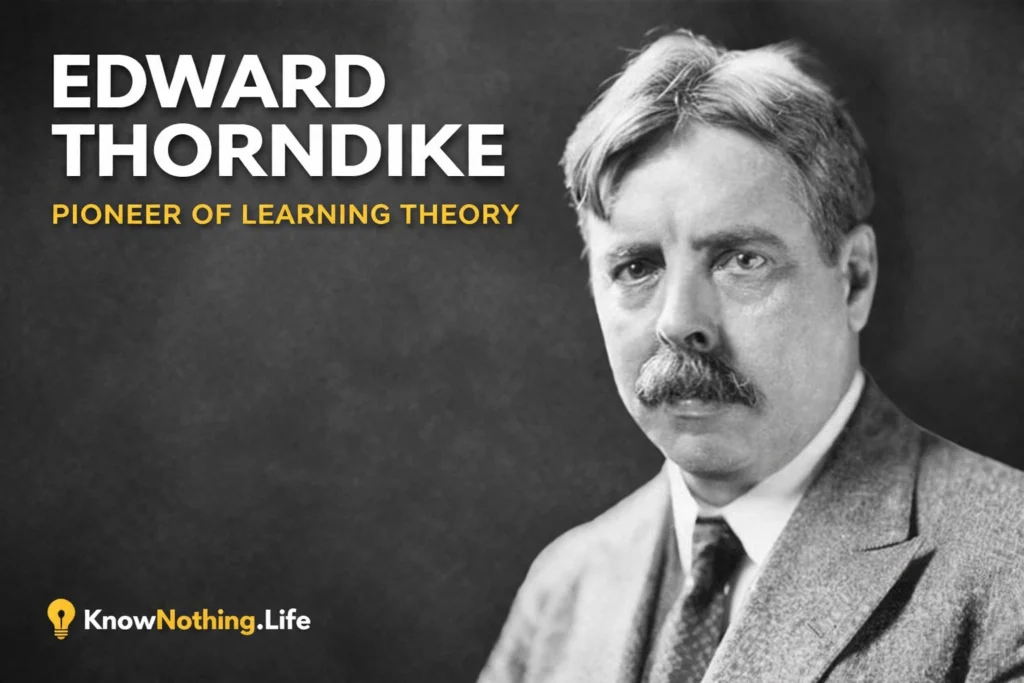
The development of modern educational psychology and learning theory owes an immense intellectual debt to Edward Thorndike, a pioneering figure who bridged the gap between experimental psychology and practical education. Thorndike’s work marked a decisive shift toward understanding learning as a measurable, observable process governed by identifiable laws. His research laid the groundwork for behaviorism while simultaneously shaping how educators approach teaching, assessment, and curriculum design.
Thorndike’s central contribution—the Law of Effect—offered a simple yet powerful principle: behaviors followed by satisfying consequences are more likely to be repeated, while those followed by discomfort are less likely to recur. This idea became foundational not only for psychology but also for education, influencing later thinkers such as B. F. Skinner. Through rigorous experimentation and an unwavering commitment to empirical evidence, Thorndike transformed learning from a philosophical concept into a scientific discipline.
Early Life and Academic Formation
Edward Lee Thorndike was born on August 31, 1874, in Williamsburg, Massachusetts, into a family that valued education and intellectual development. His father was a Methodist minister, and the disciplined environment of his upbringing fostered a strong work ethic and curiosity about human behavior. Thorndike initially pursued classical studies, but his interests shifted toward psychology during his time at Wesleyan University.
His intellectual direction crystallized further when he studied under William James at Harvard University. James’s emphasis on functionalism—the idea that mental processes should be understood in terms of their practical utility—deeply influenced Thorndike’s approach. However, it was at Columbia University, under the mentorship of James McKeen Cattell, that Thorndike developed his experimental methods and began conducting the research that would define his career.
Thorndike’s early work focused on animal learning, a relatively new area of study at the time. By observing how animals solved problems, he sought to uncover the basic mechanisms of learning that could be generalized to humans. This approach reflected his belief that psychology should be grounded in objective observation rather than introspection.
Puzzle Boxes and Experimental Breakthroughs
Thorndike’s most famous experiments involved the use of “puzzle boxes,” specially designed enclosures in which animals—typically cats—were placed and required to perform specific actions to escape. These actions might include pulling a string, pressing a lever, or stepping on a platform. Outside the box, a reward such as food provided motivation for the animal to learn the correct behavior.
Through repeated trials, Thorndike observed that animals did not solve these problems through sudden insight but rather through a gradual process of trial and error. Initially, the animals engaged in a variety of random behaviors, but over time, successful actions were repeated more frequently while ineffective ones diminished. This pattern led Thorndike to conclude that learning is incremental and shaped by consequences rather than by reasoning or understanding.
These findings challenged earlier assumptions about animal intelligence and had profound implications for human learning. Thorndike demonstrated that behavior could be analyzed quantitatively, with measurable improvements over time. His work introduced a new level of scientific rigor to the study of learning, emphasizing data, repetition, and controlled experimentation.
The Law of Effect and Learning Principles
Thorndike’s Law of Effect remains one of the most influential principles in psychology. It states that responses followed by satisfying outcomes become more strongly associated with the situation, increasing the likelihood of their recurrence. Conversely, responses followed by unpleasant outcomes are weakened. This principle provided a clear, testable explanation for how behaviors are acquired and maintained.
In addition to the Law of Effect, Thorndike proposed other learning principles, including the Law of Exercise, which suggested that repetition strengthens associations between stimuli and responses. Although he later revised this idea, it contributed to early theories about practice and habit formation. Together, these laws formed a comprehensive framework for understanding learning as a mechanical and observable process.
Thorndike famously wrote, “Connections are strengthened when the consequences are satisfying.” This statement encapsulates his belief that learning is fundamentally about forming and reinforcing connections. Unlike later behaviorists, Thorndike did not entirely dismiss mental processes, but he prioritized observable behavior as the primary subject of scientific inquiry.
Major Works and Contributions to Education
Thorndike’s influence extended beyond laboratory research into the field of education, where his ideas reshaped teaching practices and curriculum design. His book Animal Intelligence (1898) presented his early findings on trial-and-error learning and established his reputation as a leading experimental psychologist. This work remains a landmark in the study of comparative psychology.
In Educational Psychology (1903) and subsequent volumes, Thorndike applied his theories to human learning, emphasizing the importance of measurement and assessment. He advocated for standardized testing and objective evaluation methods, arguing that education should be guided by scientific principles rather than tradition or intuition. His work helped establish educational psychology as a distinct field of study.
Thorndike also contributed to the development of psychometrics, creating scales and tests to measure intelligence, achievement, and aptitude. His efforts to quantify learning outcomes laid the foundation for modern educational assessment and data-driven instruction. By integrating psychology with education, Thorndike transformed both disciplines.
Influence on Behaviorism and Later Thinkers
Thorndike’s work served as a crucial bridge between early experimental psychology and the rise of behaviorism. His emphasis on observable behavior and reinforcement anticipated many of the ideas later developed by B. F. Skinner. While Skinner expanded these concepts into a more comprehensive theory of operant conditioning, the core idea that consequences shape behavior can be traced directly to Thorndike’s Law of Effect.
His influence also extended to John B. Watson, who adopted a similarly objective approach to psychology. Thorndike’s work demonstrated that behavior could be studied scientifically without relying on introspection, paving the way for behaviorism’s dominance in the early 20th century.
Beyond psychology, Thorndike’s ideas have had lasting impact on fields such as education, organizational behavior, and artificial intelligence. The concept of reinforcement learning in computer science, for example, echoes the principles he identified over a century ago. His work continues to inform how systems—both biological and artificial—adapt and learn from experience.
Criticism and Limitations
Despite his significant contributions, Thorndike’s theories have been subject to criticism. Some scholars argue that his emphasis on trial-and-error learning underestimates the role of insight, cognition, and creativity in human problem-solving. Later research in cognitive psychology demonstrated that individuals often use mental representations and strategies that cannot be fully explained by stimulus-response associations.
Additionally, Thorndike’s early formulations of the Law of Exercise were later revised, as evidence showed that repetition alone does not guarantee learning. The quality of practice and the context in which learning occurs also play critical roles. These refinements highlight the complexity of learning processes and the limitations of purely mechanical explanations.
Nevertheless, Thorndike’s work remains foundational. His willingness to revise his theories in light of new evidence reflects the scientific integrity that defined his career. Rather than diminishing his contributions, these criticisms underscore the evolving nature of psychological science.
Legacy and Lasting Impact
Edward Thorndike’s legacy is deeply embedded in both psychology and education. His pioneering research established learning as a scientific process governed by identifiable laws, transforming how scholars and practitioners understand behavior. The principles he introduced continue to influence teaching methods, assessment strategies, and behavioral interventions.
His contributions to educational psychology helped create a more systematic and evidence-based approach to learning. By emphasizing measurement and experimentation, Thorndike ensured that education could be studied and improved using scientific methods. His work laid the groundwork for modern instructional design and curriculum development.
Thorndike once observed, “Psychology helps to measure the probability of success in learning.” This statement captures his enduring impact: a commitment to understanding learning not as an abstract ideal but as a measurable, improvable process. His insights continue to guide educators, researchers, and psychologists in their efforts to enhance human potential.
Final Thoughts
To understand Edward Thorndike is to appreciate the origins of modern learning theory. His work transformed psychology into a discipline grounded in observation, experimentation, and practical application. By uncovering the mechanisms through which behavior is shaped, he provided tools that remain essential across multiple fields.
Thorndike’s vision of learning as a process of connection and reinforcement continues to resonate in contemporary research and practice. While later developments have expanded and refined his ideas, the core principles he established remain as relevant as ever. His legacy stands as a testament to the power of scientific inquiry in illuminating the processes that define how we learn and grow.