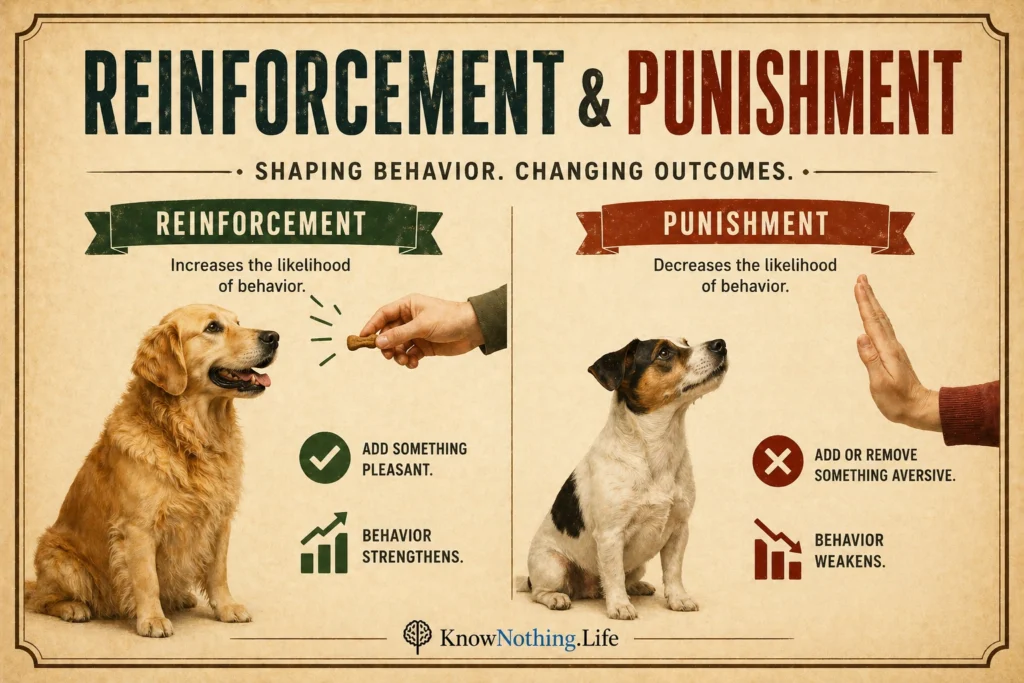
Reinforcement and punishment are central concepts in behavioral psychology, forming the core mechanisms through which behavior is shaped, strengthened, or reduced over time. These principles explain how organisms learn from the consequences of their actions, adapting their behavior in response to environmental feedback. Whether in everyday habits, educational systems, or therapeutic settings, reinforcement and punishment provide a framework for understanding how behavior evolves and persists.
At a fundamental level, these processes reflect a simple but powerful idea: behavior is influenced by what follows it. Actions that lead to desirable outcomes tend to be repeated, while those that produce unfavorable consequences are less likely to occur. However, the mechanisms underlying reinforcement and punishment are far more nuanced than this basic formulation suggests. They involve timing, context, perception, and individual differences, all of which contribute to the complexity of behavioral change. Understanding these dynamics is essential for effectively applying these principles in real-world situations.
Foundations in Operant Conditioning
The concepts of reinforcement and punishment are most closely associated with the theory of operant conditioning, developed by B. F. Skinner. Skinner proposed that behavior is not merely a response to stimuli but is actively shaped by its consequences. This perspective shifted the focus from passive learning to a more dynamic model in which organisms interact with their environment and adjust their behavior based on outcomes.
Operant conditioning distinguishes between different types of consequences and their effects on behavior. Reinforcement refers to any consequence that increases the likelihood of a behavior, while punishment refers to any consequence that decreases it. Importantly, these effects are defined functionally rather than intuitively. A consequence is considered reinforcing or punishing based on its impact on behavior, not on whether it is inherently pleasant or unpleasant.
This framework provides a systematic way to analyze behavior and predict how it will change under different conditions. By identifying the contingencies that govern behavior, psychologists can design interventions that promote desired actions and reduce unwanted ones. The principles of operant conditioning thus serve as the foundation for a wide range of applications, from education and therapy to organizational management and behavioral economics.
Positive and Negative Reinforcement
Reinforcement can be divided into two primary types: positive reinforcement and negative reinforcement. Positive reinforcement involves the addition of a desirable stimulus following a behavior, thereby increasing the likelihood that the behavior will be repeated. Examples include receiving praise for a job well done or earning a reward for completing a task. These outcomes create associations between the behavior and positive consequences, strengthening the behavior over time.
Negative reinforcement, by contrast, involves the removal of an aversive stimulus following a behavior. Although the term “negative” often carries a misleading connotation, it simply refers to the subtraction of something unpleasant. For instance, fastening a seatbelt to stop an annoying alarm or completing a task to avoid criticism are examples of negative reinforcement. In both cases, the behavior is strengthened because it leads to the removal of discomfort.
Understanding the distinction between these forms of reinforcement is crucial, as they operate through different psychological mechanisms. Positive reinforcement builds associations with rewarding outcomes, while negative reinforcement emphasizes relief from negative conditions. Both can be highly effective, but their impact may vary depending on context, individual preferences, and the nature of the behavior being shaped.
Positive and Negative Punishment
Punishment, like reinforcement, can be categorized into positive and negative forms. Positive punishment involves the introduction of an aversive consequence following a behavior, with the goal of reducing its occurrence. Examples include receiving a fine for speeding or being reprimanded for inappropriate conduct. The addition of an unpleasant outcome is intended to discourage the behavior in the future.
Negative punishment, on the other hand, involves the removal of a desirable stimulus. This might include taking away privileges, such as restricting access to entertainment or social activities, in response to undesirable behavior. By removing something valued, negative punishment reduces the likelihood that the behavior will be repeated. Like reinforcement, the effectiveness of punishment depends on how it is perceived and experienced by the individual.
While punishment can be effective in reducing behavior, it is often less reliable than reinforcement in producing long-term change. Punishment may suppress behavior temporarily without addressing its underlying causes, and it can sometimes lead to unintended consequences such as avoidance, anxiety, or aggression. For this reason, many behavioral approaches emphasize reinforcement as a more constructive and sustainable strategy for behavior modification.
Reinforcement Schedules and Timing
The effectiveness of reinforcement and punishment is not determined solely by their type but also by how and when they are delivered. Reinforcement schedules describe the patterns according to which consequences are applied, and they play a critical role in shaping behavior. Continuous reinforcement, in which every instance of a behavior is reinforced, is effective for establishing new behaviors but may lead to rapid extinction once reinforcement stops.
Intermittent reinforcement schedules, such as fixed and variable ratios or intervals, produce more durable behavior patterns. For example, a variable-ratio schedule, in which reinforcement is delivered after an unpredictable number of responses, tends to generate high and persistent levels of behavior. This pattern is commonly observed in activities such as gambling, where the uncertainty of rewards maintains engagement over time.
Timing is equally important. Immediate reinforcement is generally more effective than delayed reinforcement, as it strengthens the association between behavior and consequence. Similarly, punishment is most effective when it is applied consistently and promptly. Delays or inconsistencies can weaken the connection between action and outcome, reducing the impact of these processes. By understanding the role of schedules and timing, practitioners can optimize the application of reinforcement and punishment to achieve desired results.
Applications in Real-World Contexts
Reinforcement and punishment are widely used in various domains, demonstrating their practical significance. In education, teachers use reinforcement to encourage learning and participation, while minimizing reliance on punishment to maintain a positive classroom environment. Reward systems, feedback, and structured reinforcement strategies help students develop desirable behaviors and academic skills.
In therapeutic settings, behavioral techniques based on reinforcement are used to address a range of issues, from anxiety and addiction to developmental disorders. Approaches such as applied behavior analysis rely heavily on reinforcement to promote adaptive behaviors and reduce maladaptive ones. These methods are grounded in careful observation and data-driven decision-making, ensuring that interventions are tailored to individual needs.
Beyond formal settings, reinforcement and punishment influence everyday behavior. From workplace incentives to personal habit formation, these principles shape how individuals respond to challenges and opportunities. Understanding how consequences affect behavior allows individuals to design environments that support their goals, whether by reinforcing productive habits or reducing behaviors that hinder progress.
Ethical Considerations and Limitations
The use of reinforcement and punishment raises important ethical considerations, particularly when applied in contexts involving power dynamics or vulnerable populations. The potential for misuse or overreliance on punishment highlights the need for careful and responsible application. Ethical guidelines emphasize the importance of promoting well-being, respecting autonomy, and avoiding harm when implementing behavioral interventions.
There are also limitations to these concepts. Not all behavior can be easily explained or modified through reinforcement and punishment alone. Internal factors such as beliefs, emotions, and motivations play a significant role in shaping behavior, and ignoring these elements can lead to incomplete or ineffective interventions. This has led to the integration of behavioral principles with cognitive approaches, creating more comprehensive models of behavior change.
Despite these limitations, reinforcement and punishment remain essential tools for understanding and influencing behavior. When applied thoughtfully and ethically, they provide valuable insights into the mechanisms of learning and adaptation. Their effectiveness depends not only on their correct application but also on an awareness of their broader psychological and social context.
Conclusion
Reinforcement and punishment form the backbone of behavioral psychology, offering a powerful framework for understanding how behavior is shaped by its consequences. Through the principles of operant conditioning, these processes explain how actions are strengthened or weakened over time, providing a foundation for both theoretical inquiry and practical application.
While reinforcement tends to be more effective for promoting lasting behavioral change, punishment can play a role in reducing undesirable actions when used appropriately. The interplay between these mechanisms, along with factors such as timing and reinforcement schedules, underscores the complexity of behavior modification. By integrating these principles with ethical considerations and broader psychological insights, individuals and practitioners can harness their power to foster meaningful and sustainable change.