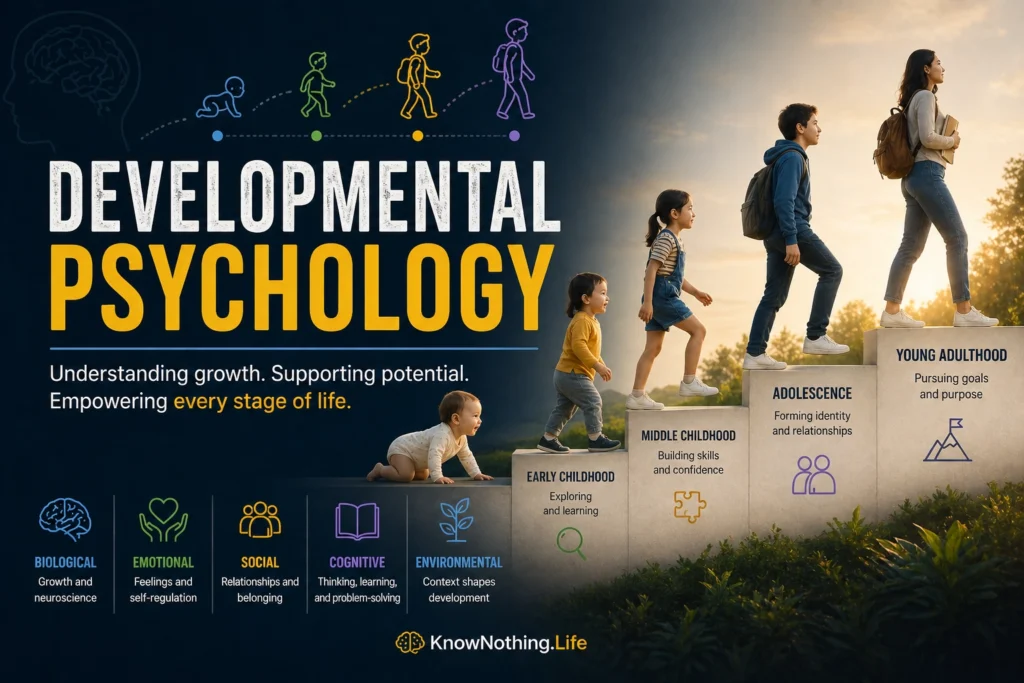
Developmental psychology is the scientific study of how human beings grow, change, and adapt across the lifespan. It examines the physical, cognitive, emotional, and social transformations that occur from infancy through old age, seeking to understand both the patterns that are universal and the variations that make each individual unique. Far from being limited to childhood, developmental psychology encompasses the entire human experience, recognizing that growth and change continue well into adulthood and later life.
At its core, developmental psychology addresses fundamental questions about human nature. How do we acquire knowledge and skills? What shapes our personalities and identities? How do biological factors interact with environmental influences to guide development? By exploring these questions, the field provides insight into the processes that underlie learning, behavior, and adaptation. It also offers practical applications in education, healthcare, parenting, and public policy, making it one of the most influential areas of psychological science.
Historical Foundations and Key Theorists
The foundations of developmental psychology were established through the work of pioneering thinkers who sought to understand how children grow and learn. Among the most influential was Jean Piaget, whose theory of cognitive development proposed that children progress through distinct stages of thinking. Piaget emphasized that children are active learners, constructing knowledge through interaction with their environment rather than passively absorbing information. His work highlighted the qualitative differences between child and adult thought, reshaping how development was understood.
Another key figure, Lev Vygotsky, emphasized the role of social interaction and cultural context in development. Vygotsky argued that learning is inherently social, occurring through collaboration and guided participation. His concept of the “zone of proximal development” illustrated how individuals can achieve higher levels of understanding with appropriate support. This perspective shifted attention toward the importance of language, culture, and social relationships in shaping development.
In the domain of emotional and social development, Erik Erikson introduced a lifespan model that described development as a series of psychosocial stages. Each stage involves a central conflict that must be resolved for healthy development to occur. Erikson’s work expanded the scope of developmental psychology beyond childhood, emphasizing that identity, relationships, and personal growth continue to evolve throughout life.
Biological Foundations of Development
Biological factors play a crucial role in shaping human development, providing the foundation upon which all other processes build. Genetics influence physical growth, brain development, and predispositions toward certain traits and behaviors. From the earliest stages of life, biological processes guide the formation of neural structures, sensory systems, and motor abilities, creating the basis for interaction with the environment.
The brain undergoes significant changes throughout development, particularly during early childhood. Rapid neural growth, synaptic pruning, and the strengthening of connections contribute to the development of cognitive and emotional capacities. These processes are influenced by both genetic programming and environmental input, illustrating the dynamic interplay between nature and nurture. Sensitive periods, during which the brain is particularly responsive to certain types of experiences, highlight the importance of timing in development.
Hormonal changes also play a key role, especially during adolescence, when they contribute to physical maturation and influence behavior and emotional regulation. These biological transformations are not isolated; they interact with social and environmental factors, shaping the trajectory of development. Understanding the biological foundations of development provides essential insight into how individuals grow and adapt over time.
Cognitive Development
Cognitive development refers to the growth of thinking, reasoning, problem-solving, and understanding. It encompasses the ways in which individuals perceive the world, process information, and construct knowledge. Early in life, cognitive development is closely tied to sensory and motor experiences, as infants learn about their environment through exploration and interaction. Over time, these experiences give rise to more complex forms of thinking.
As children develop, they begin to use language, symbols, and abstract concepts, allowing them to represent ideas and engage in more sophisticated reasoning. Memory, attention, and executive functions also improve, enabling greater control over thought processes. These changes are influenced by both maturation and experience, reflecting the combined effects of biological growth and environmental stimulation.
Cognitive development continues into adulthood, though its nature changes over time. While certain abilities, such as processing speed, may decline, others, such as knowledge and expertise, can increase. This ongoing development underscores the idea that cognition is not fixed but evolves in response to experience and context. By studying these changes, developmental psychology provides insight into how individuals learn and adapt throughout life.
Social and Emotional Development
Social and emotional development involves the formation of relationships, the understanding of emotions, and the development of identity. From infancy, humans are deeply social beings, forming attachments to caregivers that provide a foundation for later relationships. These early bonds influence emotional regulation, trust, and the ability to connect with others.
As individuals grow, they develop a more complex understanding of emotions, both their own and those of others. This includes the ability to recognize, interpret, and manage emotional experiences, as well as to empathize with others. Social interactions become increasingly important, shaping self-concept and influencing behavior. Peer relationships, in particular, play a significant role during childhood and adolescence, contributing to the development of social skills and identity.
Identity formation is a central aspect of social and emotional development, particularly during adolescence and early adulthood. Individuals explore different roles, values, and beliefs, gradually forming a coherent sense of self. This process is influenced by cultural, social, and personal factors, reflecting the diversity of human experience. Understanding social and emotional development provides valuable insight into how individuals navigate relationships and construct meaning in their lives.
Lifespan Perspective
One of the defining features of developmental psychology is its lifespan perspective, which recognizes that development is a continuous process that extends from birth to death. This perspective emphasizes that growth and change occur at every stage of life, each with its own challenges and opportunities. By examining development across the lifespan, psychologists can identify patterns and understand how earlier experiences influence later outcomes.
Adulthood is characterized by a range of developmental tasks, including career development, relationship formation, and the pursuit of personal goals. Middle adulthood often involves balancing multiple roles and responsibilities, while later life may bring changes in health, cognition, and social networks. Despite these challenges, many individuals continue to experience growth, adaptation, and fulfillment throughout their lives.
The lifespan perspective also highlights the importance of context. Development is shaped by historical, cultural, and social factors that influence opportunities and experiences. By considering these broader influences, developmental psychology provides a more comprehensive understanding of human growth and change.
Nature and Nurture
The interplay between nature and nurture is a central theme in developmental psychology. Nature refers to the biological and genetic factors that influence development, while nurture encompasses the environmental experiences that shape behavior. Rather than viewing these influences as opposing forces, modern perspectives emphasize their interaction.
Genes provide the potential for development, but their expression is influenced by environmental conditions. For example, a child may have a genetic predisposition for a particular ability, but whether that potential is realized depends on opportunities for learning and practice. Similarly, environmental factors such as parenting, education, and culture can have profound effects on development, shaping both behavior and underlying biological processes.
This interaction is dynamic and ongoing, with each influencing the other over time. Understanding the relationship between nature and nurture is essential for explaining individual differences and for designing interventions that support healthy development. It underscores the complexity of human growth, highlighting the multiple factors that contribute to who we become.
Applications and Real-World Implications
Developmental psychology has wide-ranging applications that extend beyond academic research. In education, insights from developmental theory inform teaching methods, curriculum design, and approaches to learning. Understanding how children think and learn allows educators to create environments that support cognitive and social development.
In healthcare, developmental psychology contributes to the understanding of physical and mental health across the lifespan. It informs interventions for developmental disorders, supports early detection of potential challenges, and guides strategies for promoting well-being. Parenting practices are also influenced by developmental research, helping caregivers provide appropriate support at different stages of growth.
Public policy and social programs benefit from developmental insights as well. Policies related to education, childcare, and aging populations are often shaped by research on human development. By applying these principles, societies can create environments that support individuals at every stage of life, enhancing overall well-being and social functioning.
Conclusion
Developmental psychology provides a comprehensive framework for understanding how humans grow and change throughout their lives. By examining biological, cognitive, social, and emotional processes, it offers a multidimensional view of development that captures both universal patterns and individual differences. Its integration of theory, research, and application makes it a vital field for understanding human behavior.
As research continues to evolve, developmental psychology remains central to addressing some of the most important questions about human life. It sheds light on how we learn, adapt, and form relationships, offering insights that are relevant across disciplines and contexts. Ultimately, the study of development reveals not only how we change over time but also the enduring capacity for growth and transformation that defines the human experience.