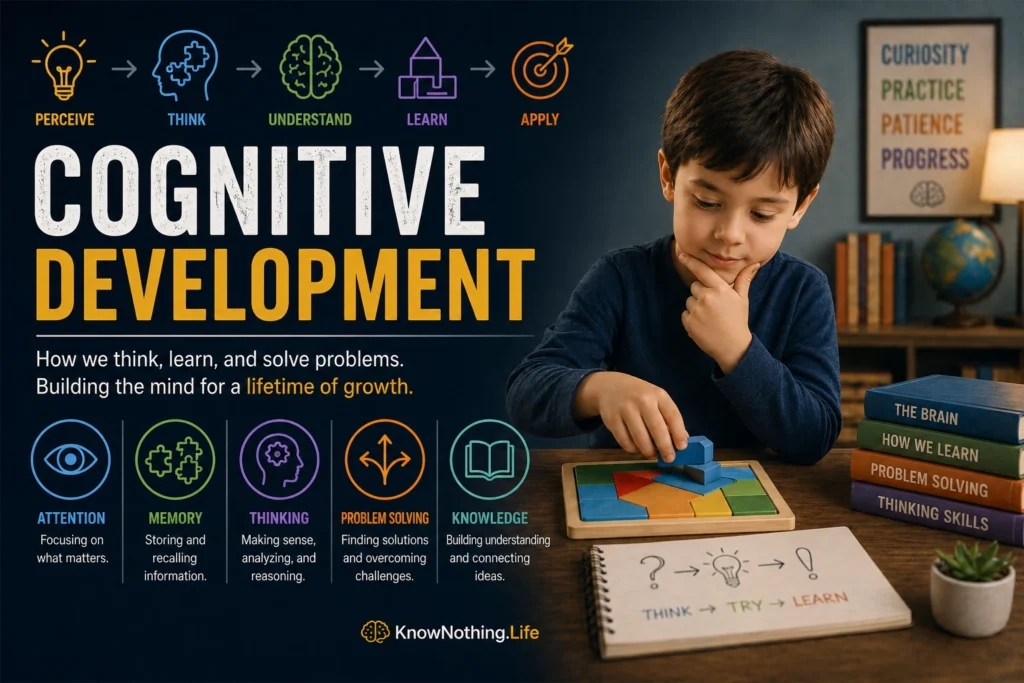
Cognitive development refers to the progression of thinking, reasoning, memory, and problem-solving abilities across the human lifespan. It encompasses how individuals acquire, process, and apply knowledge, as well as how they interpret and respond to the world around them. From the earliest sensory experiences of infancy to the abstract reasoning of adulthood, cognitive development shapes the way individuals understand reality and navigate complex environments.
What makes cognitive development particularly significant is its role in virtually every aspect of human functioning. Learning, decision-making, language, and social interaction all depend on cognitive processes that evolve over time. Rather than unfolding as a simple accumulation of knowledge, cognitive development involves qualitative changes in how thinking is structured and organized. These transformations reflect the dynamic interaction between biological maturation, environmental experience, and social context.
Historical Foundations and Theoretical Perspectives
The study of cognitive development has been shaped by several influential theoretical frameworks. One of the most prominent is the work of Jean Piaget, who proposed that children progress through a series of stages characterized by distinct ways of thinking. In his view, cognitive development is driven by processes of assimilation and accommodation, through which individuals integrate new information and adjust existing mental structures. Piaget’s theory emphasized that children are active participants in their own learning, constructing knowledge through interaction with their environment.
In contrast, Lev Vygotsky highlighted the importance of social interaction and cultural context. Vygotsky argued that cognitive development is fundamentally shaped by communication and collaboration with others. His concept of the “zone of proximal development” describes the range of tasks that individuals can perform with guidance but not yet independently. This perspective underscores the role of language, instruction, and social relationships in facilitating cognitive growth.
Another influential figure, Jerome Bruner, emphasized the role of representation and discovery in learning. Bruner proposed that individuals construct knowledge through different modes of representation—enactive, iconic, and symbolic—and that education should support active exploration. Together, these theoretical perspectives provide a comprehensive understanding of cognitive development, highlighting both individual and social dimensions.
Early Cognitive Development
Cognitive development begins in infancy, where learning is closely tied to sensory and motor experiences. During this period, infants explore their environment through actions such as reaching, grasping, and observing. These interactions allow them to form basic concepts about objects, space, and causality. One of the most important milestones in early cognitive development is the emergence of object permanence, the understanding that objects continue to exist even when they are not visible.
As infants grow into toddlers, their cognitive abilities expand rapidly. They begin to use symbols, such as words and images, to represent objects and experiences. This shift marks the transition from purely sensory-based understanding to more abstract forms of thinking. Memory and attention also develop during this period, enabling children to retain information and focus on specific aspects of their environment.
Language acquisition plays a crucial role in early cognitive development, providing a tool for organizing and expressing thought. As vocabulary grows, children become better able to categorize experiences, solve problems, and communicate ideas. This period lays the foundation for more complex cognitive processes, demonstrating how early experiences shape the trajectory of development.
Development of Thinking and Reasoning
As children move into early and middle childhood, their thinking becomes more structured and logical. They develop the ability to classify objects, understand relationships, and perform basic operations. According to Piaget, this stage involves the emergence of concrete operational thinking, in which children can apply logical reasoning to tangible situations. They begin to understand concepts such as conservation, recognizing that quantity remains the same despite changes in appearance.
During this stage, children also improve in their ability to take different perspectives. This development enhances social understanding and communication, allowing them to consider the thoughts and feelings of others. Memory strategies, such as rehearsal and organization, become more sophisticated, supporting learning and problem-solving. These changes reflect the growing complexity of cognitive processes and the increasing integration of different mental functions.
In adolescence, cognitive development reaches a new level with the emergence of abstract thinking. Individuals become capable of reasoning about hypothetical situations, considering multiple possibilities, and engaging in systematic problem-solving. This stage, often referred to as formal operational thinking, allows for advanced forms of reasoning, including scientific and philosophical thought. The development of these abilities marks a significant expansion of cognitive capacity.
Information Processing and Cognitive Mechanisms
Modern approaches to cognitive development often focus on information processing, examining how the mind handles information at a more detailed level. This perspective emphasizes processes such as attention, memory, and executive function, which work together to support thinking and learning. Rather than viewing development as a series of stages, information processing theories highlight gradual improvements in efficiency and capacity.
Attention plays a critical role in cognitive development, determining which information is selected for processing. As children grow, they become better able to focus on relevant stimuli and ignore distractions. Memory also undergoes significant development, with improvements in both short-term and long-term storage. Strategies for encoding and retrieving information become more effective, supporting learning across various domains.
Executive functions, including planning, inhibition, and cognitive flexibility, are essential for goal-directed behavior. These abilities develop gradually and are closely linked to the maturation of the prefrontal cortex. They enable individuals to regulate their thoughts and actions, adapt to new situations, and solve complex problems. The development of these mechanisms provides a deeper understanding of how cognitive processes evolve over time.
Language and Cognitive Development
Language is both a product and a driver of cognitive development. It provides a system of symbols that allows individuals to represent ideas, communicate with others, and organize their thoughts. The acquisition of language is closely intertwined with cognitive growth, as it enables more complex forms of reasoning and understanding.
Vygotsky emphasized the role of language in shaping thought, arguing that internal speech—thinking in words—plays a key role in cognitive processes. Through language, individuals can plan actions, reflect on experiences, and engage in self-regulation. This perspective highlights the importance of social interaction in cognitive development, as language is learned through communication with others.
As language skills develop, individuals gain access to new ways of thinking. They can engage in abstract reasoning, construct narratives, and participate in cultural practices that shape cognition. The relationship between language and cognition is therefore reciprocal, with each influencing the other in dynamic ways. Understanding this relationship provides insight into how cognitive abilities are constructed and expressed.
Social and Cultural Influences
Cognitive development does not occur in isolation but is deeply influenced by social and cultural factors. The environment in which individuals grow up shapes the opportunities they have for learning and the types of knowledge they acquire. Cultural practices, educational systems, and social interactions all contribute to the development of cognitive abilities.
Social interaction plays a particularly important role, as it provides opportunities for learning through collaboration and guidance. Caregivers, teachers, and peers all contribute to cognitive development by offering support, feedback, and shared experiences. These interactions help individuals acquire new skills and refine existing ones, illustrating the importance of social context in shaping cognition.
Cultural differences in cognitive development highlight the diversity of human experience. Different cultures emphasize different skills, values, and ways of thinking, leading to variations in cognitive processes. By studying these differences, researchers can gain a more comprehensive understanding of how cognition develops and how it is influenced by broader social and cultural factors.
Lifespan Development of Cognition
Cognitive development continues throughout the lifespan, extending beyond childhood and adolescence into adulthood and later life. While certain cognitive abilities, such as processing speed and working memory, may decline with age, others, such as knowledge and expertise, often increase. This ongoing development reflects the adaptability of the human mind.
In adulthood, cognitive development is often characterized by the application of knowledge to real-world situations. Individuals develop practical problem-solving skills and the ability to integrate different types of information. This stage may also involve the development of wisdom, which encompasses not only knowledge but also judgment and insight.
Later in life, cognitive changes may include both challenges and opportunities. While some abilities decline, others remain stable or even improve. Factors such as education, health, and lifestyle can influence cognitive aging, highlighting the importance of maintaining an active and engaged mind. The lifespan perspective emphasizes that cognitive development is a continuous process, shaped by both biological and environmental factors.
Conclusion
Cognitive development is a complex and dynamic process that shapes how individuals think, learn, and understand the world. From the earliest stages of life to later adulthood, cognitive abilities evolve through the interaction of biological maturation, experience, and social context. Theoretical perspectives from thinkers such as Jean Piaget and Lev Vygotsky have provided valuable frameworks for understanding these processes, while modern research continues to expand and refine this knowledge.
By examining cognitive development, we gain insight into the mechanisms that underlie learning and behavior. This understanding has important implications for education, psychology, and everyday life, offering strategies for supporting cognitive growth and addressing challenges. Ultimately, cognitive development reflects the remarkable capacity of the human mind to adapt, learn, and transform across the lifespan.