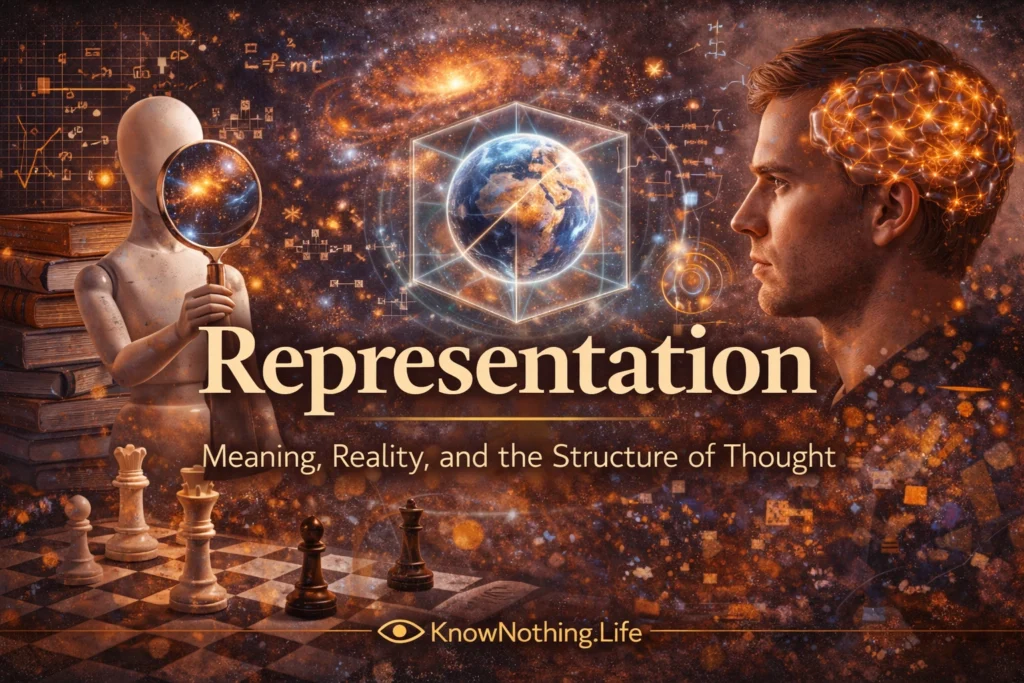
Representation lies at the heart of philosophy, shaping how we understand language, perception, art, and knowledge itself. To represent is to stand in for something—to depict, describe, symbolize, or refer. Yet this seemingly simple idea raises profound questions. How can words or images refer to things in the world? Do representations mirror reality, or do they construct it? And what is the relationship between representation and truth?
Philosophers across traditions have treated representation as a central problem because it touches nearly every domain of inquiry. From the theories of language developed by Aristotle to modern analytic philosophy and contemporary cultural theory, representation has been examined as both a cognitive and social process. It is through representation that humans organize experience, communicate ideas, and make sense of the world.
At the same time, representation is not neutral. It can clarify or distort, reveal or conceal. The way something is represented—whether in language, art, or media—shapes how it is understood. To study representation is therefore to investigate not only how meaning is formed, but how reality itself is mediated through systems of signs and symbols.
Classical Foundations of Representation
The philosophical study of representation begins in antiquity, particularly with Plato and Aristotle. Plato’s theory of Forms introduces a layered conception of reality in which representation plays a crucial role. In The Republic, he argues that artistic representations are imitations of physical objects, which themselves are imperfect copies of eternal Forms. This leads him to conclude that representation is inherently removed from truth. A painting of a bed, for example, is not the bed itself but an imitation of an imitation, twice removed from reality.
Plato’s skepticism highlights a central tension in the philosophy of representation: the gap between appearance and reality. Representations may resemble or refer to objects, but they are not identical to them. This raises concerns about deception and illusion, particularly in art and rhetoric. Plato feared that representations could mislead audiences, shaping beliefs without providing genuine knowledge. His critique established a lasting philosophical concern with the reliability and ethical implications of representation.
Aristotle offers a more nuanced account, especially in Poetics and On Interpretation. For Aristotle, representation (mimesis) is a natural human activity and a fundamental way of learning about the world. Rather than distancing us from reality, representation can reveal patterns, structures, and possibilities that are not immediately apparent. He argues that humans take pleasure in representations because they allow us to recognize and understand what is depicted. This positive view frames representation as a bridge between perception and knowledge, rather than a barrier.
Representation and Language
The problem of representation becomes especially prominent in the philosophy of language, where words are understood as symbols that refer to objects, ideas, or states of affairs. Ferdinand de Saussure revolutionized this field by arguing that linguistic signs consist of two components: the signifier (the form of a word) and the signified (the concept it represents). Crucially, the relationship between these components is arbitrary, meaning that words do not inherently resemble the things they represent.
This insight shifts the focus from correspondence to structure. Meaning arises not from a direct link between words and objects, but from differences within a system of signs. Language, in this view, does not simply mirror reality; it organizes and interprets it. This has far-reaching implications for how we understand representation, suggesting that meaning is shaped by conventions and contexts rather than fixed connections.
Building on these ideas, Ludwig Wittgenstein explores representation in terms of language use. In his early work, Tractatus Logico-Philosophicus, he proposes the picture theory of language, arguing that propositions represent states of affairs by sharing a logical structure with them. He famously writes, “The picture is a model of reality,” suggesting that language functions as a kind of mapping between thought and the world.
In his later work, Philosophical Investigations, Wittgenstein abandons this rigid model in favor of a more flexible account. He argues that meaning is determined by use within “language games,” emphasizing the diversity of ways in which language represents reality. This shift underscores the complexity of representation, highlighting its dependence on social practices and contexts rather than fixed logical relationships.
Representation in Art and Aesthetics
In aesthetics, representation is often discussed in terms of depiction and meaning in art. Traditional theories of art emphasized its representational function, viewing artworks as imitations of the natural world. From Renaissance painting to classical sculpture, artistic value was often measured by how accurately and convincingly a work represented its subject.
However, modern art challenged this assumption by moving away from realistic depiction toward abstraction and conceptual expression. Philosophers such as Nelson Goodman argue that representation in art is not based on resemblance but on symbolic systems. In Languages of Art, Goodman contends that representation is a matter of denotation within a system of symbols, rather than visual similarity. A painting represents its subject not because it looks like it, but because it functions as a symbol within a given context.
This perspective broadens the concept of representation, allowing for non-representational and abstract art to be understood as meaningful. It also emphasizes the role of interpretation, suggesting that the meaning of an artwork depends on the viewer’s engagement with its symbolic structure. Representation, in this sense, becomes an active process rather than a passive reflection.
At the same time, thinkers such as Arthur Danto highlight the importance of context in determining what counts as representation. Danto argues that identical objects can have different meanings depending on their placement within the “artworld.” This suggests that representation is not solely a matter of form or content, but of interpretation within a broader cultural framework.
Mental Representation and Cognition
Representation is also central to theories of mind and cognition. To think, in many philosophical accounts, is to manipulate internal representations—mental images, concepts, or symbols that stand in for objects and ideas. This view, often associated with cognitive science, treats the mind as a representational system that processes information about the world.
Philosophers such as Jerry Fodor have defended a representational theory of mind, arguing that mental states are defined by their representational content. According to this view, beliefs, desires, and perceptions are all forms of representation that encode information about the world. For example, to believe that it is raining is to hold a mental representation of a particular state of affairs.
However, this approach has been challenged by philosophers who question whether representation is the best way to understand cognition. Critics argue that not all mental processes involve symbolic representation, emphasizing instead the role of embodied and dynamic interactions with the environment. These debates reflect broader questions about the nature of thought and the extent to which it depends on representational structures.
Representation, Power, and Culture
In contemporary philosophy and cultural theory, representation is often analyzed in relation to power, identity, and social structures. Representations do not merely describe the world; they shape how individuals and groups are perceived and understood. This insight has been central to fields such as critical theory, media studies, and postcolonial philosophy.
Michel Foucault examines how systems of representation are tied to power and knowledge. In his work, he argues that what can be said, seen, and thought is governed by discursive structures that shape our understanding of reality. Representation, in this sense, is not neutral but embedded within networks of authority and control.
Similarly, Edward Said explores how representations of the “Orient” in Western literature and art reflect and reinforce colonial power dynamics. In Orientalism, he argues that these representations are not accurate depictions but constructions that serve specific political and cultural interests. This perspective highlights the ethical and political dimensions of representation, emphasizing its role in shaping social realities.
These approaches expand the scope of representation beyond individual perception or artistic practice, situating it within broader systems of meaning and power. They reveal that representation is not only about how we see the world, but also about how the world is structured and understood through language, images, and discourse.
Conclusion
Representation is a foundational concept that connects diverse areas of philosophy, from language and art to cognition and culture. It raises fundamental questions about how meaning is created, how reality is understood, and how knowledge is communicated. From the skepticism of Plato to the structural insights of Ferdinand de Saussure and the critical analyses of Michel Foucault, philosophical accounts of representation reveal its complexity and significance.
What emerges from these perspectives is not a single definition but a recognition of representation as a dynamic and multifaceted process. It is at once a tool for understanding and a force that shapes understanding itself. Representation allows us to navigate the world, but it also mediates our access to it, introducing layers of interpretation and meaning.
To study representation is to examine the very conditions of thought and communication. It invites us to question how we know what we know, how we describe what we see, and how meaning is constructed across different contexts. In doing so, it reveals that reality, as we experience it, is inseparable from the systems of representation through which it is understood.