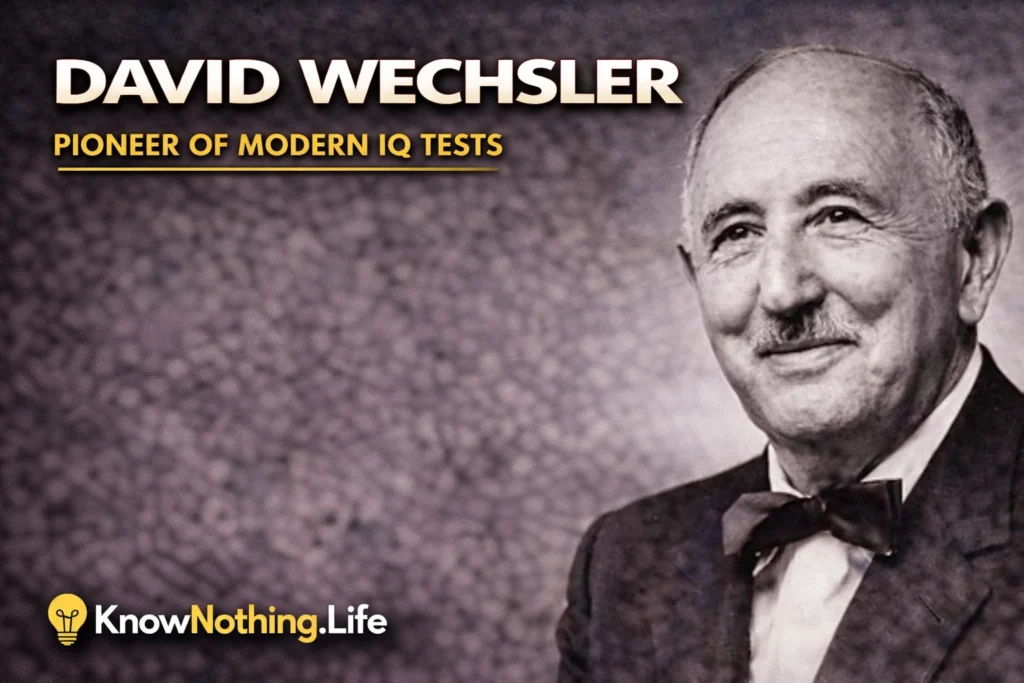
Few psychologists have shaped modern intelligence assessment as deeply as David Wechsler. Best known for creating the Wechsler Adult Intelligence Scale, the Wechsler Intelligence Scale for Children, and the Wechsler Preschool and Primary Scale of Intelligence, Wechsler changed how psychologists measure cognitive ability across the lifespan. His tests became some of the most widely used intelligence measures in clinical psychology, education, neuropsychology, and psychological assessment because they offered more than a single score. They provided a profile of strengths and weaknesses.
Wechsler’s greatest contribution was not simply building new tests. It was changing the philosophy of intelligence testing. Earlier intelligence scales, especially those influenced by Alfred Binet and Lewis Terman, often relied heavily on mental age and a single IQ calculation. Wechsler believed this approach was too limited, especially for adults. He argued that intelligence should be understood as a broad capacity involving purposeful action, rational thought, and effective adaptation to the environment. That practical and clinical vision made his work one of the cornerstones of modern psychological measurement.
Early Life and Education
David Wechsler was born on January 12, 1896, in Lespezi, Romania, and immigrated with his family to the United States as a child. Growing up in New York, he entered an American society increasingly shaped by immigration, public schooling, military classification, and scientific interest in measuring human ability. These forces would later become central to his professional life. Like many early twentieth-century psychologists, Wechsler came of age during a period when intelligence testing was expanding rapidly but still carried major conceptual and ethical problems.
He studied at the City College of New York and later at Columbia University, where he completed graduate work in psychology. Columbia was an important center for applied psychology and measurement, and Wechsler’s training exposed him to experimental methods, clinical observation, and psychometric thinking. He was influenced by the broader testing movement but did not simply inherit its assumptions. From the beginning, his interest was clinical: how could testing help psychologists understand real people more accurately?
Army Testing and Clinical Experience
During World War I, Wechsler worked with the Army testing program, which used large-scale mental tests to classify soldiers. This experience exposed him to both the power and weakness of mass testing. The Army Alpha and Beta tests showed that psychological tools could be administered on a large scale, but they also revealed how easily testing could misrepresent people when language, culture, education, and practical ability were not properly considered.
This early experience shaped Wechsler’s later dissatisfaction with overly narrow testing methods. He saw that intelligence could not be captured adequately by verbal knowledge alone. People solve problems in different ways, and a useful test must account for both verbal and nonverbal abilities. Later, as chief psychologist at Bellevue Psychiatric Hospital in New York, Wechsler worked with adults facing complex clinical problems. He needed tools that could help evaluate patients as individuals, not merely sort them by a school-based mental age score.
Rejecting Mental Age for Adults
One of Wechsler’s most important innovations was his rejection of the traditional mental age model for adult intelligence testing. The Binet-style approach worked reasonably well for children because a child’s intellectual development could be compared with age-based expectations. But for adults, the idea of mental age became awkward and misleading. A forty-year-old adult could not meaningfully be described as having a mental age of twenty or fifty in the same developmental sense.
Wechsler replaced this approach with deviation IQ. Instead of comparing adult performance to an idealized mental age, he compared individuals to others in the same age group. The average score was set at 100, and individual performance was interpreted according to distance from that age-group mean. This shift became one of the most important advances in intelligence testing because it made adult assessment more statistically sensible and clinically useful.
The Wechsler-Bellevue Intelligence Scale
In 1939, Wechsler published The Measurement of Adult Intelligence and introduced the Wechsler-Bellevue Intelligence Scale. This test was designed specifically for adults and reflected his belief that intelligence assessment should include multiple kinds of tasks. It combined verbal subtests with performance subtests, allowing clinicians to examine different aspects of cognitive functioning rather than relying on a single undifferentiated score.
The Wechsler-Bellevue was important because it treated intelligence as multidimensional while still allowing for an overall estimate of general ability. Verbal tasks measured areas such as vocabulary, comprehension, arithmetic, and information. Performance tasks measured nonverbal reasoning, visual organization, processing, and practical problem-solving. This structure gave psychologists a richer clinical picture. A person might show strong verbal reasoning but weaker visual-motor organization, or strong perceptual problem-solving but weaker acquired knowledge. That pattern mattered.
Defining Intelligence
Wechsler’s most famous definition of intelligence remains one of the most quoted in psychology. He described intelligence as “the global capacity of a person to act purposefully, to think rationally, and to deal effectively with his environment.” This definition reveals the practical center of his theory. Intelligence was not merely school knowledge, speed, vocabulary, or abstract reasoning. It was the broader capacity to meet life’s demands.
He also believed intelligence was affected by what he called non-intellective factors. Personality, motivation, persistence, anxiety, emotional control, and life experience could all influence intellectual performance. This did not mean his tests directly measured personality, but it did mean he rejected the idea that intelligence was a cold, isolated mental substance. A person’s ability to function intelligently depends partly on how cognition interacts with emotion, temperament, and circumstance.
The WAIS, WISC, and WPPSI
The Wechsler-Bellevue eventually evolved into the Wechsler Adult Intelligence Scale, first published in 1955. The WAIS became a dominant adult intelligence test because it was clinically flexible, statistically sophisticated, and useful across many settings. Psychologists used it to evaluate cognitive ability, intellectual disability, brain injury, psychiatric conditions, educational planning, and occupational concerns.
Wechsler also adapted his model for children. The Wechsler Intelligence Scale for Children, first published in 1949, became one of the most important tools in school psychology and child assessment. Later, the Wechsler Preschool and Primary Scale of Intelligence extended his approach to younger children. Together, these scales created a lifespan model of intelligence testing. They allowed psychologists to assess cognitive functioning from early childhood through adulthood using a shared conceptual framework.
Major Works and Contributions
Wechsler’s major works include The Range of Human Capacities, The Measurement of Adult Intelligence, and The Measurement and Appraisal of Adult Intelligence. These writings helped explain his theory of intelligence, his criticism of mental age, and his approach to test construction. He also published work on memory assessment, including contributions that led to the Wechsler Memory Scale, another major clinical tool.
His lasting contribution was the integration of psychometrics with clinical judgment. Wechsler did not want testing to become a mechanical process in which a single number defined a person. He wanted test results interpreted as part of a broader psychological evaluation. The pattern of subtest scores, the person’s behavior during testing, and the clinical context all mattered. This made the Wechsler tradition especially influential in clinical psychology and neuropsychology.
Criticism and Limitations
Like all intelligence testing, the Wechsler scales have faced criticism. Critics argue that IQ tests can be affected by culture, language, education, socioeconomic background, disability, test anxiety, and examiner interpretation. These concerns are serious because intelligence tests have often been used in high-stakes settings, including schools, disability determinations, employment contexts, and clinical diagnosis.
Wechsler’s approach reduced some earlier problems by including nonverbal tasks and age-based norms, but it did not eliminate the ethical challenges of psychological measurement. A test score can be useful, but it can also be misused if treated as a complete summary of human potential. Modern psychologists increasingly emphasize careful interpretation, cultural awareness, and the limits of what any standardized test can reveal.
Legacy and Lasting Influence
David Wechsler died on May 2, 1981, in New York City, but his influence remains enormous. The Wechsler scales continue to be revised, updated, and widely used around the world. Their basic structure—multiple subtests, age-based norms, composite scores, and attention to cognitive profile—remains central to modern assessment.
His work changed intelligence testing from a narrow ranking system into a more clinically useful method for understanding cognitive functioning. He showed that intelligence is not best understood as a single isolated number, but as a pattern of abilities that help people reason, adapt, solve problems, and function in the world.
Final Thoughts
To study David Wechsler is to study one of the most practical revolutions in psychological assessment. He inherited an intelligence-testing tradition shaped by Binet, Terman, and military testing, but he reworked it into something more flexible and clinically meaningful. His scales gave psychologists tools for understanding individuals across age groups and across different kinds of cognitive ability.
Wechsler’s greatest insight was that intelligence must be connected to life. It is not merely what a person knows, but how effectively a person thinks, acts, adapts, and responds to challenges. His work reminds us that measurement can be useful when handled carefully, but no score should ever be mistaken for the full human being behind it.