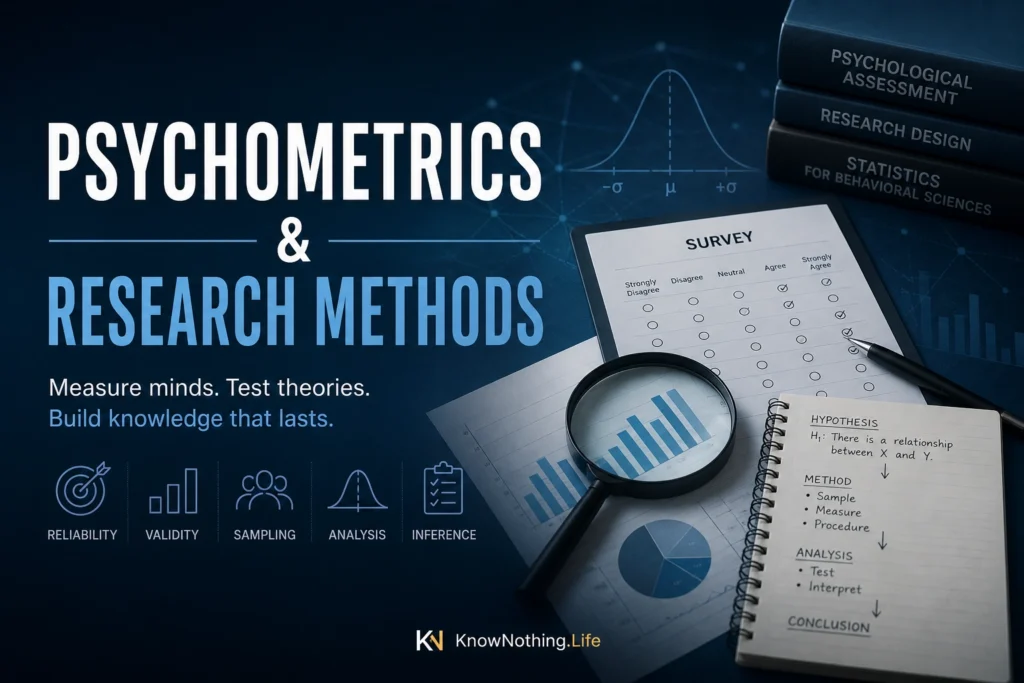
Psychometrics and research methods form the backbone of scientific psychology, providing the tools and frameworks necessary to measure mental processes and test hypotheses about human behavior. While psychology often grapples with abstract concepts such as intelligence, personality, and emotion, psychometrics offers a way to quantify these constructs, transforming subjective phenomena into data that can be analyzed and interpreted. Research methods, in turn, provide the systematic procedures through which this data is collected, evaluated, and used to generate knowledge.
The development of psychometrics is closely tied to the broader history of scientific measurement. Early pioneers such as Francis Galton sought to quantify individual differences, laying the groundwork for modern psychological testing. Later, researchers like Charles Spearman introduced statistical techniques such as factor analysis, enabling the identification of underlying dimensions in complex data. These contributions transformed psychology into a more rigorous and empirically grounded discipline.
At its core, the integration of psychometrics and research methods reflects a fundamental challenge: how to measure the mind with precision and validity. This challenge continues to drive innovation in both fields, as researchers refine tools and methodologies to better capture the complexity of human experience.
Foundations of Psychometrics
Psychometrics is the science of measuring psychological constructs, including abilities, traits, and attitudes. Its primary goal is to develop instruments—such as tests and questionnaires—that produce reliable and valid data. Reliability refers to the consistency of a measure, while validity concerns whether the instrument accurately captures the construct it is intended to assess.
The importance of these concepts cannot be overstated. A test that yields inconsistent results cannot be trusted, while a test that measures the wrong construct is fundamentally flawed. As Lee Cronbach emphasized in his work on reliability, measurement is meaningful only when it is both consistent and interpretable. Cronbach’s alpha, a widely used statistic, remains a standard tool for assessing internal consistency in psychological scales.
Psychometric theory also addresses issues such as scaling, standardization, and norming. These processes ensure that test scores can be compared across individuals and contexts. By establishing norms based on representative samples, psychometricians create reference points that allow for meaningful interpretation of results. This foundation enables the use of psychological tests in diverse applications, from education to clinical assessment.
Classical Test Theory and Modern Approaches
Classical Test Theory (CTT) provides a foundational framework for understanding measurement in psychology. According to CTT, an observed score consists of a true score plus error. The goal of measurement is to minimize error and approximate the true score as closely as possible. This model has guided the development of countless psychological tests, emphasizing the importance of reliability and error reduction.
However, CTT has limitations, particularly in its assumption that measurement error is uniform across all levels of a construct. To address these limitations, modern approaches such as Item Response Theory (IRT) have been developed. IRT focuses on the relationship between individual test items and the underlying trait being measured, allowing for more precise and flexible assessment.
The transition from CTT to IRT reflects a broader evolution in psychometrics toward greater sophistication and accuracy. Researchers such as Frederic Lord played a key role in advancing these methods, demonstrating how statistical models can enhance the precision of measurement. Today, IRT is widely used in large-scale testing and adaptive assessments, highlighting its practical significance.
Research Design and Methodological Rigor
Research methods provide the framework for conducting scientific investigations in psychology. Central to this framework is the concept of research design, which determines how data is collected and analyzed. Experimental designs, for example, involve the manipulation of variables to establish causal relationships, while correlational designs examine associations between variables without implying causation.
The distinction between these approaches is critical. Experimental research allows for stronger inferences about causality but often requires controlled conditions that may limit generalizability. Correlational research, while more flexible, cannot establish cause-and-effect relationships. As Donald Campbell noted in his work on experimental design, “The validity of an experiment depends on the degree to which alternative explanations can be ruled out.”
Methodological rigor also involves careful consideration of sampling, measurement, and data analysis. Representative samples ensure that findings can be generalized, while appropriate statistical techniques enable accurate interpretation of results. Together, these elements form the foundation of scientific inquiry, ensuring that conclusions are supported by evidence.
Measurement of Psychological Constructs
One of the central challenges in psychometrics is the measurement of constructs that cannot be directly observed. Intelligence, personality, and attitudes are inherently abstract, requiring indirect methods of assessment. Psychometric instruments translate these constructs into measurable variables, often through self-report questionnaires or performance-based tests.
The development of such instruments involves multiple steps, including item generation, pilot testing, and validation. Each stage is designed to ensure that the instrument accurately reflects the construct and produces reliable data. Factor analysis, introduced by Charles Spearman, plays a key role in identifying the underlying structure of constructs, allowing researchers to refine their measures.
Despite these advances, measurement remains an imperfect process. Cultural, linguistic, and contextual factors can influence how individuals respond to tests, introducing variability that must be carefully managed. Recognizing these limitations is essential for interpreting results and advancing the science of measurement.
Ethics and Challenges in Research
Ethical considerations are central to both psychometrics and research methods. Researchers must ensure that participants are treated with respect, that their data is handled responsibly, and that the potential risks of research are minimized. Ethical guidelines, such as those established by the American Psychological Association, provide a framework for conducting research in a responsible and transparent manner.
One of the key ethical challenges in psychometrics is the potential for misuse of tests. Psychological assessments can have significant consequences, influencing decisions in education, employment, and clinical practice. Ensuring that tests are used appropriately and interpreted correctly is therefore essential for protecting individuals and maintaining public trust.
Another challenge is the replication crisis, which has highlighted issues related to reproducibility and transparency in psychological research. Efforts to address these issues include the adoption of open science practices, such as preregistration and data sharing. These initiatives aim to strengthen the reliability of research findings and promote greater accountability within the field.
Integration and Future Directions
The integration of psychometrics and research methods continues to evolve as new technologies and analytical techniques emerge. Advances in data science, machine learning, and computational modeling are expanding the possibilities for measuring and analyzing psychological constructs. These developments offer the potential for more personalized and adaptive assessments, as well as deeper insights into complex patterns of behavior.
At the same time, the increasing availability of large datasets presents new challenges, including issues of privacy, data quality, and interpretation. Balancing innovation with ethical responsibility will be a key concern for future research. As Lee Cronbach emphasized, the goal of measurement is not merely to produce data but to generate meaningful understanding.
The future of psychometrics and research methods lies in their ability to adapt to changing contexts while maintaining scientific rigor. By integrating traditional principles with modern technologies, researchers can continue to refine their tools and expand the scope of psychological inquiry.
Conclusion
Psychometrics and research methods are essential to the scientific study of psychology, providing the means to measure, analyze, and understand complex mental processes. From the early work of Francis Galton to the modern advancements in statistical modeling, these fields have transformed psychology into a discipline grounded in empirical evidence.
Through concepts such as reliability, validity, and methodological rigor, psychometrics ensures that psychological measurement is both accurate and meaningful. Research methods, in turn, provide the framework for testing hypotheses and generating knowledge, enabling psychologists to explore the intricacies of human behavior.
Ultimately, the integration of these fields reflects a broader commitment to understanding the mind through systematic inquiry. By continuing to refine measurement and methodology, psychology can deepen its insights and contribute to a more comprehensive understanding of human experience.