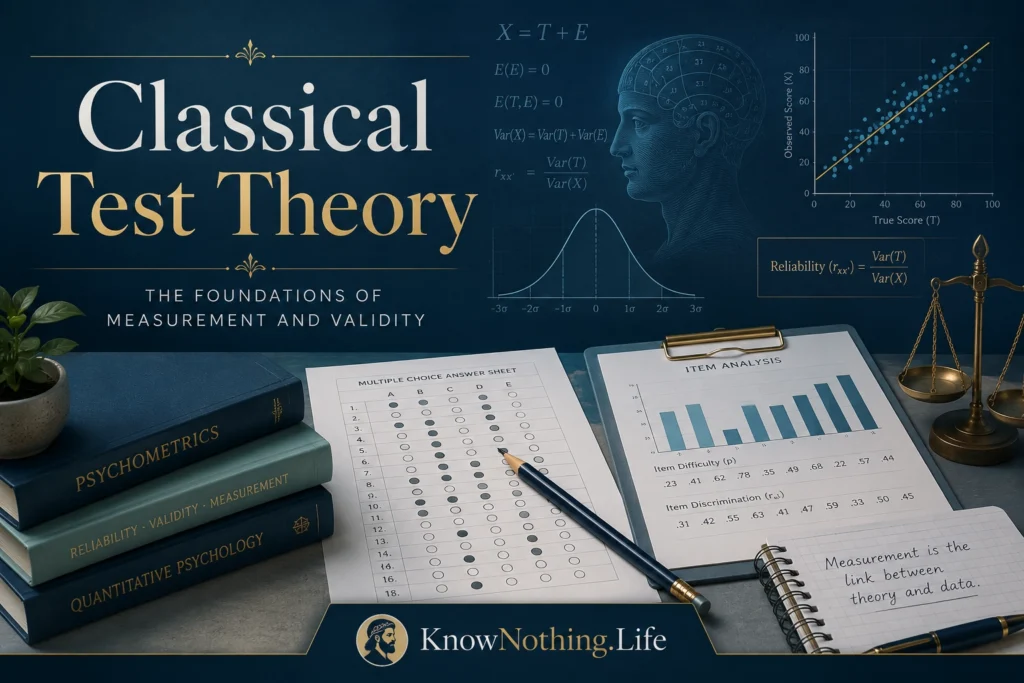
Classical Test Theory, often abbreviated as CTT, is one of the foundational frameworks in psychological and educational measurement. It explains how test scores should be understood when measurement is imperfect. In psychology, education, employment testing, personality assessment, and clinical screening, scores are often treated as if they directly reveal ability, achievement, or traits. Classical Test Theory reminds us that every observed score contains uncertainty. A person’s score on an intelligence test, anxiety scale, reading exam, or personality inventory is not a flawless measurement of who they are. It is an estimate shaped by both the trait being measured and the errors introduced by testing conditions.
The roots of CTT lie in early psychometrics, especially the work of Charles Spearman, Louis Thurstone, Harold Gulliksen, Lee Cronbach, and other measurement theorists. Spearman’s work on correlation and general intelligence helped establish the statistical foundation of test reliability, while Gulliksen’s Theory of Mental Tests became a classic statement of the theory. Cronbach’s influential paper on coefficient alpha gave researchers one of the most widely used tools for estimating internal consistency. Classical Test Theory remains important because it is practical, flexible, and easy to apply. Even with newer models such as Item Response Theory, CTT remains the starting point for understanding reliability, error, and score interpretation.
The Basic Model
At the center of Classical Test Theory is a simple but powerful idea: an observed score is composed of a true score plus error. In symbolic form, this is often written as X = T + E. The observed score is the score a person actually receives. The true score is the theoretical average score the person would obtain across an infinite number of equivalent testing occasions. Error is the difference between the observed score and that true score. This does not mean that a person has a perfect score hidden inside them waiting to be discovered. Rather, the true score is a statistical concept that represents the stable part of performance.
This model is useful because it introduces humility into assessment. A student who earns an 86 on an exam may not truly be an “86” in an absolute sense. If the student took another equivalent version of the test, the score might be 83, 88, or 90 because of fatigue, guessing, anxiety, distractions, item wording, or temporary motivation. Classical Test Theory treats these fluctuations as measurement error. A good test does not eliminate error completely, but it reduces error enough that scores can be interpreted with reasonable confidence.
True Score and Measurement Error
The true score is one of the most important concepts in CTT, but it is often misunderstood. It does not mean a person’s ultimate ability, intelligence, character, or potential. It means the expected value of that person’s observed scores over repeated equivalent measurements. If someone took many parallel forms of the same test under similar conditions, their true score would be the average of those scores. The true score is therefore an idealized estimate of the consistent part of performance.
Measurement error includes anything that causes an observed score to differ from the true score. Some error is random, such as lucky guesses, momentary distraction, unclear instructions, temporary illness, or noise in the testing room. Other influences may be more systematic, such as language barriers, cultural mismatch, stereotype threat, or disability-related obstacles. Traditional CTT focuses mainly on random error, but responsible test interpretation must also consider systematic sources of unfairness. The central lesson remains the same: observed scores are not pure truth. They are measurements affected by conditions.
Reliability
Reliability is the central concern of Classical Test Theory. It refers to the consistency, stability, or dependability of test scores. A reliable test produces scores that are relatively free from random measurement error. If a depression scale, math exam, or personality inventory produces wildly different results for the same person under similar conditions, the test is not reliable enough to support serious interpretation. Reliability does not prove that a test measures the right thing, but it does indicate that the score is consistent.
In CTT, reliability is often defined as the proportion of observed score variance that reflects true score variance. If most of the differences among test takers reflect real differences in the construct being measured, reliability is high. If much of the variation reflects error, reliability is low. Reliability coefficients usually range from 0 to 1, with higher values indicating greater consistency. However, reliability is not a permanent property of a test in all circumstances. A test may be reliable in one population and less reliable in another. It is more accurate to speak of the reliability of scores in a particular context than the reliability of a test in the abstract.
Types of Reliability
Classical Test Theory includes several ways to estimate reliability because measurement error can come from different sources. Test-retest reliability examines score stability over time by giving the same test to the same people on two occasions. It is useful when the trait being measured is expected to remain stable, such as certain abilities or personality traits. Parallel-forms reliability compares scores from two equivalent versions of a test, while split-half reliability divides a test into two parts and examines whether both halves produce similar results.
Inter-rater reliability is important when human judgment is involved, such as essay grading, clinical diagnosis, or behavioral observation. Internal consistency examines whether items on a test tend to measure the same general construct. Cronbach’s alpha is the most famous estimate of internal consistency, but it is frequently overinterpreted. A high alpha does not prove that a test is valid, nor does it guarantee that all items measure only one construct. It simply shows that items tend to covary in a consistent way.
Standard Error of Measurement
The standard error of measurement, or SEM, is one of the most practical ideas in Classical Test Theory. It estimates how much an observed score is likely to vary because of measurement error. Instead of treating a score as an exact point, the SEM encourages us to interpret scores as ranges. For example, if a person scores 100 on a test and the SEM is 5, their true score may plausibly fall within a range around 100. The higher the reliability, the smaller the SEM; the lower the reliability, the wider the uncertainty.
This matters greatly in high-stakes decisions. School placement, college admission, employment selection, clinical diagnosis, and eligibility decisions should not treat tiny score differences as meaningful when they fall within the margin of measurement error. Two people who score 98 and 101 may not truly differ in the trait being measured. CTT reminds test users that precision has limits. Ethical assessment requires acknowledging those limits before making decisions that affect people’s lives.
Item Analysis
Classical Test Theory also supports item analysis, which evaluates the quality of individual test questions. One common statistic is item difficulty. In achievement testing, this usually means the proportion of people who answer an item correctly. An item answered correctly by 90 percent of examinees is easier than one answered correctly by 30 percent. Test developers use difficulty levels to create assessments that are neither too easy nor too difficult for the intended group.
Another important statistic is item discrimination, which shows how well an item distinguishes between high-scoring and low-scoring examinees. A strong item is more likely to be answered correctly by people who perform well overall and incorrectly by those who perform poorly overall. A weak item may be confusing, miskeyed, irrelevant, or measuring something unintended. Item analysis helps improve tests by identifying flawed questions and strengthening the reliability of the total score.
Validity and Interpretation
Reliability is essential, but validity is the deeper goal. Validity concerns whether the interpretation and use of test scores are justified. A test can be reliable without being valid. For example, a scale can consistently produce the same result and still be measuring the wrong thing. A personality test may produce stable scores, but if those scores do not actually represent the intended trait, the test is not valid for that purpose.
Samuel Messick’s influential work on validity emphasized that validity is not simply a property of the test itself, but of the interpretations and decisions based on scores. A valid test use requires evidence from content, internal structure, relationships with other variables, response processes, and consequences. Classical Test Theory helps by estimating consistency and error, but reliability alone is not enough. A test must also measure the construct it claims to measure and do so fairly.
Strengths and Limitations
The main strength of Classical Test Theory is its simplicity. Its basic model is easy to understand, and its statistics are relatively easy to calculate. This makes CTT useful for teachers, researchers, clinicians, and test developers. It provides practical tools for estimating reliability, improving items, calculating score precision, and interpreting results with appropriate caution. Its accessibility explains why it remains widely used across psychology and education.
However, CTT also has limitations. Item statistics depend heavily on the sample being tested. An item may appear easy in a highly skilled group and difficult in a less prepared group. Reliability can also change across populations and testing conditions. CTT focuses mainly on total test scores and does not model item-level response patterns as precisely as Item Response Theory. IRT can show how item difficulty and discrimination relate to different levels of ability, and it is especially useful in adaptive testing. Still, CTT remains valuable because it provides the conceptual foundation on which more advanced models build.
Conclusion
Classical Test Theory remains one of the most important frameworks in psychometrics because it explains the basic reality of measurement: observed scores contain both true-score information and error. Its concepts of reliability, standard error of measurement, item difficulty, item discrimination, and score interpretation continue to shape psychological testing, educational assessment, survey design, and research methods.
The enduring value of CTT is that it teaches careful interpretation. A score should never be treated as an infallible fact about a person. It is an estimate, and like all estimates, it must be understood in relation to reliability, error, validity, fairness, and context. In a world that often gives numbers more authority than they deserve, Classical Test Theory provides an essential warning: measurement is powerful, but it is never perfect.