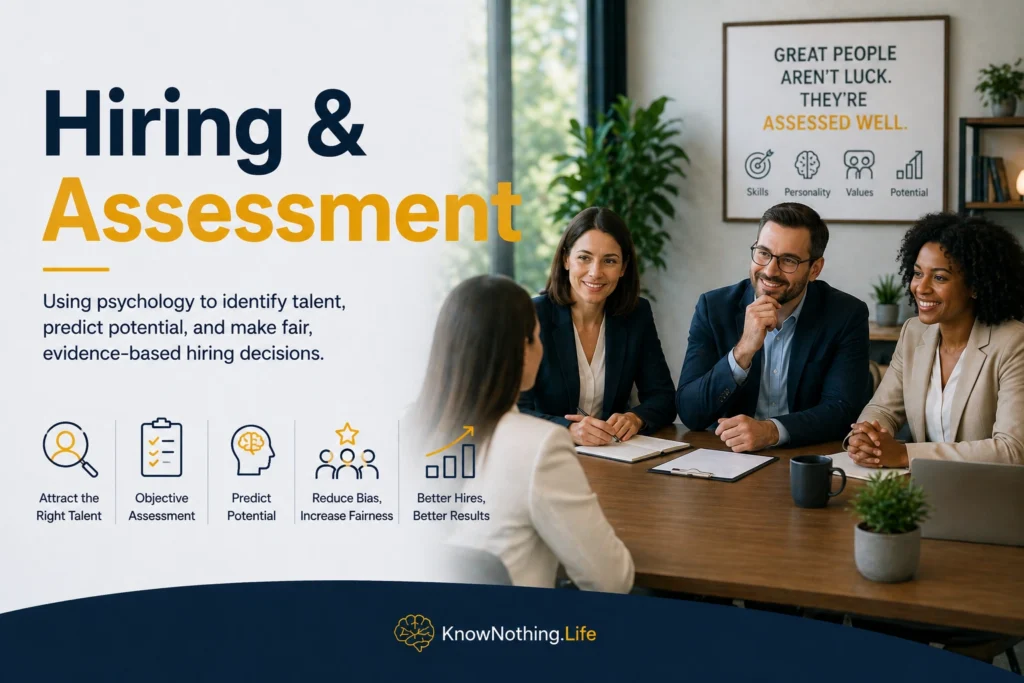
Hiring and assessment are foundational processes in organizational life, determining not only who enters an organization but how effectively its human capital aligns with strategic goals. These processes involve identifying, evaluating, and selecting individuals whose abilities, personalities, and values fit the demands of specific roles and the broader organizational culture. In modern industrial-organizational psychology, hiring is no longer viewed as a simple matching exercise but as a complex, evidence-based practice that integrates data, behavioral insight, and ethical considerations.
The stakes of hiring decisions are exceptionally high. Poor hiring can lead to reduced productivity, increased turnover, and negative impacts on team dynamics, while effective hiring enhances performance, innovation, and organizational cohesion. As early organizational psychologist Hugo Münsterberg argued in Psychology and Industrial Efficiency, “The right man in the right place is the first condition of efficiency.” This foundational insight continues to guide contemporary hiring practices, though it has been expanded to include considerations of diversity, adaptability, and long-term potential.
Historical Foundations of Hiring Practices
The scientific approach to hiring emerged in the early 20th century, particularly during World War I, when psychologists developed aptitude tests to assign soldiers to appropriate roles. These early efforts demonstrated the value of systematic assessment in predicting performance and laid the groundwork for modern personnel selection. Over time, hiring practices evolved from informal judgment to structured, research-based methods.
One of the most influential developments in this evolution was the use of standardized testing. Psychologists such as Alfred Binet pioneered the measurement of cognitive abilities, which later informed selection processes in organizations. However, early applications of testing were not without controversy, as concerns about fairness and bias emerged. These debates have shaped the ongoing development of hiring practices, emphasizing the need for validity, reliability, and ethical responsibility.
Job Analysis and Competency Modeling
Effective hiring begins with a clear understanding of the job itself. Job analysis is the systematic process of identifying the tasks, responsibilities, and requirements associated with a role. This process provides the foundation for all subsequent hiring decisions, ensuring that assessments are aligned with the actual demands of the job.
Modern approaches often incorporate competency modeling, which focuses on the skills, behaviors, and attributes required for success. Research by Frank L. Schmidt has emphasized the importance of aligning selection methods with job-relevant criteria, noting that “validity depends on the degree to which a test measures what it is intended to measure.” By clearly defining competencies, organizations can design more effective assessment tools and improve the accuracy of their hiring decisions.
Assessment Methods and Tools
A wide range of assessment methods is used in hiring, each with its strengths and limitations. Cognitive ability tests, personality assessments, structured interviews, and work samples are among the most commonly used tools. Cognitive tests have been shown to be strong predictors of job performance, particularly in complex roles, while personality assessments provide insight into traits such as conscientiousness and emotional stability.
Structured interviews, in which candidates are asked standardized questions and evaluated using consistent criteria, have gained prominence due to their reliability and fairness. Research by Robert P. Tett has highlighted the value of integrating multiple assessment methods to capture different aspects of performance. Work sample tests, which require candidates to perform tasks similar to those they would encounter on the job, provide a direct measure of capability. These diverse tools reflect the multifaceted nature of performance and the need for comprehensive evaluation.
Validity, Reliability, and Fairness
The effectiveness of hiring and assessment processes depends on their validity and reliability. Validity refers to the extent to which an assessment accurately predicts job performance, while reliability refers to the consistency of results over time and across different contexts. High-quality assessments must meet both criteria to ensure that hiring decisions are based on accurate and dependable information.
Fairness is another critical consideration, particularly in diverse and global workforces. Assessments must be free from bias and accessible to all candidates, regardless of background. Psychologist Lee J. Cronbach emphasized the importance of validity in psychological testing, noting that “one validates not a test, but an interpretation of data arising from a specified procedure.” This perspective highlights that assessment is not merely about tools but about how their results are interpreted and applied. Ensuring fairness and equity is essential for both ethical and practical reasons, as biased hiring practices can undermine organizational effectiveness.
The Role of Technology in Hiring
Advances in technology have transformed hiring and assessment processes, introducing new tools and methods for evaluating candidates. Online assessments, artificial intelligence, and data analytics are increasingly used to screen applicants, analyze responses, and predict performance. These technologies offer the potential for greater efficiency and scalability, allowing organizations to process large volumes of applications quickly.
However, the use of technology also raises important challenges, including concerns about privacy, transparency, and bias. Algorithms may inadvertently replicate existing biases if they are trained on biased data, leading to unfair outcomes. As organizational psychologist Daniel Kahneman has noted, “Algorithms are less biased than humans, but only when designed and used carefully.” This highlights the need for rigorous oversight and ethical guidelines in the use of technology. Balancing innovation with responsibility is a key challenge in modern hiring practices.
Person-Job and Person-Organization Fit
A central concept in hiring is the idea of fit, which refers to the alignment between an individual and the job or organization. Person-job fit focuses on the match between a candidate’s skills and the requirements of the role, while person-organization fit considers the alignment of values, culture, and goals. Both forms of fit are important for predicting performance and satisfaction.
Research has shown that employees who experience a strong sense of fit are more likely to perform well, remain with the organization, and experience higher levels of job satisfaction. However, an overemphasis on fit can also limit diversity by favoring candidates who resemble existing employees. As organizational scholar Benjamin Schneider argued, “The people make the place,” emphasizing that organizations are shaped by the individuals they select. Balancing fit with diversity is essential for creating dynamic and innovative workplaces.
Ethical and Legal Considerations
Hiring and assessment processes are subject to a range of ethical and legal considerations, reflecting their impact on individuals and society. Organizations must ensure that their practices comply with laws related to discrimination, privacy, and equal opportunity. Ethical guidelines emphasize the importance of transparency, informed consent, and the responsible use of assessment data.
The potential consequences of hiring decisions make ethical considerations particularly important. Candidates invest time and effort in the process, and outcomes can significantly affect their careers and well-being. As psychologist Stephen Jay Gould cautioned in The Mismeasure of Man, “The abstraction of intelligence as a single entity… has no validity,” warning against oversimplification and misuse of assessment tools. Ethical hiring practices require careful consideration of both the methods used and their broader implications.
Diversity, Inclusion, and Hiring
Diversity and inclusion have become central priorities in hiring, reflecting the recognition that diverse teams can enhance creativity, decision-making, and performance. Inclusive hiring practices aim to reduce bias and create opportunities for individuals from different backgrounds, ensuring that organizations benefit from a wide range of perspectives.
Strategies for promoting diversity include structured interviews, blind recruitment processes, and targeted outreach efforts. Research by Iris Bohnet has shown that “designing processes that reduce bias can lead to more equitable outcomes,” highlighting the importance of systemic approaches. By prioritizing inclusion, organizations can not only improve fairness but also enhance their overall effectiveness and innovation.
Future Directions in Hiring & Assessment
The future of hiring and assessment is likely to be shaped by ongoing advances in technology, data analytics, and psychological research. Personalized assessments, predictive modeling, and continuous evaluation are emerging as key trends, offering new ways to understand and support employees throughout their careers.
At the same time, there is growing recognition of the need to balance efficiency with human judgment. While data-driven approaches can enhance accuracy, they must be complemented by contextual understanding and ethical considerations. The integration of technology and human insight represents the next frontier in hiring, promising more effective and equitable outcomes.
Conclusion
Hiring and assessment are critical processes that shape the composition and success of organizations. By applying scientific principles and ethical practices, organizations can make informed decisions that enhance performance, support diversity, and promote fairness. From job analysis to advanced assessment tools, each stage of the hiring process contributes to the overall effectiveness of the organization.
Ultimately, successful hiring is not just about selecting the best candidate, but about creating a system that aligns individual potential with organizational goals. As the field continues to evolve, the integration of research, technology, and ethical responsibility will remain essential in shaping the future of work.