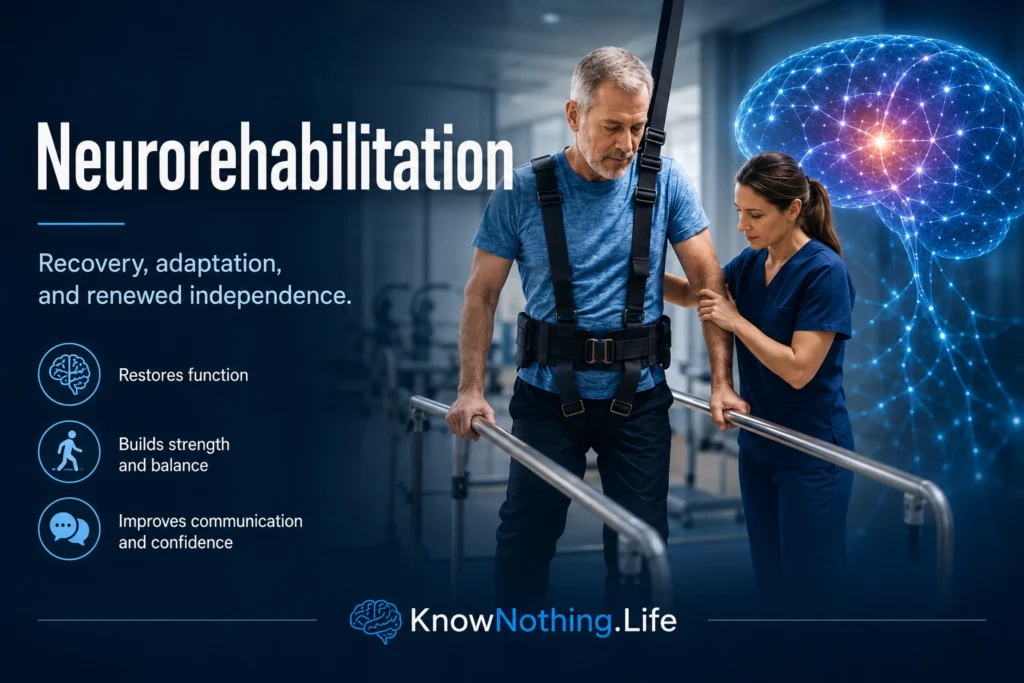
Neurorehabilitation is the coordinated treatment of people whose movement, communication, cognition, sensation, behavior, or independence has been affected by an injury or disease of the nervous system. It is used after stroke, traumatic brain injury, spinal cord injury, brain tumors, infections, and periods of reduced consciousness. It also helps people manage progressive conditions such as Parkinson’s disease, multiple sclerosis, amyotrophic lateral sclerosis, and dementia. The purpose is not limited to repairing damaged tissue. Neurorehabilitation seeks to improve what a person can do, reduce preventable complications, teach compensatory strategies, and restore participation in family, work, education, and community life.
A rehabilitation program may involve physicians, nurses, physical therapists, occupational therapists, speech-language pathologists, neuropsychologists, rehabilitation psychologists, social workers, dietitians, and specialists in assistive technology. The exact combination depends on the person’s impairments and goals. Someone recovering from a stroke may need gait training and aphasia therapy, while a person with spinal cord injury may need wheelchair skills, pressure-injury prevention, bowel and bladder management, and strategies for returning to work. The strongest programs connect medical stability with personally meaningful activities rather than treating isolated muscles or test scores.
Neuroplasticity and the Biology of Recovery
Neurorehabilitation is built partly on neuroplasticity, the nervous system’s capacity to alter its structure and function in response to experience. Recovery may occur through several processes. Swelling can resolve, temporarily suppressed tissue may regain function, surviving pathways can become more efficient, and other networks may assume part of the work previously performed by damaged regions. Rehabilitation does not simply “rewire the brain” on command, however. Plasticity is influenced by the location and severity of damage, age, attention, motivation, sleep, cardiovascular health, medications, and the type and amount of practice provided.
Training is generally most useful when it is repetitive, progressively challenging, and connected to the function being restored. Practicing grasping is more likely to improve practical hand use than performing unrelated movements, while repeated walking practice can strengthen the coordination required for gait. The EXCITE randomized trial demonstrated this principle by showing that constraint-induced movement therapy improved arm function among selected people three to nine months after stroke. The intervention combined intensive practice of the affected arm with reduced reliance on the less affected limb, addressing the learned tendency to avoid difficult movement.
Assessment, Goals, and Individualized Treatment
Rehabilitation begins with an assessment of the person rather than the diagnosis alone. Clinicians evaluate strength, muscle tone, balance, coordination, sensation, vision, speech, swallowing, memory, attention, mood, pain, fatigue, and daily functioning. They also consider the home environment, caregiver support, transportation, employment demands, and the activities the person values. Two patients with similar brain scans may require very different programs because one wants to return to a physically demanding job while another needs to communicate more effectively or remain safely independent at home.
Goals should be specific enough to guide treatment but flexible enough to change as recovery unfolds. Early priorities may include preventing falls, aspiration, blood clots, pressure injuries, contractures, and severe deconditioning. Later treatment may focus on walking outdoors, preparing meals, driving, using technology, managing finances, or returning to school. Progress is measured through impairment scales and performance tests, but meaningful recovery also includes confidence, social participation, emotional adjustment, and reduced dependence on caregivers. A small change in walking speed or hand control can be important if it allows someone to cross a street safely or dress without assistance.
Stroke Rehabilitation and the Importance of Timing
Stroke is one of the most extensively studied areas of neurorehabilitation. Treatment may address weakness, spasticity, balance loss, visual neglect, sensory changes, aphasia, swallowing difficulty, cognitive impairment, depression, and fatigue. Recovery often proceeds fastest during the early weeks and months, but improvement can continue later when patients receive appropriately targeted practice. The existence of an early period of heightened responsiveness does not mean that recovery becomes impossible once that period has passed.
The timing and intensity of treatment require balance. The AVERT trial examined very early, frequent mobilization beginning within 24 hours of stroke and found that the intensive protocol produced less favorable outcomes than usual care. The findings challenged the assumption that beginning more activity sooner is always better. Patients need movement, but the dose must reflect medical stability and neurological tolerance.
The LEAPS trial produced another important result. Body-weight-supported treadmill training was not superior to a structured home exercise program delivered by a physical therapist for restoring walking after stroke. All groups improved, and approximately half of the participants increased their functional walking ability. The trial demonstrated that specialized equipment does not automatically outperform well-designed, progressive practice. It also emphasized that accessible treatment can be effective when it provides sufficient repetition, progression, supervision, and attention to the individual’s limitations.
Cognitive, Language, and Behavioral Rehabilitation
Neurological injury can impair abilities that are less visible than paralysis. Problems with attention, memory, processing speed, planning, self-monitoring, language, emotional control, and social judgment may prevent a person from returning to work or maintaining relationships even when physical recovery appears strong. Cognitive rehabilitation may attempt to restore impaired skills through structured exercises, but it also teaches compensatory methods such as calendars, written routines, alarms, environmental modifications, and step-by-step problem-solving systems.
A randomized trial led by Joseph Cicerone found that holistic neuropsychological rehabilitation improved community integration and quality of life after traumatic brain injury compared with standard rehabilitation. The program combined cognitive remediation with emotional regulation, interpersonal skills, functional activities, and group treatment. Its significance lies in treating cognition within real life rather than as a collection of isolated test performances.
Speech-language therapy follows a similar functional approach. Treatment may address word retrieval, sentence production, comprehension, reading, writing, speech-motor control, or the use of communication devices. Research shows that people with chronic post-stroke aphasia can improve years after the original injury. A multicenter randomized trial led by Caterina Breitenstein found that intensive speech and language therapy improved verbal communication in everyday situations among people with chronic aphasia. However, the VERSE trial found that substantially increasing very early aphasia therapy did not produce better communication outcomes than high-quality usual care, again showing that intensity must be considered alongside timing, treatment content, and patient tolerance.
Spinal Cord Injury and Activity-Based Rehabilitation
Neurorehabilitation after spinal cord injury involves much more than attempting to restore walking. Programs address mobility, transfers, wheelchair use, skin protection, respiratory health, pain, spasticity, sexual function, bowel and bladder management, autonomic complications, and community participation. The degree of neurological recovery depends heavily on the level and completeness of the injury, but rehabilitation can substantially improve independence even when the damaged spinal cord does not regain its previous function.
Locomotor training uses repetitive stepping, partial body-weight support, manual assistance, robotic devices, or overground practice to activate spinal and supraspinal movement systems. The Spinal Cord Injury Locomotor Trial found that body-weight-supported treadmill training did not produce significantly better walking outcomes than a defined overground mobility program among people with incomplete injuries. Both groups improved, suggesting that repeated task-specific walking practice may matter more than one particular delivery system.
Later research has continued to explore whether greater intensity can improve outcomes in chronic injury. A randomized study led by Michael Jones found that an intensive activity-based program improved motor scores, walking speed, and endurance in people with chronic motor-incomplete spinal cord injury compared with delayed treatment. The average improvements did not guarantee meaningful benefit for every participant, but they challenged the idea that recovery becomes completely fixed after the first year.
Robotics, Electrical Stimulation, and Neuromodulation
Technology can increase repetition, provide feedback, reduce physical assistance, or help patients perform movements that would otherwise be impossible. Robotic devices guide the arm or legs through controlled patterns, while functional electrical stimulation activates peripheral nerves to produce grasping, ankle dorsiflexion, cycling, or stepping. Brain-computer interfaces detect neural signals related to movement intention and translate them into device commands or sensory feedback. These tools are most useful when they support goal-directed practice rather than replacing active participation.
Evidence remains mixed. The large RATULS trial found that robot-assisted upper-limb training did not improve function more than usual care after stroke, despite providing highly repetitive movement. This result demonstrates that repetition alone may be insufficient when movement lacks appropriate difficulty, sensory feedback, motivation, or relevance to daily tasks.
Other technologies attempt to amplify the nervous system’s response to training. In the VNS-REHAB trial, implanted vagus nerve stimulation paired with upper-limb exercises produced greater improvement than rehabilitation paired with sham stimulation in people with chronic arm weakness after ischemic stroke. The stimulation was delivered during successful movements, with the intention of strengthening task-related plasticity. The treatment requires surgery and is not appropriate for every patient, but it provides evidence that neuromodulation can enhance the effects of carefully structured rehabilitation.
The Future of Neurorehabilitation
Future neurorehabilitation will likely become more adaptive and biologically informed. Wearable sensors can measure movement outside the clinic, while home-based platforms can provide exercises, feedback, and remote supervision. Brain imaging, electrophysiology, digital performance data, and blood biomarkers may eventually help identify which patients are most likely to respond to a particular treatment. Brain-computer interfaces and closed-loop stimulation systems may connect movement intention with robotic assistance, electrical stimulation, or sensory feedback, especially for patients with severe paralysis.
Technology will not remove the need for human care. Recovery is shaped by fatigue, fear, depression, pain, identity, family relationships, economic resources, and opportunities to use regained abilities in ordinary life. A device may improve movement during a laboratory test without helping a person cook, work, communicate, or participate in the community. The central challenge is therefore not simply to produce more neural activity but to turn biological change into meaningful independence.
Neurorehabilitation works best when it combines scientific evidence with individualized goals, sufficient practice, medical oversight, and long-term support. It recognizes both the adaptability and the limitations of the injured nervous system. Not every function can be fully restored, but carefully designed rehabilitation can help people recover abilities, develop effective alternatives, prevent secondary complications, and construct satisfying lives after neurological injury or disease.