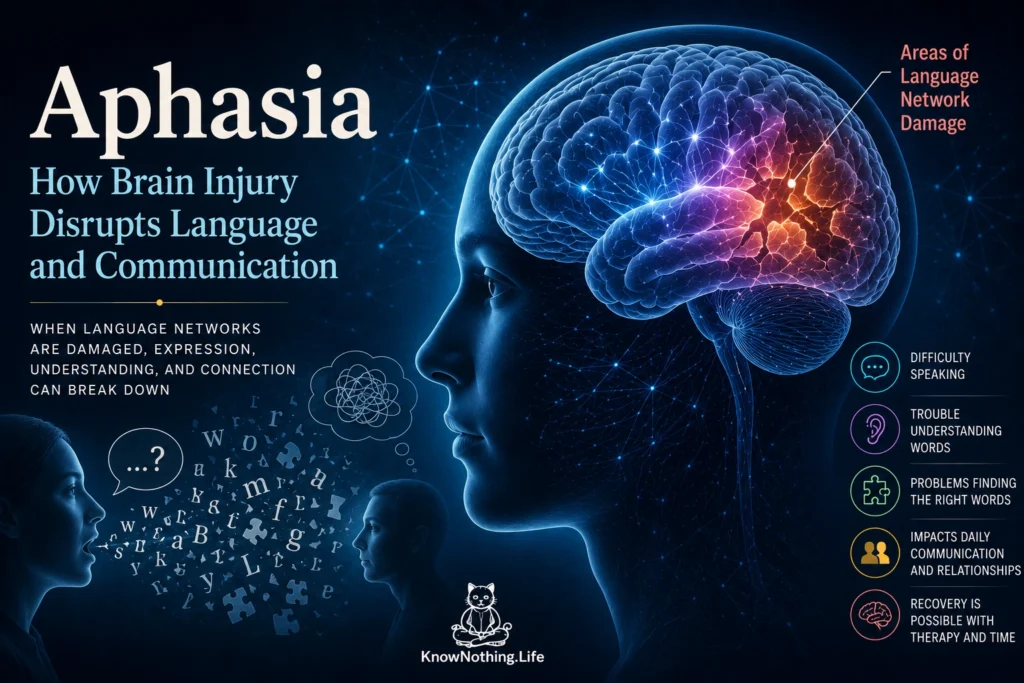
Aphasia is an acquired language disorder caused by damage to brain systems that support speaking, understanding, reading, and writing. It may interfere with retrieving a familiar word, constructing a sentence, following conversation, repeating a phrase, or interpreting written material. Aphasia does not mean that a person has lost intelligence or ideas. The central difficulty is accessing or organizing language after the neural network that supported it has been injured.
Stroke is the most common cause, especially when damage occurs in the language-dominant left hemisphere. In a prospective study of 881 people with acute stroke, Peder Pedersen and colleagues found aphasia in 38 percent at admission, although the proportion declined as early recovery occurred. Aphasia may also follow traumatic brain injury, tumors, infection, or other neurological damage. Primary progressive aphasia emerges gradually as neurodegeneration selectively affects language systems, as Marsel Mesulam established in 1982.
Language Is a Distributed Brain Function
Classical accounts divided language between Broca’s area for production and Wernicke’s area for comprehension. Those regions remain important landmarks, but modern lesion studies show that language depends on interacting frontal, temporal, parietal, subcortical, and white-matter systems. Daniel Mirman and colleagues studied 99 people with chronic post-stroke aphasia and identified partly separable systems for speech production, speech perception, semantic processing, and verbal working memory rather than two isolated centers.
The pattern and severity of aphasia depend on lesion size, location, damaged connections, and surviving tissue. Leonardo Bonilha and colleagues found that fragmentation of residual left-hemisphere white-matter networks predicted chronic aphasia severity even after lesion volume was considered. Cortical-stimulation research has likewise shown that essential language sites often function as connectors between subnetworks. This helps explain why similar-looking strokes may produce different symptoms and why a small lesion can be highly disruptive when it damages a strategic pathway.
Major Types and Symptoms
Clinicians traditionally describe aphasia using patterns such as Broca’s, Wernicke’s, conduction, global, transcortical, and anomic aphasia. Broca’s aphasia usually involves effortful, reduced speech; Wernicke’s aphasia fluent but error-filled speech and impaired understanding; conduction aphasia difficulty repeating; and global aphasia severe impairment across several abilities. Anomic aphasia is dominated by word-retrieval difficulty. These labels are useful summaries, but many people show mixed or changing symptoms that do not fit one category.
Modern voxel-based lesion–symptom mapping revealed why these boundaries are imperfect. In 2003, Elizabeth Bates and colleagues related damage at each brain voxel to performance in 101 people with left-hemisphere injury. The findings supported broad anterior–posterior differences while showing that multiple interacting regions contribute to fluency and comprehension. Aphasia is therefore better understood as an individual profile across naming, grammar, sound processing, meaning, repetition, reading, writing, and connected speech.
Word Finding, Grammar, and Meaning
Anomia, or difficulty retrieving words, is among the most common symptoms. A person may recognize an object and know its purpose yet remain unable to name it. The word may appear after a sound or meaning cue, emerge later, or be replaced by a related term. Other errors alter sounds inside a word. These differences can reflect disruption at distinct stages between conceptual knowledge, lexical selection, phonological assembly, and articulation.
Sentence problems can be equally important. Some people omit grammatical words and endings, creating short, effortful expressions, while others produce long, fluent sentences that are difficult to understand. Comprehension may remain adequate for familiar words and simple commands yet decline with unusual word order, embedded clauses, or competing interpretations. Mirman and colleagues separated semantic recognition, speech recognition, speech production, and verbal short-term memory into related but distinguishable components.
Reading, Writing, and Daily Life
Aphasia extends beyond conversation. Reading may become slow or inaccurate, familiar written words may lose meaning, and spelling may deteriorate even when the hand can form letters. Some people understand individual words but struggle with paragraphs; others comprehend writing more successfully than speech. Writing may contain missing words, sound-based spelling errors, grammatical omissions, or difficulty organizing a message. Spoken and written language overlap in the brain but also depend on partly distinct systems.
The consequences affect relationships, employment, independence, and identity. In a multicenter follow-up study, Jean-Michel Mazaux and colleagues found that stroke survivors with aphasia frequently struggled with strangers, abstract conversations, telephone calls, administrative documents, money-related tasks, and communication outside the home. Marja-Liisa Kauhanen and colleagues also documented high rates of depression after post-stroke aphasia. Progress cannot be measured only by naming scores; emotional health, social participation, and successful everyday exchanges also matter.
Diagnosis and Primary Progressive Aphasia
Assessment examines spontaneous speech, comprehension, naming, repetition, reading, writing, gesture, speech-motor control, attention, and realistic communication. Brain imaging helps identify stroke, hemorrhage, tumor, degeneration, or another cause. Evaluation must also consider hearing, vision, education, literacy, culture, and every language used by a multilingual person. Its purpose is not merely to assign a label but to determine which stages of language processing remain available and where communication breaks down.
Primary progressive aphasia differs from post-stroke aphasia because language declines gradually rather than being lost suddenly. Mesulam’s original patients developed worsening word finding, comprehension, reading, and writing while other cognitive abilities remained relatively preserved for years. In 2004, Maria Luisa Gorno-Tempini and colleagues identified nonfluent, semantic, and logopenic presentations associated with distinguishable cognitive and anatomical patterns. Therapy and assistive communication cannot reverse the degeneration, but they can help preserve participation and prepare for changing needs.
Recovery and Brain Plasticity
The largest spontaneous gains often occur during the first weeks and months after stroke, but improvement can continue for years. Pedersen and colleagues found that initial severity strongly influenced recovery, with mild aphasia tending to stabilize earlier than severe aphasia. Improvement reflects restoration in temporarily suppressed tissue, resolution of swelling, better circulation, learning, compensation, and reorganization among surviving regions. Severity shapes prognosis, but it does not establish an absolute limit on progress.
Recovery is not simply the movement of language from the damaged left hemisphere to a matching area on the right. Depending on the lesion and recovery stage, useful activity may involve surviving left-hemisphere tissue, regions surrounding the lesion, right-hemisphere homologues, and cognitive-control networks. Longitudinal imaging research indicates that these changes reflect a mixture of neural reorganization and altered blood-flow responses, so brain activation must be interpreted together with actual communication performance.
Speech-Language Therapy
Speech-language therapy is the central treatment for aphasia. It may target word retrieval, sentence construction, comprehension, reading, writing, practiced scripts, or alternative communication. Therapy can also train relatives and caregivers to slow conversations, confirm meaning, use writing or pictures, and allow sufficient response time. Effective rehabilitation connects a defined impairment to personally meaningful goals, because producing a word correctly during an exercise is not identical to using it successfully in conversation.
Evidence shows that people can benefit during the chronic stage. In a 2017 multicenter randomized trial, Caterina Breitenstein and colleagues found that three weeks of intensive therapy improved everyday verbal communication in people who had lived with post-stroke aphasia for at least six months. The Big CACTUS trial later showed that self-managed computerized therapy improved retrieval of practiced words, although those gains did not automatically improve functional conversation. Treatment must address both the impaired process and the situations in which communication matters.
Timing, Technology, and the Human Meaning of Aphasia
More therapy is not automatically better at every stage. The VERSE randomized trial tested very early, intensive treatment after stroke and found no superior communication outcome over usual care when the extra protocol was added. This does not mean early rehabilitation lacks value. It shows that dose, timing, fatigue, medical stability, and spontaneous recovery must be considered together. Computerized exercises, teletherapy, apps, and brain-stimulation methods may expand rehabilitation, but they work best as additions to individualized care.
Aphasia reveals that language is both a cognitive system and a foundation of social life. Brain damage may interrupt the route between thought and expression without erasing intelligence, memory, personality, or emotional depth. Modern understanding has moved beyond rigid categories and isolated language centers toward networks, individual profiles, and meaningful participation. Successful care should aim not only to improve test performance but also to restore conversation, relationships, autonomy, confidence, and a public voice.