Language disorders are persistent difficulties understanding or using a system of words, sentences, and meanings. They may affect spoken language, written language, signed language, or several forms of communication at once. A person may struggle to learn new vocabulary, follow explanations, construct grammatical sentences, organize a story, interpret implied meaning, or retrieve familiar words. These problems are not evidence of low intelligence or a lack of ideas. They reflect difficulty accessing, processing, or organizing language efficiently enough for everyday communication, education, work, or relationships.
Language disorders must be distinguished from speech disorders. Speech concerns the physical production and fluency of sounds, while language concerns the symbolic system used to communicate meaning. Childhood apraxia of speech, dysarthria, stuttering, and some speech sound disorders can occur even when vocabulary and grammar are relatively intact. Conversely, a child may pronounce words clearly but have serious difficulty understanding sentences or expressing ideas. The CATALISE consortium recommended using “language disorder” when difficulties are likely to persist and produce a significant functional impact, placing everyday communication above performance on any single standardized test.
How Language Difficulties Appear
Language contains several interacting domains. Vocabulary involves learning and retrieving words, while morphology concerns meaningful word parts such as plural endings and verb tense. Syntax organizes words into sentences, semantics supports meaning, and pragmatics governs how language is adapted to social situations. Narrative language allows people to explain events, connect causes and consequences, introduce characters, and maintain a coherent topic. A language disorder may affect one domain strongly or create smaller difficulties across several domains. The resulting profile often changes as linguistic demands become more complex.
Signs also vary with age. A young child may begin talking late, use few words, rely on short sentences, or misunderstand instructions. A school-aged child may have trouble learning vocabulary, following classroom discussion, understanding complex grammar, retelling a story, or explaining how an answer was reached. Adolescents and adults may struggle with figurative language, rapid conversation, written assignments, unfamiliar terminology, and the organization of detailed explanations. Because language demands increase with age, a difficulty that initially seems mild may become more visible when school, work, or social relationships require greater speed and precision.
Developmental Language Disorder
Developmental language disorder, commonly abbreviated DLD, is diagnosed when significant language difficulties arise during development, are likely to persist, and are not explained by a known biomedical condition. Earlier terms included specific language impairment, language delay, and developmental dysphasia, but inconsistent terminology made research and public awareness difficult. The CATALISE panel recommended DLD as the shared term for persistent developmental difficulties without a differentiating biomedical cause. Language disorder associated with autism, Down syndrome, hearing loss, intellectual disability, or another identified condition is described by naming that associated condition rather than excluding the person from the broader category of language disorder.
DLD is common but frequently unrecognized. Courtenay Norbury and colleagues assessed children entering school and estimated that approximately 7.6 percent had language disorder without a known biomedical cause. This is roughly two children in an average classroom, although prevalence varies with the criteria and assessments used. DLD can affect both comprehension and expression, and it often continues beyond early childhood. A child who eventually speaks in complete sentences may still experience difficulties with advanced vocabulary, grammatical complexity, verbal memory, narrative organization, reading comprehension, or communication under pressure.
Causes, Genetics, and the Language Network
There is no single cause of most developmental language disorders. Language development depends on genetic variation, prenatal and early development, hearing, attention, memory, neural plasticity, environmental opportunity, and access to understandable communication. Family and twin studies indicate that inherited differences contribute to language ability, but common language disorders generally have a complex genetic structure involving many variants with small effects. A study of more than 46,000 individuals led by Ron Nudel identified one genome-wide significant locus but did not support a simple genetic explanation, illustrating the heterogeneity of DLD.
Rare mutations can produce severe speech and language conditions, but they should not be treated as explanations for DLD as a whole. Cecilia Lai and colleagues identified a damaging FOXP2 variant in members of the KE family, who experienced serious difficulties with speech-motor sequencing as well as broader linguistic abilities. The discovery was important because it connected a transcription-regulating gene to developing neural systems involved in communication. FOXP2 is not a “language gene,” however, and rare FOXP2-related disorders differ from the more common, polygenic forms of language difficulty found across the population.
Language Disorders and the Brain
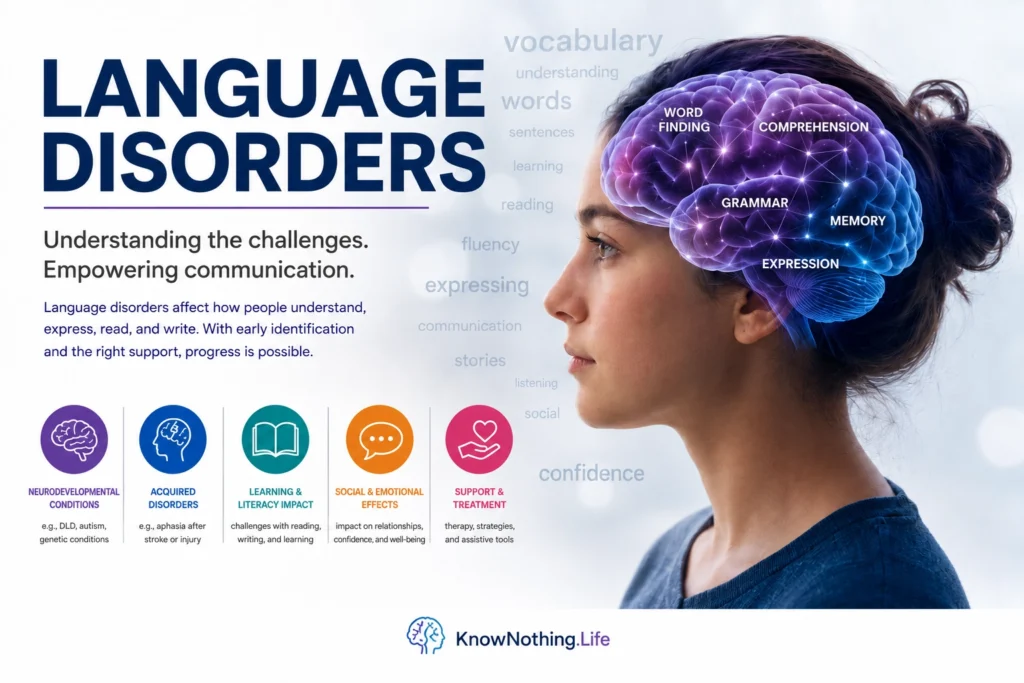
Language depends on a distributed network rather than one isolated brain center. Frontal regions contribute to sentence formulation, selection, sequencing, and speech planning. Temporal regions support speech recognition, vocabulary, conceptual knowledge, and the integration of meaning. Parietal regions and white-matter pathways help connect sounds, words, attention, memory, reading, and motor planning. Subcortical structures and the cerebellum also contribute to timing, learning, and coordination. A developmental language disorder may reflect subtle differences across networks and developmental processes rather than a clearly visible lesion.
Research on adults with acquired aphasia demonstrates how partly separable language operations are organized. Daniel Mirman and colleagues used lesion-symptom mapping to identify major divisions between meaning and phonological form and between language recognition and production. Phonological difficulties were associated primarily with damage around the Sylvian fissure, while different semantic impairments were linked to anterior temporal tissue and connections with frontal cortex. Although developmental disorders cannot simply be equated with adult brain injury, these findings show why vocabulary, comprehension, sound processing, and production can be affected in different combinations.
Assessment and Diagnosis
A comprehensive assessment examines more than the number of words a person knows. Speech-language pathologists may evaluate comprehension, vocabulary, grammar, sentence repetition, narrative skills, conversational communication, phonological processing, reading, writing, and the ability to learn when given support. Hearing should be considered because reduced access to sound can affect language development. Clinicians may also examine speech production, attention, memory, educational history, developmental milestones, and communication in real situations. Standardized scores are useful, but diagnosis depends on whether the overall pattern creates persistent functional difficulty.
Multilingualism does not cause a language disorder. Multilingual children distribute knowledge across their languages and may not perform like monolingual speakers on a test administered in only one language. A genuine developmental disorder should affect the person’s capacity to learn and use language across their linguistic experience, even though symptoms may look different in each language. Johanne Paradis and colleagues found that combining a parent questionnaire with sentence-repetition and nonword-repetition tasks helped distinguish bilingual children with DLD from bilingual children undergoing typical second-language development. Assessment should therefore consider every language used, the amount and quality of exposure, and opportunities to learn each one.
Educational, Social, and Lifelong Effects
Language is central to learning because teachers communicate knowledge largely through explanations, questions, discussion, and written text. A student with DLD may understand a concept when it is demonstrated visually but struggle to explain it verbally or interpret a complex written question. Difficulties with vocabulary, grammar, phonological processing, and narrative structure can increase the risk of problems in reading, spelling, and written composition. Longitudinal research by Ingrid Schoon and colleagues found that receptive language problems at age five were associated with weaker adult literacy, although family resources and the early literacy environment also influenced outcomes.
The effects extend beyond academic achievement. Fast conversation requires people to interpret words, tone, implied intentions, and changing topics while planning a response. Someone who needs more processing time may be perceived as inattentive, uncooperative, shy, or uninterested. Language difficulties can complicate friendship, conflict resolution, emotional expression, and access to mental-health care. Studies following young people with DLD have found increased risks of social, emotional, and behavioral difficulties, though outcomes vary greatly and are shaped by literacy, peer relationships, support, and the severity of the language impairment.
Acquired Language Disorders
Language can also be disrupted after it has developed normally. Aphasia commonly follows a stroke affecting the language-dominant hemisphere, but it can also result from traumatic brain injury, tumors, infection, or other neurological damage. Depending on the injured network, a person may experience impaired naming, sentence production, comprehension, repetition, reading, or writing. Fluent speech does not necessarily mean intact language, and reduced speech does not necessarily indicate reduced understanding. Aphasia represents disruption of access to language, not the erasure of intelligence, personality, or knowledge.
Primary progressive aphasia differs because language abilities decline gradually as neurodegenerative disease affects the language network. In 1982, Marsel Mesulam described patients whose word finding, comprehension, reading, and writing progressively deteriorated while other abilities remained comparatively preserved during the early stages. Developmental language disorder, post-stroke aphasia, and primary progressive aphasia can produce superficially similar symptoms, but they have different timelines, causes, and treatment goals. Careful history and neurological evaluation are therefore essential whenever an adult develops new or worsening language difficulty.
Treatment and Communication Support
Treatment is most effective when it targets the individual’s language profile and everyday needs. A child may receive direct teaching in vocabulary, grammar, sentence comprehension, storytelling, phonological processing, or conversational strategies. Explicit instruction can make language patterns visible rather than expecting them to be learned incidentally. Controlled research has found benefits from focused grammatical interventions, while broader evidence reviews support combining universal classroom practices, targeted group instruction, and individualized therapy according to the severity and persistence of need.
Support should also change the communication environment. Teachers can use clear instructions, visual aids, repetition, vocabulary previews, written summaries, and additional processing time. Families and communication partners can confirm meaning without repeatedly correcting every error, reduce unnecessary verbal complexity, and provide several ways to respond. Adults with acquired or progressive disorders may benefit from word-retrieval therapy, communication-partner training, scripts, writing, gesture, picture systems, or electronic communication aids. The goal is not merely a higher test score. Effective care improves participation, independence, relationships, education, and the person’s ability to communicate what they know and experience.