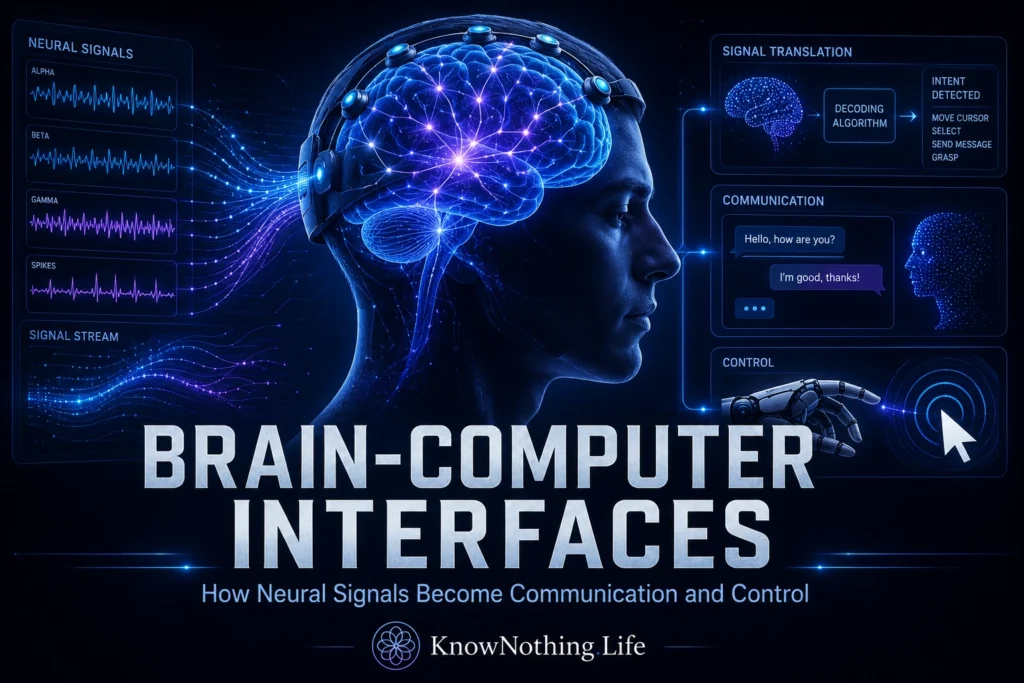
A brain-computer interface, or BCI, is a system that detects patterns of neural activity and converts them into commands for a computer, communication device, prosthetic limb, wheelchair, or other technology. Unlike a keyboard, touchscreen, or voice assistant, a BCI can create a direct channel between the nervous system and an external device without requiring ordinary muscular movement. This makes the technology especially valuable for people whose ability to speak or move has been disrupted by amyotrophic lateral sclerosis, stroke, spinal cord injury, brainstem injury, or another neurological condition.
Jonathan Wolpaw and colleagues defined a BCI as a communication or control system that does not depend on the brain’s normal output pathways through peripheral nerves and muscles. A typical system records neural activity, processes the signal, extracts useful features, estimates the user’s intended action, and sends the resulting command to an application. The user also receives feedback and gradually learns how to operate the interface. A BCI is therefore not simply a device that “reads the brain.” It is a closed interaction in which the person and the computer adapt to one another over time.
How Brain-Computer Interfaces Record Neural Activity
BCIs can be classified according to how closely their sensors are placed to the brain. Noninvasive systems record from outside the skull, usually through electroencephalography, or EEG. EEG headsets detect small voltage changes produced by populations of neurons and are relatively inexpensive, portable, and safe. They can identify broad patterns associated with attention, visual responses, imagined movement, or changes in brain rhythm. The skull and scalp weaken and blur these signals, however, limiting the amount of detailed information that can be extracted.
Invasive interfaces obtain stronger signals through electrodes positioned on the brain’s surface or inserted into cortical tissue. Electrocorticography uses grids or strips placed beneath the skull, while intracortical arrays record from small populations of neurons. These approaches can support faster and more precise control, but they require surgery and introduce risks involving infection, bleeding, inflammation, tissue response, and hardware failure. Partially invasive devices can also be placed through blood vessels near the brain, potentially reducing the need for open neurosurgery. Each method involves a tradeoff among signal quality, surgical risk, portability, durability, and the complexity of the intended task.
The Development of BCI Communication
Some of the earliest communication BCIs relied on event-related brain responses rather than attempted speech. In 1988, Lawrence Farwell and Emanuel Donchin introduced the P300 speller, which presented letters in a flashing grid. When the letter a user wanted to select appeared, it generated a measurable electrical response approximately 300 milliseconds later. By identifying which stimulus produced that response, the system could infer the desired character. The method was slow, and its accuracy depended on sustained attention and reliable visual perception, but it demonstrated that brain activity could create a practical communication channel without physical typing.
Later interfaces used imagined movement or attempted hand movements to control a cursor and select letters on a screen. A fully implanted system described by Mariska Vansteensel and colleagues in 2016 enabled a woman with late-stage ALS to operate communication software independently at home by intentionally attempting hand movements. A subsequent report documented seven years of home use before declining neural signals associated with disease progression eventually made the interface ineffective. The case demonstrated both the possibility of sustained independent BCI use and the importance of understanding how changing brain conditions affect long-term performance.
Speech Neuroprostheses
Speech BCIs attempt to decode the neural processes that would normally guide movements of the tongue, lips, jaw, larynx, and respiratory system. A person who can no longer produce audible speech may still generate organized activity in cortical areas involved in planning attempted words. Machine-learning models can be trained to recognize these patterns and transform them into text, synthesized sound, or facial movements on a digital avatar. Because spoken communication is much faster than selecting individual letters, speech decoding could provide a more natural way for people with severe paralysis to participate in conversations.
In 2023, Francis Willett and colleagues reported a system that decoded attempted speech from intracortical recordings at an average of 62 words per minute using a vocabulary of approximately 125,000 words. Sean Metzger and colleagues separately demonstrated a surface-electrode system that translated neural activity into text, synthesized speech, and movements of an animated face. In 2024, Nicholas Card and colleagues described a rapidly calibrated speech neuroprosthesis for a man with ALS that reached high accuracy after limited training. These systems represent major progress, but each was personalized for a specific participant and depended on deliberate attempts to speak. They were not universal mind-reading devices.
Restoring Movement and Computer Control
Motor BCIs decode activity associated with intended movements and use it to control a cursor, robotic arm, powered wheelchair, or the person’s own muscles. A landmark 2006 study led by Leigh Hochberg showed that movement-related signals remained detectable in the motor cortex of a person with tetraplegia years after spinal cord injury. The participant used an implanted array to control a computer cursor and simple external devices. The study established that paralysis does not necessarily erase the cortical activity associated with movement intention, allowing a computer to route those signals around damaged spinal pathways.
Motor control became increasingly sophisticated as recording and decoding methods improved. Jennifer Collinger and colleagues reported that a woman with tetraplegia learned to control a robotic arm across seven dimensions, including three-dimensional movement, wrist orientation, and grasping. Other systems have translated cortical activity into electrical stimulation of paralyzed muscles, allowing users to reach, grasp, drink, or feed themselves. These technologies do not repair the original spinal injury. Instead, they build an artificial connection between the brain’s movement commands and a robotic device or muscle-stimulation system.
Adding a Sense of Touch
Vision alone provides incomplete information for controlling a prosthetic limb. Natural movement also depends on touch, pressure, joint position, and knowledge of how firmly an object is being held. Without these sensations, users must watch every movement carefully and may crush, drop, or mishandle objects. Bidirectional BCIs seek to solve this problem by recording motor intentions while delivering artificial sensory feedback to the brain. Sensors on a prosthetic hand can measure contact and trigger electrical stimulation in the somatosensory cortex.
Sharlene Flesher and colleagues showed in 2016 that intracortical stimulation could produce sensations experienced in specific areas of the hand by a participant with spinal cord injury. A later study combined motor control with artificial touch, demonstrating that tactile feedback allowed faster performance in object-transfer tasks than vision alone. The sensations created by stimulation are not identical to natural touch, but they can provide useful information about contact, location, and movement. Bidirectional systems illustrate how future neuroprostheses may function less like remote-controlled tools and more like integrated extensions of the user’s body.
Machine Learning and the Adaptive Interface
Neural signals are variable. Electrode positions can shift slightly, individual neurons may change their firing patterns, scar tissue can affect recording quality, and the user’s brain state changes with fatigue, medication, emotion, and practice. A decoder trained during one session may therefore become less accurate later. Research on chronic intracortical interfaces has documented gradual instability in the relationship between recorded activity and intended movement, creating a major obstacle to dependable everyday use.
Machine learning allows the system to identify complex patterns and adapt when those patterns change. Language models can help speech BCIs correct probable decoding errors, just as predictive text assists ordinary typing. Adaptive algorithms can recalibrate cursor movement, distinguish intentional commands from noise, and combine several sources of neural information. The user is learning at the same time, discovering mental strategies that generate more consistent signals. The most successful BCI is therefore a partnership between biological plasticity and computational adaptation rather than a computer passively extracting a fixed code from the brain.
BCIs Are Not General Thought Readers
Public discussions frequently describe BCIs as devices that read thoughts, but this wording exaggerates present capabilities. Most systems decode narrowly defined signals such as attempted hand movement, attention to a flashing character, or the motor planning involved in attempted speech. They require individual calibration, controlled recording conditions, and active participation. A speech prosthesis does not normally reveal every sentence passing through a person’s mind; it recognizes patterns associated with an intentional effort to communicate.
The distinction matters because neural activity is context-dependent and distributed. The same region may contribute to several movements or cognitive operations, and similar intentions can produce variable activity across trials. Machine-learning systems also make probabilistic predictions rather than directly observing meaning. BCIs can infer selected features of intention with impressive accuracy under appropriate conditions, but claims about silently extracting unrestricted memories, beliefs, or private inner speech remain far beyond the evidence demonstrated by current clinical systems.
Privacy, Consent, and Device Abandonment
BCIs generate some of the most sensitive forms of personal information. Neural recordings may reveal health conditions, attempted actions, communication, fatigue, or responses that were not central to the original purpose of the device. When artificial intelligence is used to interpret these signals, future algorithms may extract information that was not recognizable when the data was collected. Strong protections are needed for storage, cybersecurity, secondary research, commercial reuse, deletion, and access to the models trained on an individual’s neural activity.
Implanted devices also create responsibilities extending beyond a clinical trial. Hardware may require repair, software updates, specialist programming, battery replacement, and medical monitoring for many years. A 2024 consensus statement defined neurological-device abandonment to include failures to provide necessary information or reasonable medical, technical, and financial support. UNESCO’s 2025 Recommendation on the Ethics of Neurotechnology likewise emphasized mental privacy, autonomy, informed consent, fairness, and protection against coercive uses. A BCI should not restore independence temporarily only to leave the user dependent on unsupported equipment.
The Future of Brain-Computer Interfaces
The future of BCIs will likely involve smaller wireless implants, more durable electrodes, faster decoders, artificial sensory feedback, and systems that combine speech, cursor control, and environmental access. A 2026 report described extended independent use of a multimodal intracortical system that supported both brain-to-text communication and computer cursor control outside the laboratory. Such progress is important because clinical value depends less on a spectacular one-day demonstration than on whether a person can reliably use the system at home, at work, and in ordinary conversation.
Brain-computer interfaces remain experimental, and their most important near-term purpose is restoration rather than enhancement. They may return a voice to someone unable to speak, give computer access to a person unable to use their hands, or reconnect movement intentions with paralyzed muscles. Technical progress must be matched by surgical safety, long-term reliability, affordability, privacy protections, user-centered design, and continuing care. The ultimate measure of a BCI is not how closely it resembles science fiction, but whether it gives people greater control over communication, movement, relationships, and daily life.