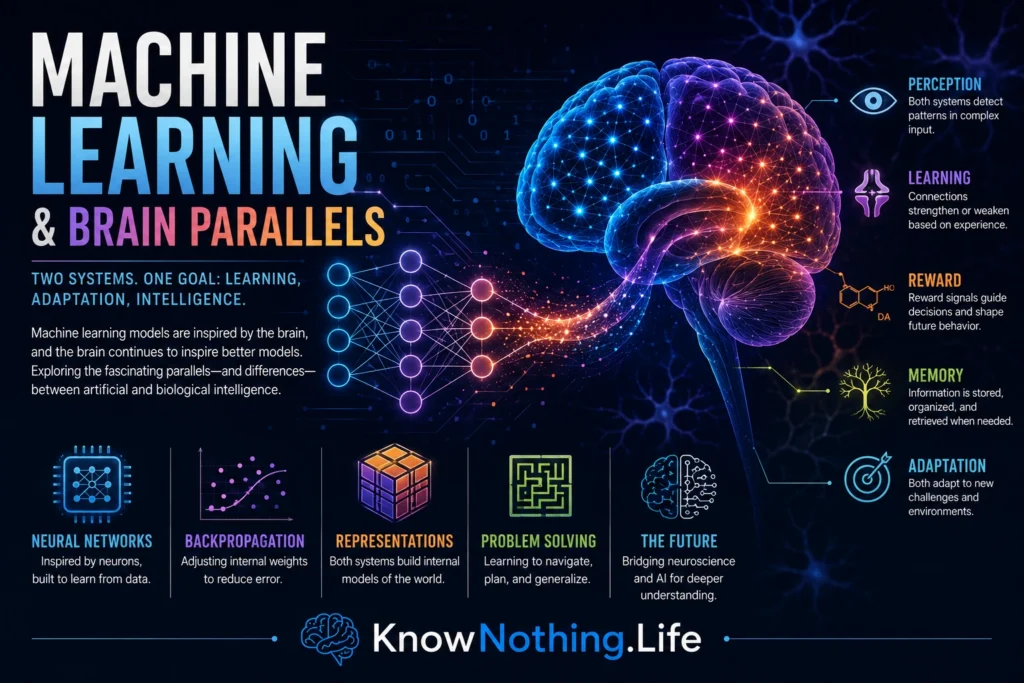
Machine learning and neuroscience share a central problem: how can a system change through experience so that it recognizes patterns, predicts outcomes, and selects useful actions? The brain solves this problem through networks of living cells whose connections and activity are modified by development, learning, attention, reward, and bodily needs. Machine-learning systems solve it through mathematical models that adjust parameters according to data and an optimization objective. Both involve distributed processing, but the resemblance is functional rather than literal.
Artificial neural networks are frequently described as brain-inspired because they contain interconnected units that combine inputs and produce outputs. Yet an artificial unit is not a realistic neuron, and a trained network is not a simulated brain. Biological neurons possess branching dendrites, multiple signaling mechanisms, complex internal chemistry, and continuously changing relationships with other cells. Machine learning borrows selected principles from neuroscience while replacing most biological detail with calculations that are easier to implement and optimize.
From Artificial Neurons to Learning Networks
Warren McCulloch and Walter Pitts provided an early bridge between neurobiology and computation in their 1943 paper “A Logical Calculus of the Ideas Immanent in Nervous Activity.” They showed that networks of simplified threshold units could perform logical operations. Their units treated neural activity as largely all-or-none and ignored most cellular physiology, but the work established that complex computation could arise from many simple interconnected elements.
Frank Rosenblatt extended this idea with the perceptron, a system capable of modifying connection weights in response to examples. In his 1958 paper “The Perceptron: A Probabilistic Model for Information Storage and Organization in the Brain,” Rosenblatt described a learning machine partly inspired by sensory and neural organization. The perceptron demonstrated that a network did not need every rule programmed in advance. It could adjust itself through experience, although a single-layer perceptron remained limited to relatively simple classification boundaries.
Hierarchical Vision and Convolutional Networks
Some of the strongest parallels between brains and machine learning appear in visual processing. David Hubel and Torsten Wiesel found that neurons in the visual cortex responded selectively to features such as line orientation and position. Their research supported a hierarchical picture in which increasingly complex visual properties could be constructed from simpler receptive-field responses. These discoveries did not directly produce modern computer vision, but they helped make layered feature processing an influential model of perception.
Convolutional neural networks follow a related computational strategy. Early layers commonly detect local patterns such as edges and textures, while deeper layers combine them into more complex representations. The match is not exact, but task-optimized networks can predict some biological responses. Daniel Yamins and colleagues showed that a hierarchical model trained for object recognition was strongly predictive of neural activity in macaque visual areas V4 and inferior temporal cortex. This suggests that optimizing a system to perform a behaviorally important task can cause representations to emerge that resemble those found in the brain.
Backpropagation and Biological Plasticity
Most modern neural networks learn through backpropagation. David Rumelhart, Geoffrey Hinton, and Ronald Williams described how errors at a network’s output could be propagated backward to calculate how each connection should change. This solved a difficult credit-assignment problem: determining which internal parameters contributed to a mistake. Backpropagation made it practical for hidden layers to learn useful representations rather than relying entirely on features selected by a human designer.
Brains clearly modify synaptic connections, but there is no established evidence that they implement ordinary backpropagation exactly. Biological plasticity is often local, depending on activity available near a synapse. Spike-timing-dependent plasticity, for example, changes synaptic strength according to the relative timing of presynaptic and postsynaptic activity. Sen Song, Kenneth Miller, and Larry Abbott showed computationally that this rule could support competitive Hebbian learning. Researchers have proposed alternatives such as feedback alignment, in which random feedback connections can still provide useful learning signals, but biological credit assignment remains an open question.
Reinforcement Learning and Dopamine
Reinforcement learning offers another important connection. In machine learning, an agent acts within an environment, receives rewards or penalties, and gradually learns which actions produce valuable outcomes. Many algorithms rely on a reward-prediction error: the difference between the reward received and the reward expected. A better-than-expected outcome produces a positive error, while an omitted or disappointing outcome produces a negative one.
Wolfram Schultz, Peter Dayan, and Read Montague connected this computational signal to dopamine activity in their 1997 paper “A Neural Substrate of Prediction and Reward.” Dopamine neurons responded strongly to unexpected rewards, shifted their activity toward cues predicting those rewards, and reduced firing when an expected reward failed to appear. The pattern resembled temporal-difference learning signals. Dopamine has broader and more varied functions than a single algorithmic variable, but the study demonstrated how a formal machine-learning concept could help explain biological activity.
Deep reinforcement-learning systems combine reward-based learning with neural networks. The deep Q-network developed by Volodymyr Mnih and colleagues learned to play Atari games from visual input and used stored experiences during training. This process, known as experience replay, improves learning by reusing and mixing previous observations. The term invites comparison with hippocampal memory replay during rest and sleep, but the mechanisms differ: artificial replay is an engineered training procedure, whereas biological replay occurs within living memory systems shaped by sleep, emotion, context, and ongoing physiology.
Prediction, Feedback, and Internal Models
Many machine-learning systems improve by predicting missing information or future events. A model may learn to predict the next word, reconstruct part of an image, or estimate the consequences of an action. This reduces dependence on manually labeled examples because the structure of the data supplies a training signal. Prediction-based learning is especially attractive as a brain parallel because organisms constantly anticipate sensory input and the effects of their movements.
Rajesh Rao and Dana Ballard proposed a predictive-coding model of visual cortex in which higher areas send predictions toward lower areas and lower areas return signals representing mismatches between expectation and input. Their model explained several visual-response properties as consequences of reducing prediction error. Predictive coding is not proven to be a universal theory of brain function, and machine-learning prediction objectives are not automatically equivalent to cortical processing. Nevertheless, both fields increasingly treat intelligence as the construction and correction of internal models rather than simple reaction to incoming stimuli.
Memory, Navigation, and Emergent Representations
Brain-inspired machine learning does not always begin by copying a biological circuit directly. Sometimes researchers train an artificial system to solve a problem and then examine whether brain-like representations emerge. Andrea Banino and colleagues trained a recurrent network to perform path integration, estimating location from movement. Units resembling grid cells appeared within the network, and those representations supported flexible navigation and shortcuts in unfamiliar environments.
This result is significant because grid-like coding was not simply inserted as a fixed rule. It emerged while the system learned a navigation task. Such findings support the idea that certain neural representations may arise because they provide efficient solutions to computational problems faced by organisms. However, similar behavior or activity does not prove identical mechanisms. Several architectures may solve the same problem, and artificial units can resemble biological recordings while relying on different learning histories or internal operations.
Where the Comparison Breaks Down
Brains learn within bodies. Sensory information is linked to movement, hunger, pain, social interaction, hormonal regulation, and survival. Human learning is continuous and shaped by relatively small amounts of structured experience. Standard machine-learning systems are commonly trained on large, curated datasets, separated into training phases and deployment phases, and optimized around a clearly defined numerical objective. They may lose older abilities when trained on new data, exploit accidental shortcuts, or fail when inputs differ from their training distribution.
Machine-learning models can also appear more brain-like than they truly are when researchers use flexible comparison methods. A 2026 study warned that apparent alignment between language models and neural data can arise from methodological choices and overlooked confounds. Brain-model comparisons are most meaningful when they predict new experimental results, survive strong controls, and explain mechanisms rather than merely producing a statistical correlation.
A Two-Way Scientific Exchange
The relationship between machine learning and neuroscience is increasingly reciprocal. Neuroscience provides ideas involving hierarchy, attention, memory, reinforcement, recurrence, and plasticity. Machine learning supplies models that can be trained, damaged, observed, and tested in ways that are impossible in living people. When a task-trained model predicts neural responses, researchers gain a candidate explanation for what a brain system may be optimizing. When the model fails, the difference can identify missing biological constraints.
The most useful future systems may not be those that imitate every detail of the brain. They may instead combine selected biological principles with the strengths of digital computation. Neuroscience can encourage machine-learning systems that learn continually, use energy efficiently, adapt through local signals, and interact meaningfully with their environments. Machine learning can give neuroscience precise theories capable of making testable predictions. The comparison becomes scientifically valuable when resemblance is treated as a hypothesis to investigate rather than proof that machines and brains work the same way.