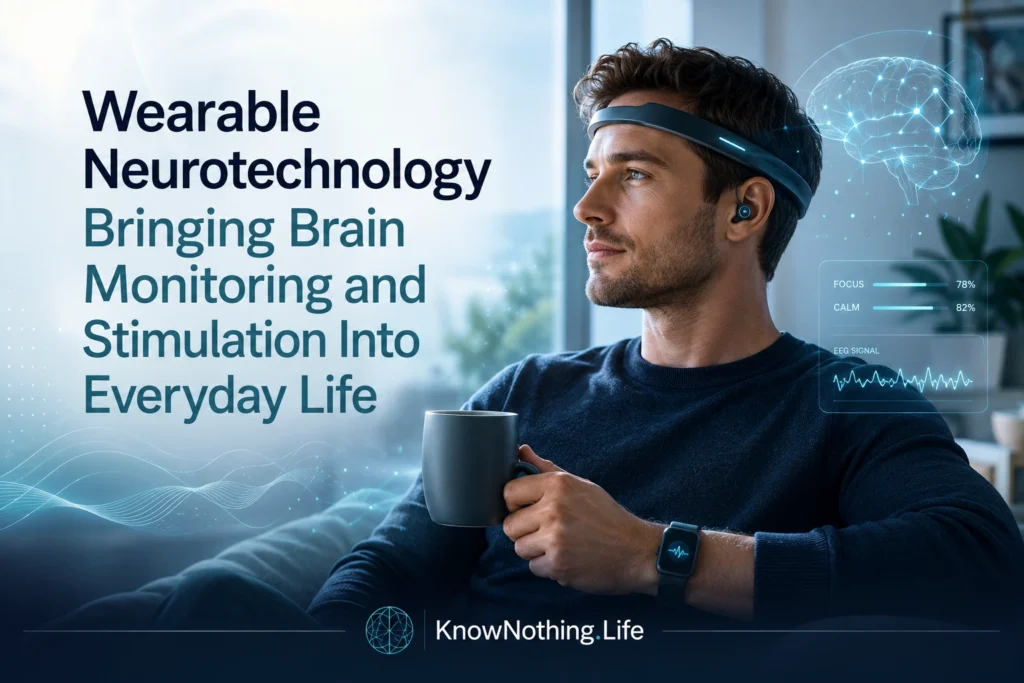
Wearable neurotechnology includes devices worn on or near the body that record, interpret, or influence nervous-system activity. Unlike implanted brain–computer interfaces, these systems generally operate without surgery and may take the form of headbands, earphones, adhesive patches, smart glasses, or compact stimulation units. Some measure electrical brain activity through electroencephalography, while others track cerebral blood oxygenation with functional near-infrared spectroscopy. A second group delivers stimulation through the scalp, peripheral nerves, sound, light, or vibration. Their shared objective is to move neural measurement and intervention beyond specialized laboratories and into homes, clinics, workplaces, and rehabilitation settings.
The category spans medically supervised equipment and consumer products marketed for sleep, focus, meditation, or performance. That breadth can be misleading because not every device measures the brain directly, and not every neural signal supports a reliable conclusion about attention, emotion, fatigue, or disease. Wearable neurotech is most credible when a device has a defined physiological target, validated sensors, transparent algorithms, and evidence connecting its output to a meaningful outcome. Portability is useful, but wearability alone cannot transform a noisy measurement into an accurate account of the mind.
From Laboratory EEG to Headbands, Earbuds, and Patches
Electroencephalography remains the foundation of most wearable brain-sensing systems. Conventional clinical EEG uses multiple scalp electrodes, conductive gel, skin preparation, and controlled recording conditions. Wearable designs attempt to preserve useful signal quality while reducing cables, bulk, discomfort, and setup time. In a 2018 study, Ali Kassab and colleagues demonstrated a battery-powered wireless system combining 32 EEG channels with 128 functional near-infrared spectroscopy channels. It operated for 24 hours and recorded useful data from healthy participants and hospital patients with epilepsy or stroke, showing how portable multimodal monitoring can capture electrical and hemodynamic activity together.
The ear is a promising recording location because an earpiece can be discreet, stable, and familiar. A dry-contact ear-EEG platform evaluated in 12 participants recorded auditory, visual, and alpha-band responses without conductive gel. In 2024, Ryan Kaveh and colleagues tested wireless dry-electrode earpieces for drowsiness monitoring, collecting about 35 hours of data from nine people and reporting classification accuracy above 93 percent under experimental conditions. A 2025 wireless forehead “e-tattoo” developed by Hyunwoo Huh and colleagues combined EEG with eye-movement recording and showed that the signals could estimate changing mental workload during a working-memory task.
Wearable Brain–Computer Interfaces
A brain–computer interface translates neural patterns into commands for a computer or machine. In wearable systems, EEG may identify responses to flashing symbols, imagined movement, shifts of attention, or intentional changes in brain rhythms. These signals can select letters, operate rehabilitation equipment, or trigger electrical stimulation of muscles. The process is limited and indirect: electrodes do not extract a complete thought, but algorithms can recognize a neural pattern associated with a defined task. Usefulness therefore depends on recording quality, calibration, user training, feedback, and the number of commands the system must distinguish.
Recent research reveals both the potential and the limits of noninvasive control. In a 2025 Nature Communications study, Yidan Ding and colleagues used scalp EEG and deep-learning decoders to control individual fingers of a robotic hand in real time. Among 21 experienced participants who met the study’s performance criteria, imagined finger movements produced average decoding accuracies of roughly 80 percent for two-finger tasks and about 60 percent for three-finger tasks. The equipment was more elaborate than an everyday wearable and the sample included selected BCI responders, but the experiment demonstrated increasingly precise noninvasive control.
Stimulation That Can Be Used at Home
Wearable neurotechnology can also deliver stimulation. Transcranial direct current stimulation applies weak electrical current through scalp electrodes to influence cortical excitability, while transcranial alternating current stimulation uses oscillating currents. These methods alter the probability and timing of neural activity rather than imposing specific thoughts or behaviors. Electrode placement, current intensity, session length, anatomy, medication, and the person’s current brain state can affect results, so findings from one protocol cannot automatically be transferred to another device or condition.
Supervised home treatment is one of the field’s most important developments. In a fully remote, multisite randomized trial published in Nature Medicine in 2025, Rachel Woodham and colleagues evaluated a ten-week course of home-based transcranial direct current stimulation for major depressive disorder. Active treatment produced greater improvement in depressive symptoms and higher response and remission rates than sham stimulation. The findings strengthened the case for controlled home neuromodulation, but they do not support casual unsupervised use. Clinical screening, correct placement, dose control, adverse-event monitoring, and realistic expectations remain essential.
Sleep, Attention, and Closed-Loop Systems
Sleep wearables demonstrate how sensing and stimulation can form a closed loop. A headband can monitor EEG, estimate sleep stage, detect a desired rhythm, and deliver a precisely timed sound. In a 2017 experiment, Luciana Besedovsky and colleagues synchronized quiet auditory pulses with slow oscillations during deep sleep. Stimulation increased slow-oscillation activity and altered endocrine and immune-related measures in 14 healthy men. The study showed that a device could respond to ongoing brain activity rather than delivering an intervention according to a fixed schedule.
A 2023 Scientific Reports study moved this principle closer to home use by evaluating a headband with dry biopotential electrodes, motion sensing, optical pulse measurement, and bone-conduction speakers. Across 883 sleep sessions involving 377 participants, its physiological measurements correlated strongly with laboratory polysomnography, automatic sleep staging reached 87.8 percent agreement with technician scoring, and closed-loop acoustic stimulation reduced sleep-onset time in the tested protocols. One platform cannot validate every commercial sleep device, but the results demonstrate the practical value of combining sensing, interpretation, and feedback in a wearable system.
Clinical Promise and Scientific Limitations
Wearable neurotech could improve long-term monitoring because neurological symptoms often occur outside the clinic. Extended EEG may help document intermittent seizures, sleep abnormalities, cognitive fluctuations, or treatment responses. Combining EEG with fNIRS adds complementary information: EEG captures rapid electrical changes, while fNIRS measures slower blood-oxygenation changes near the cortical surface. A 2024 hybrid EEG–fNIRS patch developed by Boyu Li and colleagues recorded co-located electrical and hemodynamic responses during a Stroop task, illustrating how compact multimodal sensors may eventually provide richer information than either method alone.
The central obstacle is that brain signals are small and easily contaminated. Eye movements, facial muscles, jaw tension, sweat, loose electrodes, nearby electronics, and ordinary motion can obscure neural activity. Algorithms may perform well on training participants yet lose accuracy with new users or uncontrolled environments. Wearables also have fewer recording locations than laboratory systems, limiting spatial resolution. A useful device must therefore be judged by independent validation, false-alarm rates, performance across diverse users, and improvement in a real outcome—not merely by an attractive display of “brain scores.”
Neural Data, Consent, and the Future
Wearable neurotechnology creates ethical concerns because neural measurements can be combined with identity, location, health, productivity, and behavioral data. A fatigue monitor intended to protect a user could become a workplace-surveillance tool if access and purpose are not restricted. Consent should explain what is collected, what the algorithm infers, how long data are retained, whether information is shared or sold, and whether users can delete it. In November 2025, UNESCO adopted its Recommendation on the Ethics of Neurotechnology, establishing a global framework centered on human rights, dignity, autonomy, safety, fairness, and neural-data protection.
The future will likely bring softer electrodes, longer battery life, more on-device processing, and systems combining EEG, eye movement, muscle activity, blood flow, and motion. Personalization may help algorithms distinguish genuine neural changes from artifacts and adapt stimulation to current physiology. The field’s success, however, should not be measured by how many devices claim to read the brain. It should be measured by whether they reliably restore communication, support rehabilitation, detect important events, improve treatment or sleep, and preserve the user’s control over both the technology and the data it produces.