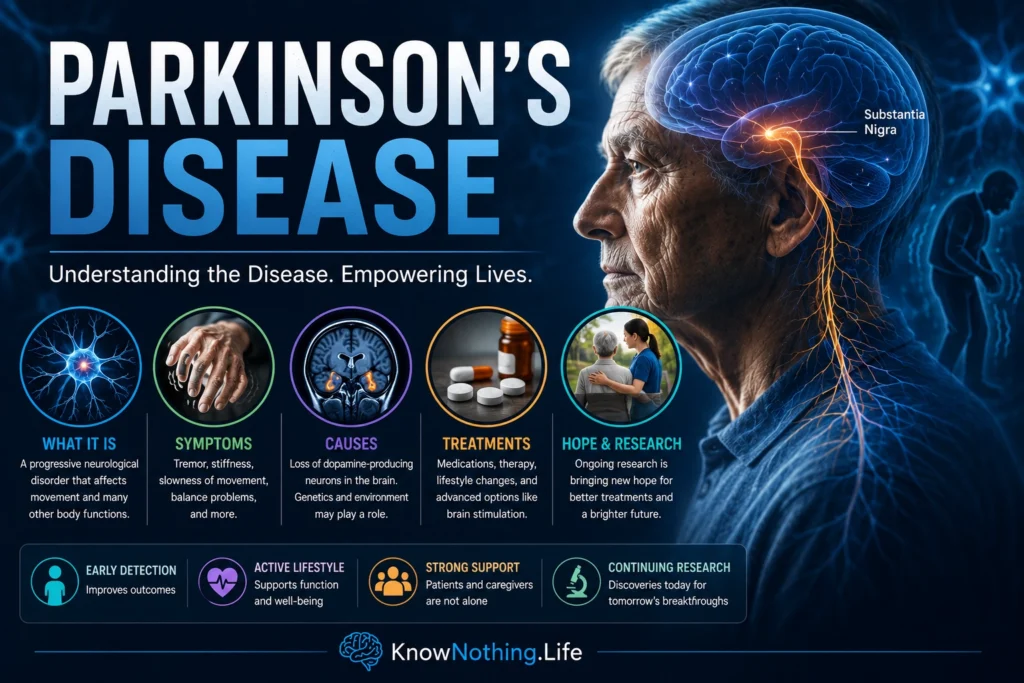
Parkinson’s disease is a progressive neurological disorder best known for affecting movement, but its effects extend far beyond tremor and stiffness. It develops as brain systems responsible for initiating and regulating movement become impaired, particularly pathways that depend on dopamine produced by neurons in the substantia nigra. The condition belongs to a broader group called parkinsonism, which includes disorders that can resemble Parkinson’s disease but differ in pathology, prognosis, and treatment response. Global estimates show that the number of people living with Parkinson’s more than doubled between 1990 and 2016, reflecting population aging, longer survival, and other demographic influences.
The disorder was systematically described by James Parkinson in his 1817 work An Essay on the Shaking Palsy. His account emphasized involuntary tremor, reduced muscular power, a forward-bending posture, and an accelerating gait. Modern neuroscience has greatly expanded that description, revealing a disease that can affect mood, sleep, smell, digestion, blood-pressure regulation, cognition, speech, and pain. Parkinson’s therefore cannot be understood solely as a motor disorder. Its biological changes involve multiple neural systems, while its clinical course varies substantially among individuals.
Dopamine, Alpha-Synuclein, and Neural Degeneration
The movement symptoms of Parkinson’s are strongly associated with degeneration of dopamine-producing neurons in the substantia nigra and reduced dopamine signaling within basal-ganglia circuits. These circuits help initiate, select, and scale voluntary actions. As dopamine input declines, movements may become smaller, slower, and harder to begin. Yet dopamine loss does not explain the entire disease. Other neurotransmitter systems and brain regions contribute to balance, sleep, autonomic function, emotion, and cognition, which is why dopamine replacement improves some symptoms much more reliably than others.
A major breakthrough came in 1997, when Maria Grazia Spillantini and colleagues demonstrated that alpha-synuclein is a principal component of Lewy bodies, the intracellular inclusions classically associated with Parkinson’s pathology. That same year, Polymeropoulos and colleagues identified a mutation in the gene encoding alpha-synuclein in families with inherited Parkinson’s disease. These discoveries connected one protein to both familial disease and the pathology observed in common sporadic cases. Alpha-synuclein can misfold and accumulate, but researchers continue to investigate whether its aggregates directly kill neurons, disrupt cellular transport and protein clearance, trigger inflammation, or reflect several interacting processes.
Causes, Genetics, and Patterns of Pathology
Most Parkinson’s cases do not arise from one identifiable cause. Age is the strongest general risk factor, while genetic susceptibility, environmental exposures, mitochondrial dysfunction, oxidative stress, inflammation, and impaired protein disposal may all contribute. Disease-associated variants in genes such as SNCA, LRRK2, GBA1, PRKN, PINK1, and DJ-1 demonstrate that Parkinson’s is biologically diverse. Zimprich and colleagues, for example, identified disease-segregating LRRK2 mutations in families with autosomal-dominant parkinsonism, yet affected carriers displayed varied neuropathology. Genetic discoveries therefore reveal important biological pathways without establishing one universal mechanism.
Heiko Braak and colleagues proposed a six-stage model in which Lewy pathology begins in lower brainstem or olfactory structures and advances through the midbrain, limbic system, and cortex. The model offers a possible explanation for why constipation, loss of smell, sleep disturbances, or mood changes can precede obvious motor symptoms. Not every patient follows this sequence, however, and some genetically defined forms show little typical Lewy pathology. Parkinson’s is increasingly viewed as a syndrome containing multiple biological subtypes that converge on overlapping clinical features.
Motor and Nonmotor Symptoms
The central motor feature is bradykinesia, meaning slowness accompanied by progressively reduced speed or amplitude during repeated movement. Diagnostic criteria developed by the International Parkinson and Movement Disorder Society require bradykinesia together with either rest tremor or rigidity to establish parkinsonism. Symptoms often begin asymmetrically. A person may notice reduced arm swing, smaller handwriting, a softer voice, difficulty turning in bed, one-sided stiffness, or a rhythmic tremor at rest. Later changes may affect posture, gait, balance, facial expression, swallowing, and the performance of complex movements.
Nonmotor symptoms may be equally disabling and sometimes appear years earlier. They include constipation, urinary problems, dizziness on standing, smell loss, fatigue, depression, anxiety, apathy, hallucinations, pain, cognitive changes, and disrupted sleep. REM sleep behavior disorder is especially important because affected people physically act out dreams after losing the normal muscle paralysis of REM sleep. In a large multicenter study led by Ronald Postuma, participants with idiopathic REM sleep behavior disorder had a high long-term rate of progression to Parkinson’s disease, dementia with Lewy bodies, or multiple system atrophy, demonstrating that neurodegeneration can become clinically detectable before classic parkinsonism.
Diagnosis and Earlier Detection
Parkinson’s disease remains primarily a clinical diagnosis based on medical history and neurological examination. The Movement Disorder Society criteria combine the presence of parkinsonism with supportive features, exclusion criteria, and warning signs suggesting another disorder. A clear and sustained response to dopaminergic treatment supports the diagnosis, while early severe falls, rapid progression, eye-movement abnormalities, or marked autonomic failure may raise concern for atypical parkinsonism. Brain imaging and laboratory tests are often used to exclude structural, metabolic, medication-related, or vascular causes rather than prove Parkinson’s by themselves.
Earlier and more biologically specific diagnosis is a major research goal. Dopamine-transporter imaging can demonstrate reduced presynaptic dopaminergic function, but it cannot reliably distinguish Parkinson’s from every degenerative parkinsonian syndrome. Alpha-synuclein seed-amplification assays instead detect the ability of misfolded alpha-synuclein to trigger further protein aggregation. A 2023 Parkinson’s Progression Markers Initiative analysis found that cerebrospinal-fluid testing identified alpha-synuclein abnormalities across many participants with Parkinson’s while revealing differences among clinical and genetic subgroups. These assays are promising, but diagnosis and prognosis still require careful clinical interpretation.
Medication, Surgery, and Rehabilitation
Levodopa remains the most effective medication for the core motor symptoms of Parkinson’s. The brain converts it into dopamine, and it is usually combined with carbidopa to reduce breakdown outside the nervous system. Dopamine agonists, monoamine oxidase-B inhibitors, catechol-O-methyltransferase inhibitors, amantadine, and other drugs may be added according to symptoms and disease stage. The ELLDOPA trial led by Stanley Fahn showed substantial symptomatic benefit from levodopa but did not conclusively establish its effect on the underlying neurodegenerative process. Over time, some patients develop wearing-off periods, involuntary movements, or unpredictable fluctuations that require careful adjustment.
Deep-brain stimulation can help selected patients whose tremor, rigidity, slowness, fluctuations, or dyskinesias are inadequately controlled with medication. Electrodes placed in targets such as the subthalamic nucleus or globus pallidus modify abnormal circuit activity. In a randomized trial led by Günther Deuschl, stimulation combined with medication produced greater improvements in motor function and quality of life than medication alone in people with advanced disease. Surgery does not stop progression and generally does not correct dementia, speech decline, or medication-resistant balance problems, making careful patient selection and realistic expectations essential.
Living With Parkinson’s and Future Directions
Effective care extends beyond medication. Physical therapy addresses gait, balance, posture, strength, and freezing; occupational therapy supports independence; and speech therapy can improve voice, communication, and swallowing safety. Exercise has become an important part of management rather than an optional addition. In a randomized phase 2 trial, Margaret Schenkman and colleagues found that high-intensity treadmill exercise was feasible in early Parkinson’s disease and did not worsen motor outcomes, supporting larger trials of exercise as a possible way to preserve function. Care must also address sleep, mood, cognition, autonomic symptoms, caregiver strain, and home safety.
The central unresolved goal is a therapy that reliably slows or prevents neurodegeneration. Research includes antibodies and vaccines directed at alpha-synuclein, gene-targeted treatments, growth factors, cell replacement, immune modulation, and therapies aimed at mitochondrial or lysosomal function. Biological definitions and staging systems are also being developed so trials can enroll people according to pathology rather than symptoms alone. Parkinson’s disease is unlikely to yield to one universal treatment because it arises through varied pathways. Progress will depend on detecting disease earlier, defining meaningful subtypes, and matching therapies to the mechanisms operating in each patient.