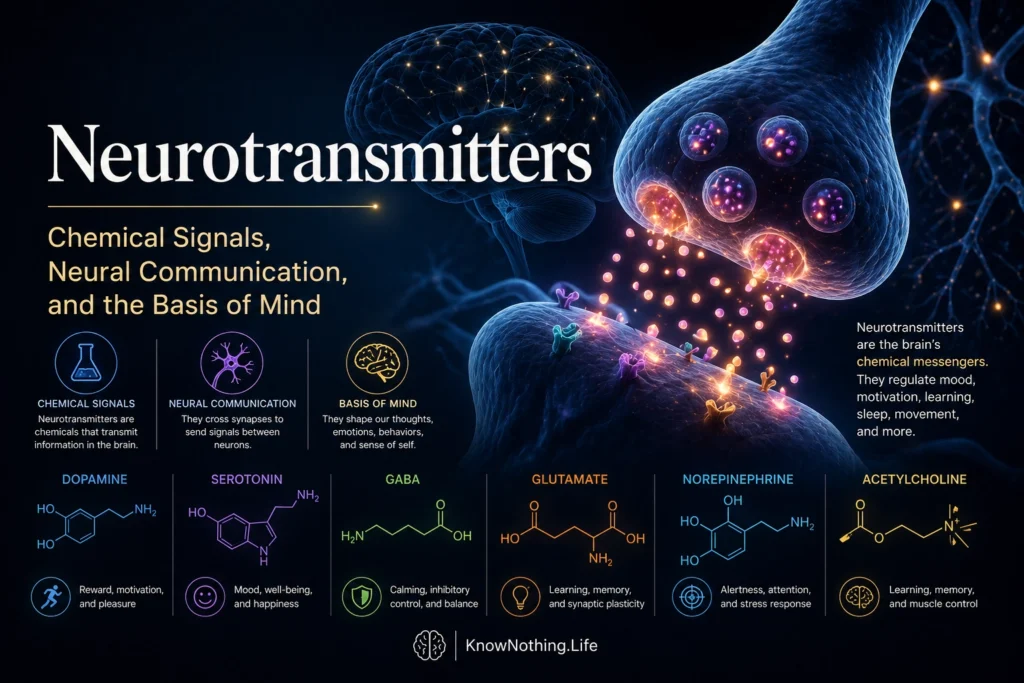
Neurotransmitters are the chemical messengers of the nervous system, enabling communication between neurons and shaping every aspect of human experience—from movement and perception to emotion and thought. While electrical impulses carry signals within neurons, neurotransmitters transmit information across synapses, bridging the microscopic gaps between cells. This chemical signaling system is fundamental to brain function, providing the dynamic flexibility required for learning, adaptation, and behavior.
The recognition of chemical transmission in the nervous system marked a turning point in neuroscience. Early debates centered on whether neural communication was purely electrical or involved chemical processes. The work of Otto Loewi, who demonstrated chemical signaling through his famous frog heart experiment, provided decisive evidence for the role of neurotransmitters. This discovery laid the foundation for modern neurobiology, revealing that the brain operates not only through electrical activity but through a complex chemistry that underlies mental life.
Mechanisms of Neural Communication
Neurotransmission begins with an electrical signal known as an action potential, which travels along the axon of a neuron toward the synapse. When the action potential reaches the synaptic terminal, it triggers the release of neurotransmitters stored in vesicles. These molecules are released into the synaptic cleft, where they bind to receptors on the postsynaptic neuron, influencing its activity.
The effect of a neurotransmitter depends on both its type and the receptors it binds to. Some neurotransmitters are excitatory, increasing the likelihood that the receiving neuron will fire, while others are inhibitory, reducing that likelihood. This balance between excitation and inhibition is essential for maintaining stable and coordinated brain activity. Disruptions in this balance can lead to neurological and psychiatric disorders.
Neuroscientist Eric R. Kandel emphasized the importance of synaptic communication in shaping behavior, noting in Principles of Neural Science that “the strength of synaptic connections determines the flow of information through neural circuits.” This insight highlights that neurotransmitters do not merely transmit signals but modulate them, influencing how information is processed and integrated.
Major Neurotransmitters and Their Functions
Several key neurotransmitters play central roles in brain function. Dopamine is associated with reward, motivation, and movement. It is a critical component of the brain’s reward system, reinforcing behaviors that are perceived as pleasurable or beneficial. Dysregulation of dopamine is implicated in conditions such as Parkinson’s disease, schizophrenia, and addiction.
Serotonin is involved in mood regulation, sleep, and appetite. It has been widely studied in relation to depression, with many antidepressant medications targeting serotonin pathways. Norepinephrine, another important neurotransmitter, is associated with arousal, attention, and the body’s response to stress, playing a key role in the fight-or-flight response.
Other neurotransmitters include glutamate, the primary excitatory neurotransmitter in the brain, and gamma-aminobutyric acid (GABA), the main inhibitory neurotransmitter. Acetylcholine is involved in muscle activation and memory, while endorphins function as natural painkillers and contribute to feelings of pleasure. As Candace Pert suggested in Molecules of Emotion, these chemical messengers form the biological basis of emotional experience, linking body and mind through molecular processes.
Neurotransmitters and Behavior
Neurotransmitters play a central role in shaping behavior by influencing how the brain processes information and responds to stimuli. The reward system, for example, relies heavily on dopamine to reinforce behaviors that promote survival, such as eating and social interaction. This system can also be hijacked by addictive substances, which artificially increase dopamine levels and create powerful associations between the substance and pleasure.
Emotional regulation is similarly influenced by neurotransmitter activity. Serotonin and GABA contribute to the modulation of mood and anxiety, helping to maintain emotional balance. When these systems are disrupted, individuals may experience heightened anxiety, depression, or mood instability. The interplay between different neurotransmitters creates a complex network of regulation, allowing for nuanced emotional responses.
Cognitive functions such as attention, memory, and decision-making also depend on neurotransmitter systems. Norepinephrine enhances alertness and focus, while acetylcholine is crucial for learning and memory formation. These systems work together to support adaptive behavior, enabling individuals to respond effectively to their environment. As neuroscientist Joseph LeDoux has noted, emotional and cognitive processes are deeply intertwined at the neural level, reflecting the integrated nature of brain function.
Neurotransmitters and Mental Disorders
Many mental disorders are associated with imbalances or dysfunctions in neurotransmitter systems. Depression, for example, has been linked to reduced activity in serotonin and norepinephrine pathways, leading to the development of medications that increase the availability of these neurotransmitters in the brain. Similarly, schizophrenia is associated with dysregulation of dopamine, particularly in pathways related to perception and thought.
Anxiety disorders often involve heightened activity in excitatory systems and reduced inhibitory control, leading to excessive arousal and fear responses. GABA, as the primary inhibitory neurotransmitter, plays a crucial role in regulating these responses, and medications that enhance GABA activity are commonly used to treat anxiety.
Neuroscientist Nora D. Volkow has emphasized the role of neurotransmitters in addiction, noting that repeated exposure to substances can alter the brain’s reward circuitry, leading to compulsive behavior. These changes highlight the dynamic nature of neurotransmitter systems and their capacity to be reshaped by experience, for better or worse.
Pharmacology and Intervention
The study of neurotransmitters has led to significant advances in pharmacology, providing the basis for many psychiatric medications. Antidepressants, such as selective serotonin reuptake inhibitors (SSRIs), work by increasing the availability of serotonin in the synaptic cleft. Antipsychotic medications often target dopamine receptors, reducing the effects of excess dopamine activity.
Other medications, such as benzodiazepines, enhance the activity of GABA, producing calming effects that are useful in treating anxiety. Stimulants used in the treatment of attention-deficit/hyperactivity disorder (ADHD) increase the availability of dopamine and norepinephrine, improving focus and impulse control.
While these medications can be highly effective, they also illustrate the complexity of neurotransmitter systems. Altering one system can have cascading effects on others, leading to side effects and variability in response. As a result, pharmacological treatment is often combined with psychological and behavioral interventions to address the broader context of mental health.
Plasticity and Adaptation
Neurotransmitter systems are not static; they are highly adaptable and responsive to experience. This plasticity allows the brain to adjust to changing conditions, but it also means that repeated patterns of behavior can reinforce certain neural pathways. For example, chronic stress can alter neurotransmitter activity, contributing to long-term changes in mood and cognition.
Learning and memory are closely tied to changes in neurotransmitter function. Repeated activation of synapses can strengthen connections, while lack of use can lead to weakening. This dynamic process underlies the brain’s ability to acquire new skills and adapt to new environments. As Donald Hebb proposed, the strengthening of synaptic connections is a fundamental mechanism of learning.
Plasticity also plays a role in recovery from injury and the treatment of mental disorders. Therapeutic interventions, whether pharmacological or psychological, can promote changes in neurotransmitter systems, supporting the restoration of balance and function. This capacity for change highlights the potential for growth and recovery, even in the face of significant challenges.
Conclusion
Neurotransmitters are the chemical foundation of neural communication, enabling the brain to process information, regulate emotion, and generate behavior. Their intricate interactions form the basis of both normal functioning and mental disorders, making them central to the study of psychology and neuroscience.
By understanding neurotransmitters, researchers and clinicians gain insight into the biological mechanisms underlying the mind. This knowledge has led to significant advances in treatment, while also revealing the complexity and adaptability of the brain. As the field continues to evolve, the study of neurotransmitters will remain essential to unraveling the mysteries of human thought and experience.