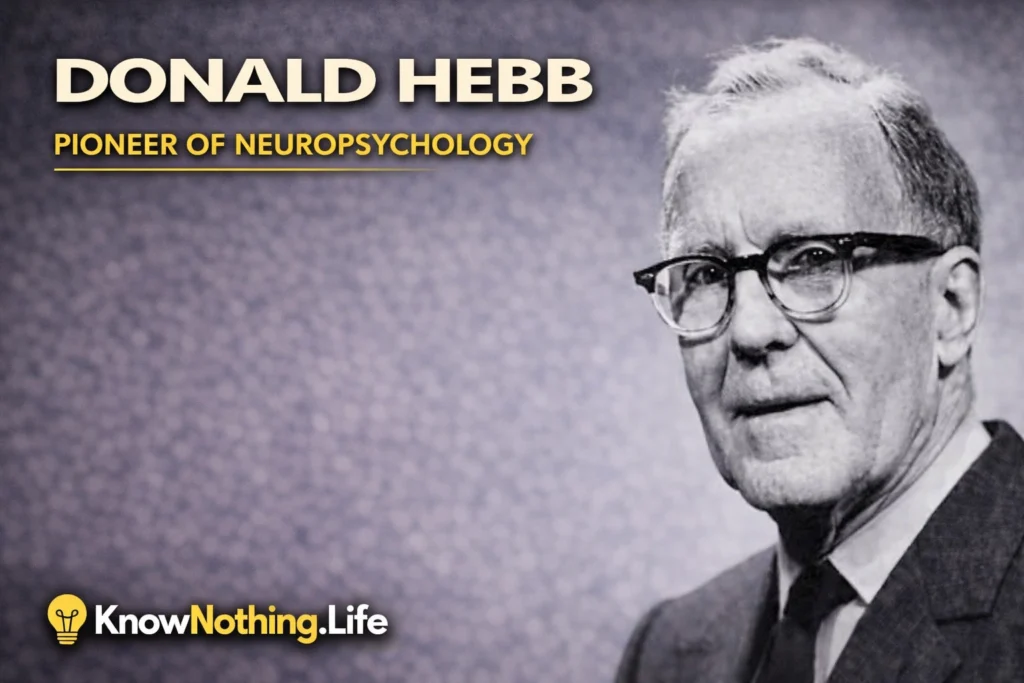
Donald Olding Hebb was born on July 22, 1904, in Chester, Nova Scotia, and became one of the most important figures in the history of psychology and neuroscience. At a time when many psychologists were still cautious about explaining the mind through the brain, Hebb argued that thought, learning, memory, and perception had to be understood through the activity of the nervous system. His work helped move psychology away from strict behaviorism and toward a more biological, brain-based science of behavior. For that reason, he is often called one of the founders of neuropsychology.
Hebb’s path was not straightforward. He studied English and philosophy at Dalhousie University, graduating in 1925, and originally showed interest in writing rather than laboratory science. He worked as a teacher and school principal before entering graduate study in psychology at McGill University, where he completed a master’s degree in 1932. His early experience in education mattered because it gave him a lifelong interest in development, learning, and the conditions that shape intelligence. Unlike theorists who treated the mind as abstract machinery, Hebb wanted to know how lived experience physically changes the brain.
Training with Karl Lashley and Wilder Penfield
Hebb’s intellectual direction sharpened when he studied with Karl Lashley, one of the leading physiological psychologists of the era. Hebb began doctoral work at the University of Chicago and followed Lashley to Harvard, where he completed his Ph.D. in 1936. Lashley’s work on learning, brain lesions, and memory gave Hebb a central problem: how can complex behavior arise from neural tissue? Lashley had shown that memory could not be easily located in one tiny brain region, but he had not solved the problem of how learning was organized. Hebb inherited that question and made it the center of his career.
After Harvard, Hebb worked with neurosurgeon Wilder Penfield at the Montreal Neurological Institute from 1937 to 1939. There he studied patients with brain injuries and surgical lesions, especially damage to the frontal and temporal lobes. This clinical experience was crucial because it forced Hebb to connect theory with real human behavior. Brain damage did not simply remove isolated mental “faculties.” It changed planning, intelligence, perception, judgment, and personality in complex ways. Hebb developed tests such as the Picture Anomaly Test and Adult Comprehension Test to study these effects more precisely, helping build the practical foundations of neuropsychological assessment.
The Organization of Behavior
Hebb’s masterpiece, The Organization of Behavior: A Neuropsychological Theory, was published in 1949. The book became a landmark because it offered a serious biological theory of mind at a moment when behaviorism still dominated American psychology. Behaviorists often emphasized observable stimulus and response, while avoiding claims about inner mental life. Hebb did not reject behavior, but he argued that behavior could not be understood without the brain mechanisms that produce it. His goal, as he wrote, was to “seek a common ground” between psychology and the biological sciences.
The central idea of The Organization of Behavior was that learning changes the connections among neurons. Hebb proposed that when one neuron repeatedly helps fire another, “some growth process or metabolic change” strengthens that relationship. This idea later became known as Hebbian learning and is often summarized as “cells that fire together, wire together,” though that exact wording was not Hebb’s original phrase. The importance of the theory was enormous. Hebb gave psychology a way to imagine how experience could become structure, how repeated activity could become memory, and how the mind could emerge from organized neural networks rather than from a separate mental substance.
Cell Assemblies and Phase Sequences
One of Hebb’s most influential concepts was the cell assembly. A cell assembly is a group of neurons that become linked through repeated activation, so that activity in part of the group can help reactivate the larger pattern. Hebb used this idea to explain how perception and thought might continue after an original stimulus is gone. When a child sees a dog many times, for example, the brain does not merely record separate sensations of fur, movement, sound, and shape. Repeated experience helps bind those features into a more stable neural pattern. That pattern can later support recognition, memory, expectation, and imagination.
Hebb also proposed the idea of a phase sequence, a connected series of cell assemblies that could underlie a stream of thought. This was one of the most ambitious parts of his theory because it tried to explain not just single memories, but mental flow. A thought leads to another thought; a perception triggers an association; a remembered place brings back a person, a smell, a fear, or a plan. Hebb’s theory suggested that such sequences might have a biological basis in linked patterns of neural activity. In modern language, he was thinking about networks, plasticity, representation, and cognition before those terms became central to neuroscience and artificial intelligence.
Major Works and Teaching Influence
Although The Organization of Behavior remains his most famous work, Hebb’s influence also came through teaching, institution building, and later writings. After time at Queen’s University and the Yerkes Laboratories of Primate Biology, he returned to McGill University in 1947. He became chair of McGill’s psychology department, helped build it into a major center for physiological psychology, and trained students who carried his ideas into laboratories around the world. Hebb did not merely publish a theory; he helped create the intellectual environment in which brain-based psychology could grow.
His other major works include A Textbook of Psychology, which became widely used and reflected his unusually clear teaching style, and Essay on Mind, published in 1980, where he returned to the mind-body problem that had shaped his entire career. He also wrote on perception, motivation, intelligence, attention, and development. Hebb’s writing was powerful because it avoided both extremes: he did not reduce psychology to simple reflexes, but he also did not treat the mind as mysterious or separate from biology. His work insisted that a scientific psychology could study meaning, thought, and experience without abandoning the brain.
Sensory Deprivation, Development, and Experience
Hebb’s broader research program also influenced the study of early experience and environmental enrichment. His interest in development led him to argue that intelligence is not fixed by biology alone. Brain organization depends on stimulation, activity, and interaction with the world. This view helped shape later research on childhood development, enriched environments, and the importance of early learning. Hebb’s work made it harder to treat heredity and environment as separate forces. Biology mattered deeply, but biology itself was changed by experience.
Research associated with Hebb’s McGill environment also contributed to the study of sensory deprivation. These studies raised important questions about what happens when the brain is deprived of normal stimulation. The findings suggested that the mind depends on active engagement with the world to remain organized. This reinforced one of Hebb’s deepest themes: the brain is not a passive receiver. It is an adaptive, organizing system that needs experience in order to develop properly. Learning is not simply information added to the mind; it is the physical shaping of the system that makes thought possible.
Legacy and Lasting Importance
Donald Hebb died on August 20, 1985, but his ideas remain alive in psychology, neuroscience, cognitive science, artificial intelligence, and theories of learning. Hebbian learning influenced research on synaptic plasticity, neural networks, memory formation, developmental neuroscience, and computational models of cognition. Even when later science revised, expanded, or corrected parts of his theory, the basic insight endured: mental life must be understood through organized brain activity, and experience can alter that organization.
Hebb’s lasting importance lies in the bridge he built. Before him, psychology and neuroscience often spoke different languages. Psychology studied behavior and thought; neuroscience studied cells and tissue. Hebb showed that these could be parts of the same question. How does experience become memory? How does perception become thought? How does the brain create the mind? His genius was not that he answered every detail, but that he asked the question in a way science could pursue. Donald Hebb changed psychology by making the mind biological without making it simple.