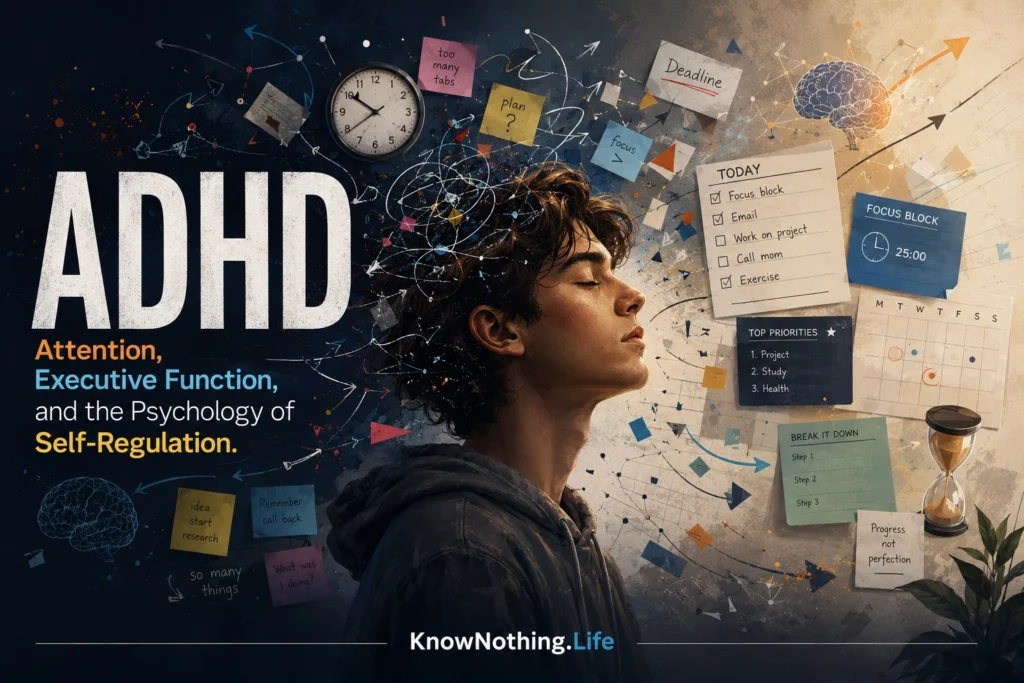
Attention-deficit/hyperactivity disorder, better known as ADHD, is one of the most discussed and misunderstood conditions in modern psychology. It is often reduced to a simple problem of distraction, restlessness, or poor discipline, but that view misses the deeper nature of the disorder. ADHD is a neurodevelopmental condition involving persistent patterns of inattention, hyperactivity, impulsivity, disorganization, and difficulty regulating behavior in ways that interfere with school, work, relationships, or daily life. The National Institute of Mental Health describes ADHD as a developmental disorder marked by ongoing symptoms of inattention, hyperactivity, and impulsivity, with some people showing mostly inattentive symptoms, some mostly hyperactive-impulsive symptoms, and others a combined pattern.
The word “attention” can also be misleading. ADHD is not simply the inability to pay attention. Many people with ADHD can focus intensely on things that are interesting, urgent, emotionally stimulating, or immediately rewarding. The difficulty is regulating attention on demand, especially when a task is repetitive, delayed, boring, complex, or weakly rewarding. Russell A. Barkley, one of the most influential ADHD researchers, has argued that ADHD is fundamentally a disorder of executive function and self-regulation rather than a mere shortage of attention. In Taking Charge of ADHD, Barkley writes that the child with ADHD has difficulty shifting “from focusing on the here and now to focusing on what is likely to come next,” capturing one of the central struggles of the disorder: acting with the future in mind.
What ADHD Means
ADHD affects the systems that help people organize behavior across time. These systems include working memory, inhibition, planning, emotional control, task initiation, and the ability to persist toward a goal even when the reward is not immediate. A student with ADHD may understand the assignment but fail to begin it. An adult may know exactly what needs to be done but still miss deadlines, lose objects, forget appointments, or bounce between unfinished tasks. This gap between knowledge and action is one reason ADHD is so frustrating for the person who has it and for the people around them.
Historically, ADHD has been described in several ways, including hyperkinetic reaction of childhood, attention deficit disorder, and attention-deficit/hyperactivity disorder. The DSM-5 and DSM-5-TR classify ADHD as a neurodevelopmental disorder, meaning that its symptoms begin in childhood and reflect differences in development rather than a sudden adult personality flaw. Current diagnostic descriptions emphasize impairing levels of inattention, disorganization, hyperactivity, and impulsivity that are inconsistent with developmental level.
Symptoms and Presentations
ADHD is usually divided into three presentations: predominantly inattentive, predominantly hyperactive-impulsive, and combined. Inattentive symptoms include difficulty sustaining attention, careless mistakes, disorganization, forgetfulness, losing things, seeming not to listen, and avoiding tasks that require sustained mental effort. Hyperactive-impulsive symptoms include fidgeting, restlessness, excessive talking, interrupting, difficulty waiting, acting without thinking, and feeling driven by inner motor-like energy. The CDC notes that DSM-5 criteria require symptoms to persist for at least six months and be inappropriate for the person’s developmental level.
The inattentive presentation is sometimes missed because it may look less disruptive. A child who stares out the window, quietly forgets assignments, or mentally drifts during lessons may not attract the same concern as a child who constantly leaves their seat. Girls and adults are especially likely to be overlooked when ADHD does not fit the stereotype of a hyperactive young boy. In adults, symptoms often appear as chronic lateness, clutter, emotional reactivity, unfinished projects, job instability, impulsive spending, or a pattern of underperformance despite intelligence and effort.
Executive Function and Self-Regulation
Executive function is the mental ability to guide behavior toward goals. It includes the capacity to pause before acting, hold information in mind, manage time, organize steps, resist distractions, and regulate emotion. Barkley’s executive-function model has been especially influential because it explains why ADHD creates problems beyond school attention. In his work on ADHD and self-regulation, Barkley argues that ADHD involves difficulty using self-directed actions to control future behavior, not merely difficulty sitting still or listening.
This is why punishment, nagging, or moral criticism often fails. People with ADHD usually know what they are supposed to do. The problem is consistently activating the right behavior at the right time. Barkley has famously summarized this idea by saying that ADHD is not primarily a disorder of knowing what to do, but of doing what one knows. That distinction matters because it shifts ADHD away from laziness and toward regulation. The person is not simply refusing responsibility; they are struggling with the internal tools that make responsibility easier to carry out.
ADHD in Children and Adults
ADHD is often diagnosed in childhood, but it does not simply vanish with age. Symptoms may change form. Hyperactivity in a child may become inner restlessness in an adult. Impulsive classroom behavior may become impulsive speech, risky decisions, or difficulty managing money. The CDC states that ADHD can last into adulthood for at least one-third of children with ADHD, and adult treatment may include medication, psychotherapy, education, training, or a combination of approaches.
Adult ADHD can be especially painful because the person may have spent years being called careless, inconsistent, dramatic, immature, or irresponsible. Many adults seek diagnosis only after a child is diagnosed, after repeated work struggles, or after anxiety and depression reveal an underlying pattern of executive dysfunction. The condition can affect relationships as well. A partner may interpret forgetfulness as indifference, lateness as disrespect, or emotional intensity as selfishness. Understanding ADHD does not excuse harmful behavior, but it can explain patterns more accurately and lead to better systems of support.
Causes and Brain-Based Factors
ADHD is not caused by bad parenting, too much television, laziness, or weak character. Research points to a combination of genetic, neurological, developmental, and environmental influences. ADHD tends to run in families, and many studies have found differences in brain networks involved in attention, reward, inhibition, and executive control. These differences do not mean that every person with ADHD has the same brain pattern, but they support the view that ADHD is a real neurodevelopmental condition rather than a cultural invention.
Reward sensitivity is one important part of the picture. Many people with ADHD struggle when rewards are delayed, abstract, or far in the future. A deadline tomorrow may activate them more than a deadline next month. Immediate feedback may work better than vague encouragement. This helps explain why ADHD is often inconsistent. The same person who procrastinates for weeks may work brilliantly under pressure, focus for hours on a favorite topic, or respond quickly in a crisis. The inconsistency is not evidence that ADHD is fake; it is part of how motivation and regulation operate in the condition.
Diagnosis and Misdiagnosis
ADHD diagnosis should be made by a trained healthcare professional using developmental history, symptom patterns, impairment, and information from multiple settings when possible. There is no single blood test, brain scan, or quick questionnaire that proves ADHD by itself. The DSM framework requires symptoms to begin in childhood, occur in more than one setting, and cause meaningful impairment. NIMH notes that symptoms must begin before age 12 and may continue into adolescence and adulthood.
Misdiagnosis can occur in both directions. Some people with trauma, anxiety, sleep disorders, depression, learning disabilities, substance use, or thyroid problems may look inattentive or restless without having ADHD. Others genuinely have ADHD but are dismissed because they get good grades, are intelligent, are not visibly hyperactive, or learned to mask symptoms. A careful diagnosis asks not only whether the person can sometimes perform well, but how much effort, stress, compensation, and inconsistency sit behind that performance.
Treatment and Support
Effective ADHD treatment usually combines education, environmental changes, behavioral strategies, and, for many people, medication. The CDC states that ADHD is often best treated with a combination of behavior therapy and medication, while behavior therapy, especially parent training, is recommended as the first line of treatment for preschool-aged children before medication is tried. Medication can reduce core symptoms such as impulsivity, inattention, and hyperactivity, but it does not teach every skill a person needs. Practical systems remain essential.
Support often works best when it makes the invisible visible. External reminders, timers, written plans, structured routines, visual calendars, body doubling, shorter work intervals, reduced clutter, and immediate feedback can all help. These tools are not crutches in a negative sense; they are prosthetics for executive function. Edward Hallowell and John Ratey, authors of Driven to Distraction, helped popularize a more humane understanding of ADHD by showing that the condition often includes creativity, intensity, intuition, and originality alongside impairment. The goal of treatment is not to erase personality, but to reduce suffering and improve self-direction.
Strengths, Stigma, and Reality
There is a growing tendency to describe ADHD only as a “superpower,” but that can be as misleading as describing it only as a defect. ADHD can be associated with creativity, energy, humor, spontaneity, curiosity, and the ability to make unusual connections. Many people with ADHD thrive in fields that reward urgency, novelty, problem-solving, movement, entrepreneurship, performance, or hands-on learning. However, ADHD can also bring serious difficulties, including academic failure, job problems, relationship conflict, emotional distress, accidents, and low self-esteem.
A balanced view avoids both shame and romanticization. ADHD is not a moral failure, but it is also not automatically a gift. It is a real condition that can create real impairment, especially when misunderstood. The most helpful approach combines compassion with structure. People with ADHD often do best when they stop trying to become “normal” through willpower alone and instead build systems that fit how their attention, motivation, and time sense actually work.
Final Thoughts on ADHD
ADHD is best understood as a disorder of attention regulation, executive function, and self-control across time. It affects how people begin tasks, resist impulses, organize life, manage emotion, and act in the service of future goals. The condition can appear differently in children, adults, men, women, students, workers, and families, which is why stereotypes are so limiting. A hyperactive child, a daydreaming student, a chronically overwhelmed adult, and a high-achieving professional who collapses privately under disorganization may all be living with ADHD.
The work of researchers and clinicians such as Russell Barkley, Edward Hallowell, John Ratey, and many others has helped move ADHD away from blame and toward understanding. Their central lesson is that ADHD should be taken seriously without reducing the person to the diagnosis. With accurate diagnosis, appropriate treatment, practical supports, and a more realistic view of executive function, people with ADHD can build lives that are not defined by failure, shame, or constant crisis. The aim is not perfect attention. The aim is better regulation, better support, and a life structured around both real limits and real strengths.