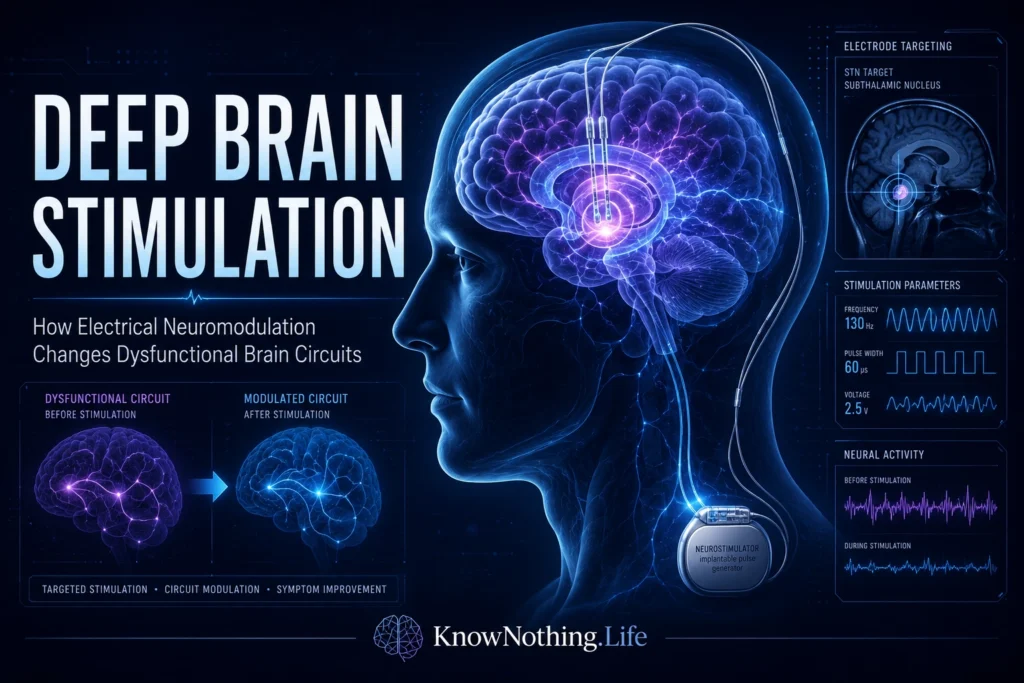
Deep brain stimulation, commonly abbreviated as DBS, is a neurosurgical treatment that uses implanted electrodes to alter activity within carefully selected brain circuits. Thin insulated leads are positioned in a target such as the subthalamic nucleus, globus pallidus, thalamus, or another structure associated with a particular disorder. These leads are connected through wires placed beneath the skin to an implantable pulse generator, usually positioned below the collarbone. The generator delivers adjustable electrical pulses that influence the activity passing through the targeted network. The National Institute of Neurological Disorders and Stroke describes DBS as an established treatment for symptoms of movement disorders including Parkinson’s disease, essential tremor, and dystonia when medication no longer provides adequate control.
DBS does not remove the affected brain tissue, and its settings can be changed after surgery. This distinguishes it from older procedures such as thalamotomy and pallidotomy, in which surgeons deliberately created permanent lesions to interrupt abnormal activity. Stimulation can be increased, reduced, redirected through different electrode contacts, or turned off if necessary. This adjustability makes DBS more flexible than destructive surgery, although it does not make the treatment entirely reversible because implantation itself carries surgical risks. DBS is also not a cure for the underlying disease. Its purpose is to control particular symptoms, improve daily functioning, and reduce the burden created by medications or uncontrolled neural activity.
The Development of Modern DBS
The modern history of DBS is closely associated with French neurosurgeon Alim-Louis Benabid and his colleagues in Grenoble. During surgery for tremor in 1987, the researchers observed that low-frequency stimulation could worsen tremor, whereas stimulation above approximately 100 hertz suppressed it. This finding encouraged the use of chronic high-frequency stimulation of the ventral intermediate nucleus of the thalamus as an alternative to creating a permanent thalamic lesion. By the early 1990s, stimulation had been extended to the subthalamic nucleus and globus pallidus for advanced Parkinson’s disease.
Clinical trials established that the improvement was not merely an impression created by surgery or patient expectation. In a multicenter trial published by William Koller and colleagues in Annals of Neurology in 1997, unilateral thalamic stimulation significantly reduced essential and parkinsonian tremor and improved disability measures. A 2001 multicenter study published in the New England Journal of Medicine subsequently found that stimulation of either the subthalamic nucleus or internal globus pallidus improved motor function in people with advanced Parkinson’s disease. These studies helped transform DBS from an experimental procedure into a major form of functional neurosurgery.
How Deep Brain Stimulation Works
DBS is often compared to a pacemaker for the brain, but the comparison can be misleading if it suggests that stimulation simply forces neurons to fire at a regular rhythm. Its effects are more complex. Electrical pulses influence neuronal cell bodies, axons, synapses, and interconnected structures extending beyond the immediate location of the electrode. Stimulation may suppress certain abnormal signals while activating other pathways, changing the timing and synchronization of activity throughout a distributed circuit. The clinical result therefore depends not only on which anatomical structure is targeted but also on the networks connected to that structure.
Many disorders treated with DBS involve abnormal oscillations or patterns of communication rather than activity in a single defective brain region. Parkinson’s disease, for example, is associated with disruption of basal ganglia circuits following the loss of dopamine-producing neurons. Abnormally synchronized beta-frequency activity is often detected in motor networks and is associated with rigidity and slowed movement. High-frequency stimulation of the subthalamic nucleus or globus pallidus can disrupt these pathological patterns and improve the flow of information through motor circuits. DBS may produce effects resembling those of a lesion, but rather than merely switching an area off, it appears to reorganize how signals travel through the network.
DBS for Parkinson’s Disease and Other Movement Disorders
Parkinson’s disease remains the best-known application of DBS. Appropriate candidates generally have symptoms that previously responded to levodopa but have become difficult to control because of motor fluctuations, involuntary movements, medication-related complications, or severe tremor. In a randomized trial led by Günther Deuschl and published in the New England Journal of Medicine in 2006, subthalamic stimulation combined with medication produced greater improvements in motor function and quality of life than medication alone among people with advanced Parkinson’s disease. DBS is particularly effective for tremor, rigidity, slowness, dyskinesias, and periods when medication stops working, but it is less reliable for problems such as dementia, speech impairment, freezing, and balance disturbances that do not improve with levodopa.
Target selection is individualized. Stimulation of the subthalamic nucleus often permits a substantial reduction in dopaminergic medication, while stimulation of the internal globus pallidus may be preferred when controlling dyskinesias is a major concern. A 2010 trial led by Kenneth Follett found that both targets improved motor function over 24 months without a significant difference in the primary motor outcome. Thalamic stimulation is frequently used when tremor is the dominant symptom, particularly in essential tremor, whereas pallidal stimulation has become an important option for medically refractory dystonia. Randomized research has supported lasting benefits from both globus pallidus and subthalamic stimulation in selected patients with dystonia.
Epilepsy and Psychiatric Applications
DBS can also be used to influence circuits involved in seizures. The Stimulation of the Anterior Nucleus of the Thalamus for Epilepsy trial, known as SANTE, evaluated adults with drug-resistant focal epilepsy. Robert Fisher and colleagues reported that anterior thalamic stimulation reduced certain seizure types during the blinded phase, while continued follow-up showed increasing benefits over time. At two years, the median reduction in seizure frequency was 56 percent. Longer-term results indicated that improvement could continue after the initial treatment period, although some patients experienced stimulation-related symptoms, infections, or other device complications.
Psychiatric DBS is more experimental and requires particular caution. The best-established psychiatric application is severe, treatment-resistant obsessive-compulsive disorder, in which electrodes may target the anterior limb of the internal capsule, ventral striatum, nucleus accumbens, or connected pathways. Studies have reported meaningful improvement in some patients, but outcomes vary and the overall evidence remains less certain than it is for movement disorders. A 2025 systematic review found a significant benefit compared with sham stimulation while emphasizing that the quality of evidence was low and that results differed considerably between studies. Trials of DBS for treatment-resistant depression have been inconsistent: some open-label studies have reported substantial responses, while a major randomized sham-controlled trial did not demonstrate a significant advantage during its controlled phase.
Surgery, Programming, and Patient Selection
DBS treatment begins with a multidisciplinary evaluation involving neurologists, neurosurgeons, neuropsychologists, psychiatrists, rehabilitation professionals, and specialized nurses. Brain imaging is used to plan the electrode trajectory, and some operations use microelectrode recordings or test stimulation to refine placement. The leads may be implanted while the patient is awake enough to participate in neurological testing, although some centers perform the procedure under general anesthesia with imaging guidance. In a separate stage, the leads are connected to the pulse generator. Rechargeable and nonrechargeable systems are available, and battery life depends on stimulation intensity and device design.
Clinical success depends heavily on programming after implantation. Specialists adjust voltage or current, pulse width, frequency, and the electrode contacts delivering stimulation. Finding effective settings may require multiple appointments because reducing one symptom can sometimes produce another problem, such as muscle contractions, tingling, speech changes, visual symptoms, mood changes, or impaired balance. Candidate selection is equally important. Severe cognitive impairment, uncontrolled psychiatric illness, unrealistic expectations, or symptoms unlikely to respond to stimulation can reduce the likelihood of benefit. DBS works best when the treatment is matched to a clearly defined symptom pattern and when the patient can participate in long-term follow-up.
Risks, Limitations, and Ethical Concerns
The implantation procedure can cause intracranial bleeding, stroke, seizures, infection, confusion, or neurological injury, although serious complications are uncommon in experienced centers. Hardware can migrate, fracture, erode through the skin, or require replacement. Stimulation itself may cause reversible adverse effects that can sometimes be corrected by changing the settings. Neuropsychiatric effects deserve particular attention because stimulation of circuits involved in motivation, emotion, and decision-making can produce depression, impulsivity, hypomania, anxiety, apathy, or personality changes in susceptible individuals. Treatment therefore requires continued monitoring rather than ending when the surgery is complete.
Ethical questions become especially important when DBS is used for psychiatric conditions or proposed for behavioral modification. Patients must understand both the uncertainty of the outcome and the possibility that stimulation may affect mood or behavior. Access is another concern because surgery, programming, battery replacement, and lifelong specialist care can be expensive and geographically limited. Neural data recorded by newer devices may also contain sensitive information about symptoms and mental states. Clear rules are needed to determine who owns these data, how they are protected, and whether manufacturers will continue supporting devices throughout a patient’s lifetime.
Adaptive DBS and the Future of Neuromodulation
Traditional DBS delivers stimulation continuously at settings selected during clinical appointments. Adaptive DBS attempts to create a closed-loop system that records brain activity and automatically changes stimulation in response to the patient’s current neural state. Instead of supplying the same electrical dose throughout the day, an adaptive device may increase stimulation when a disease-related signal becomes stronger and reduce it when less intervention is needed. This approach could extend battery life, reduce side effects, and respond more precisely to fluctuations in symptoms.
In a 2024 blinded feasibility trial published in Nature Medicine, Carina Oehrn and colleagues identified personalized neural signals associated with residual Parkinson’s symptoms in four participants. Adaptive stimulation based on these signals improved motor symptoms and quality of life compared with clinically optimized conventional DBS. More recent experimental systems have explored stimulation synchronized with walking patterns and other specific behaviors. These studies remain small, but they point toward a future in which DBS acts less like a continuously running electrical device and more like an intelligent neural regulator.
Deep brain stimulation has changed the understanding of neurological disease by demonstrating that disabling symptoms can sometimes be reduced through precise modification of brain networks. Its success in Parkinson’s disease, tremor, dystonia, and epilepsy has established neuromodulation as a major therapeutic strategy, while research in psychiatric disorders continues to reveal both its possibilities and limitations. The future of DBS will depend on more accurate targeting, improved biomarkers, responsive stimulation, safer hardware, and careful ethical oversight. Its greatest value lies not in controlling the brain from outside, but in helping disrupted circuits recover enough stability for individuals to regain movement, independence, and participation in everyday life.