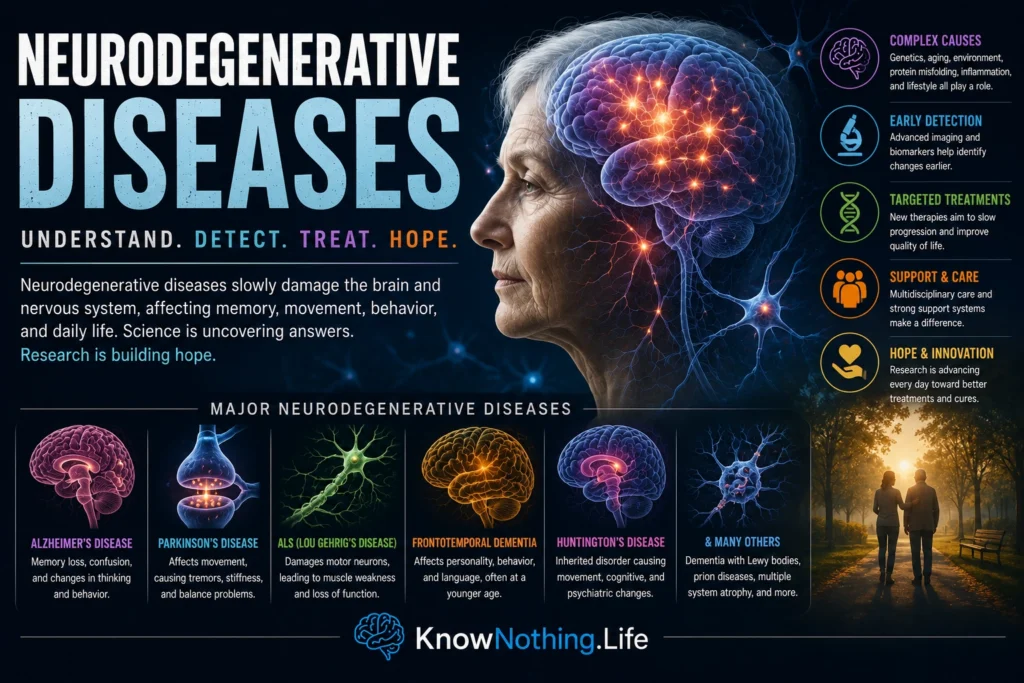
Neurodegenerative diseases are disorders in which neurons and their supporting networks progressively lose function and, in many cases, die. The category includes Alzheimer’s disease, Parkinson’s disease, amyotrophic lateral sclerosis, Huntington’s disease, frontotemporal dementia, dementia with Lewy bodies, and several rarer conditions. Each illness has a distinct pattern, but all can gradually interfere with abilities that depend on the nervous system, including memory, movement, language, judgment, swallowing, and breathing. Unlike an acute injury, degeneration generally unfolds over months or years, often beginning long before obvious disability appears.
The public-health burden is substantial and increasing as populations age. The Global Burden of Disease Study 2021 found that disorders affecting the nervous system had become the leading global cause of disability-adjusted life years, with dementias, Parkinson’s disease, motor neuron disease, and other degenerative conditions contributing to that burden. Neurodegeneration is not solely a problem of old age. Huntington’s disease and inherited forms of Alzheimer’s, Parkinson’s, and ALS may begin in midlife or earlier. The consequences also reshape family roles, employment, caregiving, and long-term planning.
Protein Misfolding and Selective Vulnerability
A defining feature of many neurodegenerative diseases is the accumulation of proteins that have folded abnormally or escaped normal systems of disposal. Alzheimer’s disease is associated with beta-amyloid plaques and intracellular tau tangles; Parkinson’s disease and dementia with Lewy bodies involve alpha-synuclein; ALS and frontotemporal dementia may involve TDP-43 or abnormal repeat-derived proteins; and Huntington’s disease results from an expanded polyglutamine sequence in huntingtin. These proteins differ, but their accumulation can disturb synapses, axonal transport, mitochondria, gene regulation, and cellular recycling systems.
Landmark studies helped establish this protein-centered view. Heiko and Eva Braak showed that Alzheimer-related neurofibrillary changes tend to appear in an ordered anatomical sequence, while John Hardy and Gerald Higgins proposed the influential amyloid cascade hypothesis. In Parkinson’s research, Maria Grazia Spillantini and colleagues demonstrated in 1997 that alpha-synuclein is a major component of Lewy bodies. Yet deposits alone do not explain why specific neurons are vulnerable. Affected cells may have unusually long axons, high energy demands, distinctive firing patterns, or limited capacity to clear damaged proteins.
Major Diseases and Their Neural Systems
Alzheimer’s disease usually begins with impairment in forming and retrieving recent memories because early pathology often affects medial temporal structures and connected cortical networks. As degeneration spreads, language, spatial reasoning, judgment, and self-care may decline. Parkinson’s disease primarily damages dopamine-producing neurons in the substantia nigra, producing slowness, rigidity, tremor, and gait difficulty, but it can also disturb sleep, mood, autonomic function, and cognition. Frontotemporal degeneration more often begins with changes in personality, social behavior, executive control, or language. The different patterns reflect the selective vulnerability of particular neural systems rather than uniform deterioration throughout the brain.
Motor neuron diseases selectively damage cells controlling voluntary movement. In ALS, degeneration of upper and lower motor neurons causes progressive weakness, muscle wasting, swallowing difficulty, and respiratory failure, although sensation may remain relatively preserved. Huntington’s disease affects movement, cognition, and psychiatric function through degeneration involving the striatum and wider networks. Prion diseases progress much more rapidly and demonstrate that an abnormal protein structure can propagate by inducing abnormal folding in other proteins. Stanley Prusiner’s 1982 paper introduced the term “prion” for a proteinaceous infectious particle associated with transmissible neurodegeneration.
Genetics, Aging, and Environmental Influence
Genetic discoveries have clarified disease mechanisms and revealed connections among diagnoses. The Huntington’s Disease Collaborative Research Group identified the expanded CAG repeat responsible for Huntington’s disease in 1993, providing a direct link between a mutation and progressive neuronal loss. In 2011, independent teams identified a hexanucleotide repeat expansion in C9ORF72 as a major cause of both ALS and frontotemporal dementia. That discovery helped explain why movement, behavior, language, and cognition can be affected within the same family and why diagnostic categories sometimes represent different expressions of a shared biological process.
Most neurodegenerative diseases are not caused by a single mutation. Aging changes mitochondrial performance, immune regulation, vascular health, DNA repair, protein clearance, and the resilience of neural networks. Genetic variants may alter risk without determining whether disease will occur, while environmental exposures, head injury, cardiovascular health, sleep, education, and physical activity may influence vulnerability or cognitive reserve. The same pathological burden can therefore produce different outcomes in different people, which is one reason prediction remains difficult even when genetic or biomarker abnormalities are detected.
Diagnosis and the Rise of Biomarkers
Diagnosis traditionally begins with the medical history, neurological examination, cognitive testing, and observation of how symptoms progress. Magnetic resonance imaging can reveal patterns of atrophy, vascular injury, tumors, or alternative causes, while positron-emission tomography can measure brain metabolism or detect proteins such as amyloid and tau. Genetic testing may be appropriate when symptoms begin unusually early or several relatives are affected. Because depression, medication effects, sleep disorders, infections, vitamin deficiencies, and vascular disease can imitate degeneration, clinicians must avoid assuming that every memory or movement problem represents a neurodegenerative condition.
Biomarkers are shifting diagnosis from symptom-based categories toward biological definitions. Cerebrospinal-fluid and blood tests can detect amyloid-related changes, phosphorylated tau, and neurofilament light chain, a structural protein released during neuroaxonal damage. Studies have connected elevated plasma neurofilament levels with Alzheimer-related neurodegeneration and an increased likelihood of cognitive decline in Parkinson’s disease. Alpha-synuclein seed-amplification assays can detect the abnormal protein-seeding activity associated with synuclein disorders. Earlier biological detection could improve clinical trials, but it creates difficult questions when a test predicts risk before an effective preventive treatment exists.
Treatment and Disease Modification
Most established treatments manage symptoms rather than stopping neuronal loss. Medications may temporarily support cognition in dementia, restore part of the lost dopaminergic signaling in Parkinson’s disease, or reduce specific movement, psychiatric, sleep, and autonomic symptoms. Physical, occupational, and speech therapies help preserve mobility, communication, swallowing, and independence. Deep-brain stimulation can reduce medication-responsive motor complications in carefully selected people with Parkinson’s disease. In a randomized trial led by Günther Deuschl, subthalamic stimulation produced greater improvements in motor function and quality of life than medical management alone, although it did not halt the underlying neurodegeneration.
Recent trials show that modifying a disease mechanism is possible, although benefits remain limited and condition-specific. In the Clarity AD trial, lecanemab reduced amyloid and modestly slowed cognitive and functional decline over 18 months in people with early Alzheimer’s disease, while creating risks that included brain swelling and bleeding. Tofersen, an antisense oligonucleotide designed for SOD1-associated ALS, reduced concentrations of SOD1 and neurofilament proteins, although its phase-three trial did not produce a statistically significant improvement in the primary clinical outcome after 28 weeks. These therapies illustrate why biomarker change, functional benefit, safety, cost, and treatment burden must be evaluated separately.
Living With Degeneration and the Future of Research
Neurodegenerative disease changes more than performance on a neurological test. Patients may lose employment, driving privileges, independence, communication, or the ability to make complex decisions. Families frequently provide years of supervision, physical assistance, and emotional support while coping with uncertain progression. Good care therefore includes management of sleep, pain, mood, nutrition, falls, swallowing, respiratory function, caregiver strain, and advance planning. Palliative care can be introduced alongside active neurological treatment to improve comfort and decision-making rather than being reserved exclusively for the final stage of illness.
The future will likely involve combinations of therapies matched to disease stage and individual biology. Researchers are investigating antibodies, gene replacement, gene silencing, RNA-targeting drugs, immune modulation, mitochondrial support, cell replacement, and treatments intended to improve protein clearance or synaptic repair. Success will require identifying which processes are active in each patient and intervening before extensive neuronal loss has occurred. Scientific progress must also be paired with equitable access, realistic communication, and respect for autonomy. Neurodegenerative diseases affect the systems through which people move, remember, communicate, and understand themselves, making humane long-term care as essential as molecular discovery.