
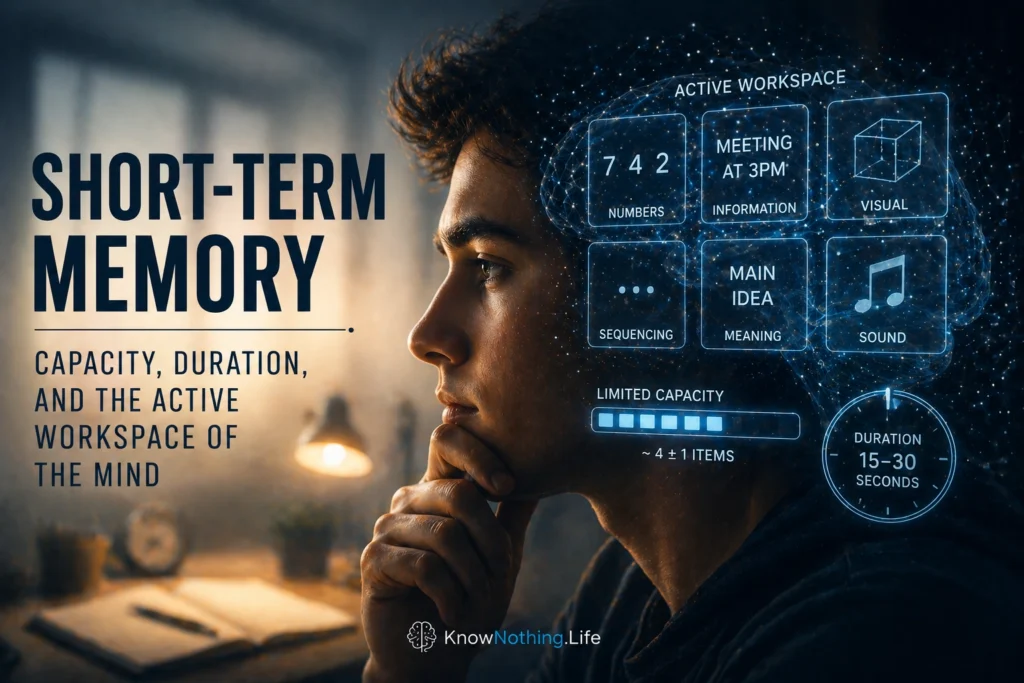
Short-term memory is the cognitive system responsible for temporarily holding a limited amount of information in an accessible state. It allows individuals to retain information for brief periods—typically seconds to minutes—while engaging in tasks such as reasoning, comprehension, and decision-making. Whether remembering a phone number long enough to dial it or holding a sentence in mind while interpreting its meaning, short-term memory functions as a mental workspace that supports ongoing cognition.
Despite its apparent simplicity, short-term memory reveals fundamental constraints of the human mind. It is characterized by limited capacity and duration, meaning that only a small amount of information can be held at any given time, and it decays rapidly without active maintenance. These limitations are not merely weaknesses but reflect the efficiency of the cognitive system, which prioritizes relevant information while discarding what is no longer needed. Understanding short-term memory provides insight into how the mind manages information in real time.
Historical Foundations and Early Research
The scientific investigation of short-term memory gained momentum in the mid-20th century as part of the broader cognitive revolution. Early researchers sought to understand the limits of immediate memory and the mechanisms underlying its operation. One of the most influential contributions came from George A. Miller, whose famous paper “The Magical Number Seven, Plus or Minus Two” suggested that individuals can hold approximately seven units of information in short-term memory.
Miller’s work highlighted the concept of capacity limitations and introduced the idea of chunking, where individual pieces of information are grouped into larger, meaningful units. This process allows for more efficient use of limited memory resources, demonstrating that capacity is not fixed but can be influenced by how information is organized. For example, remembering a sequence of digits becomes easier when they are grouped into familiar patterns, such as dates or phone numbers.
Subsequent research refined these findings, suggesting that the actual capacity of short-term memory may be closer to four chunks rather than seven. These developments reflect the evolving understanding of memory as a dynamic system, influenced by factors such as attention, complexity, and prior knowledge. Early research laid the foundation for more sophisticated models that continue to shape contemporary theories of short-term memory.
Capacity and Duration: Limits of Immediate Memory
Short-term memory is defined by its limited capacity and brief duration. Without active rehearsal, information typically fades within 15 to 30 seconds. This rapid decay highlights the transient nature of short-term memory, distinguishing it from long-term memory, where information can be stored for extended periods. The fleeting quality of short-term memory underscores its role as a temporary holding system rather than a permanent repository.
Capacity limitations are equally significant. The concept of chunking demonstrates that capacity is influenced by the structure and meaning of information. For example, a sequence of random letters may be difficult to remember, while the same letters arranged into familiar acronyms can be retained more easily. This illustrates how cognitive organization enhances memory performance, allowing individuals to maximize limited resources.
These constraints have important implications for cognitive functioning. Tasks that exceed the capacity of short-term memory can lead to errors, confusion, and reduced efficiency. Understanding these limits helps explain why complex instructions are difficult to follow without external aids and why breaking information into smaller units can improve comprehension. Short-term memory’s limitations are thus central to understanding how information is processed in real time.
Maintenance and Rehearsal Processes
To counteract the rapid decay of information, short-term memory relies on maintenance processes such as rehearsal. Rehearsal involves the active repetition of information, either silently or aloud, to keep it accessible. This process allows individuals to extend the duration of short-term memory, maintaining information long enough to use or transfer it to long-term storage.
There are different types of rehearsal, each with distinct effects on memory. Maintenance rehearsal focuses on simple repetition, helping to preserve information in its original form. Elaborative rehearsal, in contrast, involves linking new information to existing knowledge, enhancing understanding and facilitating long-term retention. While maintenance rehearsal supports short-term retention, elaborative rehearsal plays a key role in the transition to long-term memory.
The effectiveness of rehearsal depends on attention and cognitive resources. Distractions or competing tasks can disrupt rehearsal, leading to rapid forgetting. This highlights the interplay between short-term memory and attention, as maintaining information requires focused cognitive effort. Rehearsal processes illustrate how short-term memory is not a passive system but an active, dynamic component of cognition.
Short-Term Memory and Working Memory
Short-term memory is often closely associated with the concept of working memory, though the two are not identical. While short-term memory refers primarily to the storage of information, working memory encompasses both storage and manipulation. It involves actively processing information, such as solving problems, understanding language, or making decisions.
The working memory model, proposed by Alan Baddeley, provides a more comprehensive framework for understanding this system. It includes components such as the phonological loop, which handles verbal information; the visuospatial sketchpad, which processes visual and spatial data; and the central executive, which coordinates attention and control. This model highlights the complexity of short-term memory processes, emphasizing their role in active cognition.
The distinction between short-term and working memory reflects a broader shift in cognitive psychology toward dynamic models of mental processes. Rather than viewing memory as a static store, these models emphasize its role in ongoing cognitive activity. Working memory, as an extension of short-term memory, illustrates how temporary storage and active processing are integrated within the mind.
Neural Basis of Short-Term Memory
The neural mechanisms underlying short-term memory involve a network of brain regions that support temporary storage and active processing. The prefrontal cortex plays a central role in maintaining information, particularly in tasks that require attention and control. Activity in this region is associated with the sustained representation of information, even in the absence of external stimuli.
Other brain areas contribute to specific types of short-term memory. For example, regions in the temporal and parietal lobes are involved in processing verbal and spatial information, respectively. These areas interact with the prefrontal cortex to support the maintenance and manipulation of information. This distributed network reflects the complexity of short-term memory and its integration with other cognitive functions.
Neuroscientific research has also explored the mechanisms by which information is temporarily stored, including patterns of neural activation and synaptic activity. These processes allow for the rapid updating and flexibility of short-term memory, enabling the mind to adapt to changing demands. Understanding the neural basis of short-term memory provides a bridge between cognitive theory and biological processes.
Interference and Forgetting
Forgetting in short-term memory is often attributed to interference rather than simple decay. Interference occurs when new information disrupts the retention of existing information or when similar items compete for representation. This phenomenon highlights the vulnerability of short-term memory to competing demands, particularly in complex or dynamic environments.
There are different types of interference, including proactive interference, where previously learned information interferes with new information, and retroactive interference, where new information disrupts the recall of earlier material. These effects demonstrate that forgetting is not merely a passive loss of information but an active process influenced by the interaction of multiple memory traces.
Understanding interference has practical implications for improving memory performance. Strategies such as minimizing distractions, organizing information, and spacing learning can reduce interference and enhance retention. These approaches reflect the importance of managing cognitive load and structuring information effectively within short-term memory.
Short-Term Memory in Everyday Life
Short-term memory plays a critical role in everyday activities, supporting tasks that require immediate access to information. From following directions to engaging in conversation, it enables individuals to maintain and manipulate information in real time. Its limitations, however, can lead to challenges, particularly in situations that demand sustained attention or complex processing.
In educational contexts, short-term memory is essential for understanding new material and integrating it with existing knowledge. Students who struggle with short-term memory may find it difficult to follow instructions or retain information long enough to process it effectively. Recognizing these challenges can inform teaching strategies that accommodate cognitive limitations.
In professional settings, short-term memory supports tasks such as problem-solving, decision-making, and multitasking. Understanding its constraints can lead to more effective work practices, such as breaking tasks into manageable steps and using external aids to reduce cognitive load. Short-term memory is thus a central component of cognitive functioning, influencing performance across domains.
Future Directions and Expanding Understanding
The study of short-term memory continues to evolve, incorporating new insights from neuroscience, psychology, and computational modeling. Advances in brain imaging and experimental techniques are providing more detailed understanding of how information is maintained and manipulated in real time. These developments are refining theoretical models and expanding our knowledge of cognitive processes.
Emerging research is also exploring the interaction between short-term memory and other cognitive systems, such as attention, perception, and long-term memory. These interactions highlight the integrated nature of cognition, where multiple processes work together to support behavior. Understanding these relationships is essential for developing comprehensive models of the mind.
As cognitive demands increase in modern environments, understanding short-term memory remains a critical area of inquiry. Its role as a temporary workspace makes it central to learning, problem-solving, and decision-making. By examining its mechanisms and limitations, cognitive psychology continues to shed light on how the mind manages information in the moment, offering insights that are both theoretically significant and practically valuable.