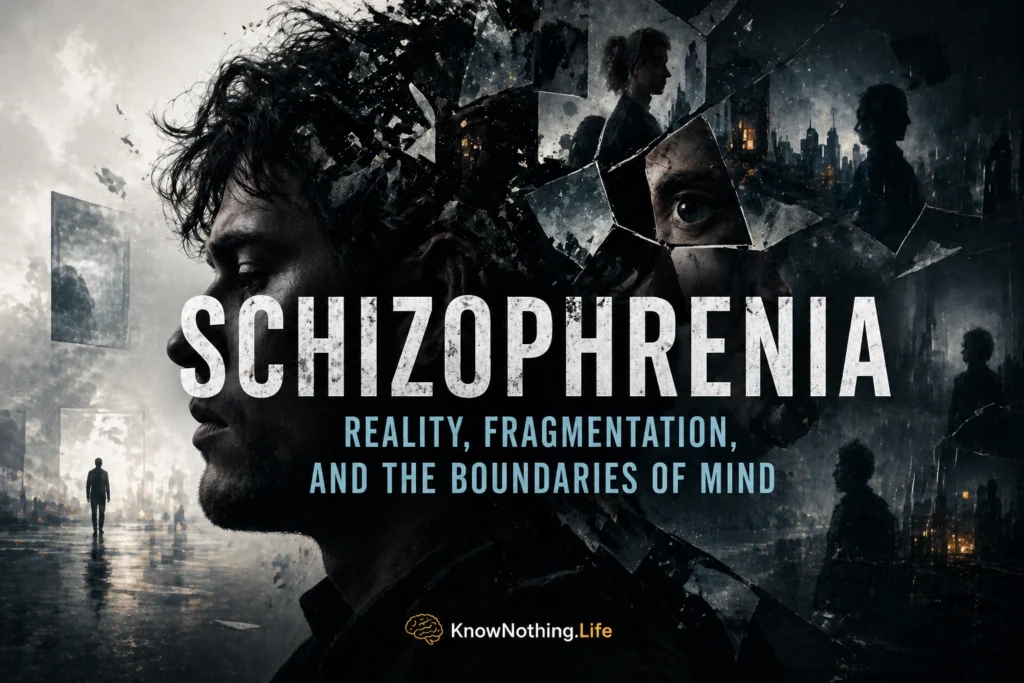
Schizophrenia is one of the most profound and challenging conditions in psychiatry, not only because of its severity but because it alters the very structure of reality as experienced by the individual. It is characterized by disruptions in thought, perception, emotion, and behavior, often involving hallucinations, delusions, and disorganized thinking. Unlike disorders that primarily affect mood, schizophrenia strikes at the coherence of consciousness itself, raising deep questions about what it means to perceive, interpret, and inhabit the world.
The term “schizophrenia” was introduced by Eugen Bleuler in 1911, derived from the Greek words for “split” (schizo) and “mind” (phren). Contrary to popular misunderstanding, this does not refer to a split personality but rather a fragmentation of mental processes. Bleuler sought to capture the disintegration of associative thinking, emotional responsiveness, and volitional control that he observed in patients. His work built on earlier descriptions by Emil Kraepelin, who had labeled the condition dementia praecox, emphasizing its early onset and progressive course.
Clinical Features and Symptom Structure
Schizophrenia is typically defined through a constellation of symptoms grouped into three broad categories: positive, negative, and cognitive. Positive symptoms include hallucinations—most commonly auditory voices—and delusions, which are fixed, false beliefs resistant to contradictory evidence. These experiences are not simply exaggerated perceptions but qualitatively different modes of reality, often imbued with personal significance and emotional intensity.
Negative symptoms involve the diminishment or absence of normal functions. These include reduced emotional expression (flat affect), lack of motivation (avolition), diminished speech (alogia), and social withdrawal. While less dramatic than hallucinations or delusions, negative symptoms are often more debilitating over time, as they erode the individual’s ability to engage with daily life and maintain relationships. Cognitive symptoms, such as impaired attention, memory, and executive functioning, further complicate functioning, making tasks that require planning or sustained focus difficult.
Psychiatrist Kurt Schneider identified what he called “first-rank symptoms,” including hearing voices commenting on one’s actions or experiencing thoughts as being inserted or controlled by external forces. These features highlight a central disturbance in schizophrenia: the boundary between self and world becomes unstable. As patients often report, their own thoughts may feel alien, as though authored by someone else, challenging the fundamental sense of agency.
Neurobiology and Genetic Foundations
Modern research has increasingly illuminated the biological underpinnings of schizophrenia, though no single cause has been identified. One of the most influential frameworks is the dopamine hypothesis, which suggests that dysregulated dopamine activity—particularly in mesolimbic pathways—contributes to positive symptoms such as hallucinations and delusions. Antipsychotic medications, which often block dopamine receptors, provide indirect support for this theory, though it does not fully account for the disorder’s complexity.
Neuroimaging studies reveal structural differences in the brains of individuals with schizophrenia, including enlarged ventricles and reduced gray matter in regions such as the prefrontal cortex and temporal lobes. These areas are associated with decision-making, language, and sensory processing, suggesting that schizophrenia involves disruptions in the integration of cognitive and perceptual information. Functional imaging also shows altered connectivity between brain regions, supporting the idea that schizophrenia is a disorder of neural networks rather than isolated structures.
Genetic factors play a substantial role, with heritability estimates around 70% to 80%. Family, twin, and adoption studies consistently demonstrate increased risk among relatives of affected individuals. However, as with bipolar disorder, schizophrenia arises from the interaction of genetic vulnerability with environmental influences, such as prenatal complications, early life stress, and social adversity. This multifactorial model reflects the broader understanding of psychiatric conditions as emerging from dynamic systems rather than single causes.
Psychological Experience and Phenomenology
To understand schizophrenia fully, it is not enough to catalog its symptoms; one must attempt to grasp the subjective experience of those who live with it. Phenomenological approaches, influenced by philosophers such as Edmund Husserl, emphasize the structure of lived experience. In schizophrenia, this structure is often disrupted at a fundamental level, affecting how time, space, and selfhood are perceived.
Psychiatrist R. D. Laing, in The Divided Self, described schizophrenia not merely as a biological disorder but as a crisis of identity and existence. He argued that the individual may retreat into a private world as a response to overwhelming social and psychological pressures. While Laing’s views remain controversial, they highlight the importance of understanding schizophrenia as a human experience, not just a clinical diagnosis. He wrote, “Insanity—a perfectly rational adjustment to an insane world,” suggesting that the condition may reflect deeper tensions between the individual and society.
Patients often describe a sense of derealization or depersonalization, in which the world feels unreal or the self feels detached. Ordinary objects may take on unusual meanings, and everyday events can be interpreted as part of a larger, often threatening, narrative. This heightened sense of significance, sometimes called “aberrant salience,” contributes to the formation of delusions. As the philosopher Karl Jaspers noted in General Psychopathology, certain experiences in schizophrenia are “un-understandable” in the sense that they cannot be fully grasped through normal empathy, marking a limit of human comprehension.
Treatment and Management
Treatment for schizophrenia has evolved significantly over the past century, though challenges remain. Antipsychotic medications are the primary intervention, helping to reduce positive symptoms by modulating neurotransmitter activity. First-generation antipsychotics, such as chlorpromazine, were introduced in the 1950s, followed by second-generation drugs with broader receptor profiles and fewer motor side effects. However, these medications often have significant side effects, including weight gain, sedation, and metabolic changes, which can affect adherence.
Psychosocial interventions are essential for improving long-term outcomes. Cognitive-behavioral therapy for psychosis (CBTp) helps individuals question and reframe delusional beliefs, while social skills training and supported employment programs address functional impairments. Family therapy and psychoeducation also play a critical role, as supportive environments can reduce relapse rates and improve quality of life.
Despite these advances, schizophrenia remains a chronic condition for many. Early intervention programs have shown promise in improving outcomes by addressing symptoms at their onset, but access to care varies widely. The recovery model emphasizes that individuals can lead meaningful lives even with ongoing symptoms, shifting the focus from cure to resilience and adaptation.
Social Impact and Stigma
Schizophrenia carries a significant social burden, both for individuals and for society. The disorder often emerges in late adolescence or early adulthood, disrupting education, employment, and social development at a critical stage of life. Many individuals face challenges in maintaining stable housing, employment, and relationships, contributing to cycles of disadvantage and marginalization.
Stigma remains one of the most persistent obstacles. Misrepresentations of schizophrenia in media and popular culture often associate it with violence or unpredictability, despite evidence that most individuals with the condition are not dangerous. These misconceptions can lead to fear, discrimination, and social exclusion, further isolating those affected.
Sociologist Erving Goffman, in Stigma: Notes on the Management of Spoiled Identity, argued that societal labels can profoundly shape self-concept and opportunity. For individuals with schizophrenia, stigma can be as debilitating as the symptoms themselves, limiting access to resources and reinforcing a sense of otherness. Efforts to reduce stigma must therefore address not only public attitudes but also structural inequalities in healthcare, housing, and employment.
Conclusion
Schizophrenia stands at the intersection of biology, psychology, and philosophy, challenging our understanding of mind and reality. It reveals how fragile the structures of perception and identity can be, and how deeply they depend on the integration of neural, cognitive, and social processes. While scientific advances have improved diagnosis and treatment, the condition continues to pose profound questions about the nature of consciousness and the limits of empathy.
Ultimately, schizophrenia is not only a medical condition but a human experience that demands both scientific rigor and compassionate understanding. By integrating biological research with phenomenological insight and social awareness, we can move toward a more comprehensive and humane approach to care. In doing so, we not only improve outcomes for those affected but also deepen our understanding of the mind itself.