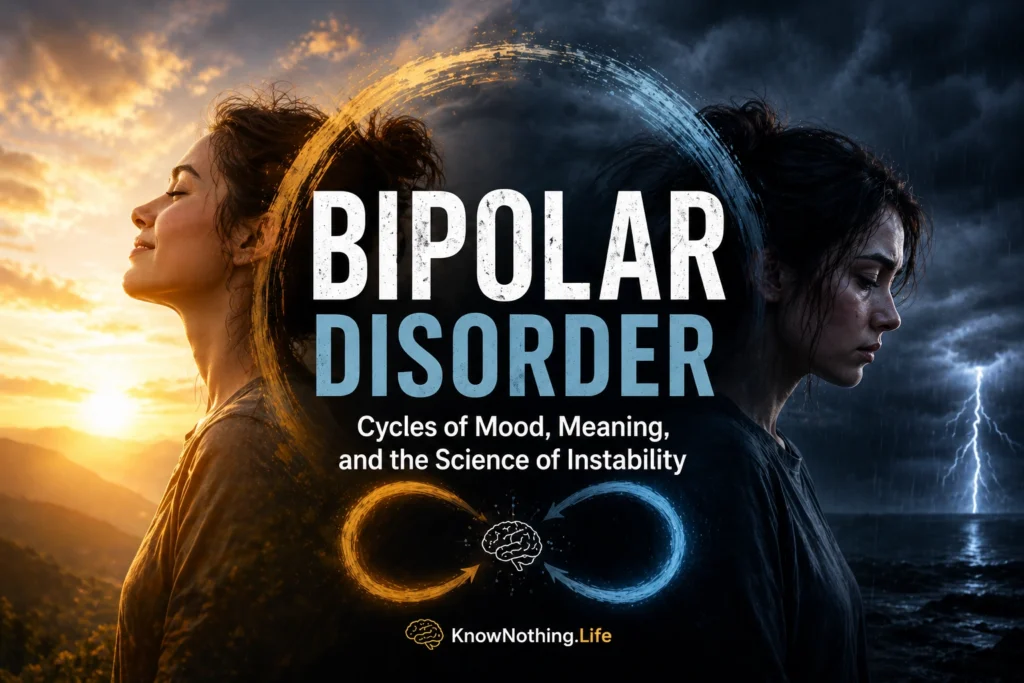
Bipolar disorder is one of the most complex and misunderstood conditions in modern psychiatry. Characterized by alternating periods of elevated mood (mania or hypomania) and depression, it challenges simple explanations of mental health by demonstrating how dramatically human emotion, energy, and perception can fluctuate within the same individual. Far from being mere mood swings, these episodes represent profound shifts in cognition, physiology, and behavior, often disrupting relationships, identity, and the continuity of lived experience.
Historically, bipolar disorder has been recognized for centuries under different names. The ancient Greek physician Hippocrates described forms of “melancholia” and “mania,” while the modern conceptualization emerged through the work of Emil Kraepelin, who distinguished manic-depressive illness from other psychiatric disorders in the early 20th century. Today, bipolar disorder is understood as a spectrum condition with biological, psychological, and social dimensions, requiring an integrated approach to diagnosis and treatment.
Clinical Features and Diagnosis
Bipolar disorder is defined by the presence of distinct mood episodes. Manic episodes involve elevated or irritable mood, increased energy, reduced need for sleep, grandiosity, rapid speech, and impulsive or risky behavior. In contrast, depressive episodes mirror the symptoms of major depression: persistent sadness, fatigue, diminished interest in activities, and cognitive slowing. Hypomania, a less severe form of mania, can appear deceptively functional, sometimes even enhancing productivity or creativity, which complicates early recognition and diagnosis.
The diagnostic criteria outlined in the Diagnostic and Statistical Manual of Mental Disorders emphasize the duration, severity, and impact of these episodes. Bipolar I disorder requires at least one full manic episode, while Bipolar II involves hypomania and major depression without full mania. Cyclothymic disorder reflects a chronic but less severe pattern of mood instability. Despite these classifications, clinicians increasingly recognize that bipolar disorder exists along a continuum, with overlapping features and individual variability.
Psychiatrist Kay Redfield Jamison, who has both studied and lived with the condition, captures its duality in An Unquiet Mind: “Others have described the emotional extremes of bipolar illness as a ‘roller coaster,’ but I think of it as more like being caught in a storm.” This metaphor underscores not only the intensity of mood shifts but also their unpredictability and lack of control.
Neurobiology and Genetic Foundations
Advances in neuroscience have transformed the understanding of bipolar disorder from a purely descriptive diagnosis to a condition rooted in brain function and biology. Research indicates that dysregulation in neurotransmitter systems—particularly dopamine, serotonin, and norepinephrine—plays a key role in mood instability. During manic episodes, increased dopaminergic activity is often observed, contributing to heightened reward sensitivity and impulsivity, while depressive phases are associated with reduced neurotransmitter activity.
Brain imaging studies reveal structural and functional differences in regions involved in emotional regulation, such as the prefrontal cortex, amygdala, and hippocampus. These areas are responsible for decision-making, emotional processing, and memory, suggesting that bipolar disorder involves disruptions in the neural circuits that balance emotion and cognition. The concept of “neuroprogression” has also been proposed, indicating that repeated mood episodes may lead to cumulative changes in brain structure and function over time.
Genetics plays a substantial role, with heritability estimates ranging from 60% to 80%. Family studies consistently show that individuals with a first-degree relative who has bipolar disorder are at significantly higher risk. However, no single gene determines the condition; rather, it arises from the interaction of multiple genetic vulnerabilities with environmental stressors. This aligns with the broader biopsychosocial model of mental illness, emphasizing that biology sets the stage, but life experience shapes the outcome.
Psychological Experience and Identity
Beyond its biological basis, bipolar disorder profoundly affects how individuals experience themselves and the world. Mania can bring feelings of euphoria, invincibility, and heightened creativity, sometimes leading individuals to perceive it as a desirable or even essential part of their identity. Depression, by contrast, often involves a collapse of meaning, motivation, and self-worth, creating a stark contrast that can be psychologically disorienting.
The philosopher William James, in The Varieties of Religious Experience, described the “divided self” as a state in which opposing emotional realities coexist within a single individual. Although not writing specifically about bipolar disorder, his insights resonate with the lived experience of those who navigate extreme mood states. The oscillation between mania and depression can create a fragmented sense of identity, raising questions about authenticity: Which version of the self is real?
Contemporary psychology also explores the relationship between bipolar disorder and creativity. Historical figures such as Vincent van Gogh and Virginia Woolf are often cited in discussions of mood disorders and artistic expression. While it is important to avoid romanticizing mental illness, research suggests that certain cognitive traits associated with hypomania—such as divergent thinking and increased associative processes—may contribute to creative output. However, these benefits are frequently outweighed by the destabilizing effects of the disorder.
Treatment and Management
Effective treatment for bipolar disorder requires a comprehensive and individualized approach. Pharmacotherapy remains the cornerstone, with mood stabilizers such as lithium being among the most widely used and well-researched options. Lithium’s effectiveness was first systematically demonstrated by John Cade in the mid-20th century, revolutionizing the treatment of mood disorders. Anticonvulsants and atypical antipsychotics are also commonly prescribed, particularly for managing acute mania or preventing relapse.
Psychotherapy plays a critical role in long-term management. Cognitive-behavioral therapy (CBT), interpersonal and social rhythm therapy (IPSRT), and psychoeducation help individuals recognize early warning signs, regulate daily routines, and develop coping strategies. Maintaining stable sleep patterns, managing stress, and adhering to medication are essential components of relapse prevention.
Despite advances in treatment, challenges remain. Medication side effects, stigma, and the fluctuating nature of the disorder can make adherence difficult. As Jamison notes, “The temptation to abandon treatment is greatest precisely when it is working.” This paradox highlights the importance of ongoing support, education, and a collaborative relationship between patients and clinicians.
Social Impact and Stigma
Bipolar disorder does not exist in isolation; it affects relationships, careers, and social functioning. During manic episodes, individuals may engage in behaviors that strain trust and create long-term consequences, such as financial instability or damaged relationships. Depressive episodes can lead to withdrawal, reduced productivity, and difficulty maintaining daily responsibilities. These disruptions often contribute to a cycle of stress that exacerbates the condition.
Stigma remains a significant barrier to diagnosis and treatment. Misconceptions about bipolar disorder—such as equating it with simple moodiness or unpredictability—can lead to misunderstanding and discrimination. Public awareness has improved in recent years, partly due to advocacy by public figures and mental health organizations, but gaps in knowledge persist.
Sociologist Erving Goffman, in his work Stigma: Notes on the Management of Spoiled Identity, argued that society often defines individuals by their perceived deviations from the norm. For those with bipolar disorder, this can result in being reduced to their diagnosis, rather than recognized as complex individuals with diverse experiences and capacities.
Conclusion
Bipolar disorder challenges fundamental assumptions about stability, identity, and the nature of mental health. It reveals how deeply intertwined biology, psychology, and social context are in shaping human experience. While significant progress has been made in understanding and treating the condition, it remains a lifelong challenge for many who live with it.
At its core, bipolar disorder is not simply a disorder of mood but a disorder of regulation—of energy, thought, and emotional equilibrium. Recognizing this complexity is essential for reducing stigma, improving treatment, and supporting those affected. As both a clinical condition and a human experience, it invites a broader reflection on the fragility and resilience of the mind.