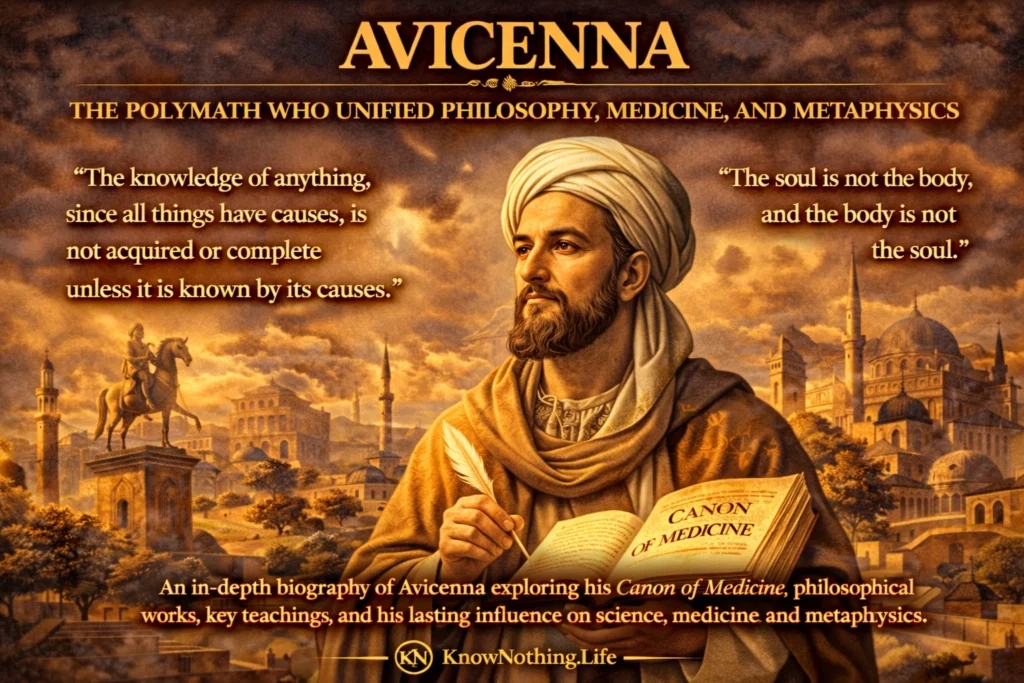
Among the greatest intellectual figures of the medieval world, Avicenna—known in Arabic as Ibn Sina—stands as a towering presence whose work bridged cultures, disciplines, and centuries. A philosopher, physician, scientist, and theologian, Avicenna made foundational contributions to both Islamic and Western intellectual traditions. His ability to synthesize Greek philosophy, particularly that of Aristotle, with Islamic thought resulted in a system of remarkable depth and coherence.
What distinguishes Avicenna is not only the breadth of his knowledge but the unity of his vision. He sought to understand reality as a whole, connecting questions of existence, knowledge, and the human soul into a comprehensive philosophical framework. His writings influenced scholars from the Islamic world to medieval Europe, shaping fields as diverse as medicine, metaphysics, and logic. Through this legacy, Avicenna remains one of the most important thinkers in the history of philosophy.
Early Life and Education
Avicenna was born in 980 CE near Bukhara, in present-day Uzbekistan, within the cultural sphere of the Samanid Empire. His early life was marked by intellectual precocity. By the age of ten, he had memorized the Quran, and he quickly advanced in his studies of literature, mathematics, and philosophy. His education was guided by both formal teachers and his own relentless curiosity.
As a young student, Avicenna encountered the works of Aristotle, which initially proved difficult for him to understand. He famously recounted reading Aristotle’s Metaphysics multiple times without grasping its meaning, only achieving clarity after studying a commentary by al-Farabi. This experience illustrates both his persistence and the collaborative nature of intellectual development during this period.
His talent soon brought him recognition. By his late teens, Avicenna had mastered medicine to such an extent that he was called upon to treat the ruler of Bukhara. His successful treatment earned him access to the royal library, where he encountered a vast collection of texts. This exposure further expanded his knowledge and set the stage for his future contributions.
Career and Intellectual Environment
Avicenna’s life was characterized by both intellectual achievement and political instability. Following the decline of the Samanid Empire, he moved between various courts and cities, serving as a physician, advisor, and administrator. These roles provided him with both opportunities and challenges, as he navigated shifting political landscapes while continuing his scholarly work.
Despite these disruptions, Avicenna maintained an extraordinary level of productivity. He wrote extensively on philosophy, medicine, astronomy, and other subjects, often composing works under difficult conditions. His ability to produce such a vast body of writing reflects both his discipline and his commitment to intellectual inquiry.
His career also brought him into contact with other scholars and traditions, allowing him to engage with a wide range of ideas. This exchange enriched his work, enabling him to refine his arguments and develop a distinctive philosophical system. Through this process, Avicenna became a central figure in the intellectual life of the Islamic Golden Age.
The Canon of Medicine and Scientific Contributions
One of Avicenna’s most influential works is the The Canon of Medicine, a comprehensive medical encyclopedia that remained a standard reference in both the Islamic world and Europe for centuries. The Canon systematized medical knowledge, combining Greek, Persian, and his own observations into a coherent framework.
In this work, Avicenna emphasized empirical observation and logical reasoning, contributing to the development of scientific methodology. He described diseases, treatments, and pharmacology with remarkable precision, and he introduced concepts that would later become central to medical practice. His approach reflects a commitment to understanding the human body as part of a broader natural order.
Beyond medicine, Avicenna made contributions to fields such as physics, psychology, and chemistry. He explored the nature of motion, the structure of the mind, and the properties of substances, often anticipating later developments. His work demonstrates the interconnectedness of scientific and philosophical inquiry, highlighting the value of a unified approach to knowledge.
Metaphysics and the Nature of Being
At the core of Avicenna’s philosophy is his exploration of existence and essence. He introduced a crucial distinction between what a thing is (its essence) and the fact that it exists. This distinction allowed him to develop a sophisticated account of being, addressing questions about necessity, contingency, and causation.
One of his most important contributions is the concept of the “Necessary Existent.” According to Avicenna, everything in the world is contingent—it depends on something else for its existence. However, there must be a being that exists necessarily, without dependence on anything else. This being, which he identifies as God, is the ultimate source of all existence.
Avicenna expressed this idea succinctly: “Every being whose existence is not necessary is caused.” This statement reflects his logical approach to metaphysics, demonstrating how reason can lead to an understanding of fundamental truths. His arguments influenced later philosophers, including Thomas Aquinas, who adapted and expanded upon them in his own work.
The Soul and Human Knowledge
Avicenna’s exploration of the soul is another key aspect of his philosophy. He proposed a thought experiment known as the “floating man,” in which a person is imagined to exist without any sensory input. According to Avicenna, this person would still be aware of their own existence, demonstrating that the soul is distinct from the body.
This argument highlights his belief in the immaterial nature of the soul and its capacity for self-awareness. He viewed the soul as a rational and enduring entity, capable of understanding universal truths. This perspective aligns with his broader philosophical system, which emphasizes the role of intellect in achieving knowledge.
He also explored the process of learning, suggesting that knowledge involves both sensory experience and intellectual insight. By integrating these elements, Avicenna developed a theory of cognition that influenced later philosophical and psychological thought. His work underscores the importance of both observation and reflection in the pursuit of understanding.
Key Teachings and Quotes
Avicenna’s writings contain numerous insights that continue to resonate. One of his notable statements is: “The knowledge of anything, since all things have causes, is not acquired or complete unless it is known by its causes.” This reflects his emphasis on understanding the underlying principles that govern reality.
Another significant teaching is: “The soul is not the body, and the body is not the soul.” This distinction forms the basis of his argument for the immaterial nature of the self, highlighting the independence of consciousness from physical form.
He also observed: “Time is a measure of motion, but it has no existence apart from it.” This statement demonstrates his engagement with philosophical questions about time and change, illustrating his ability to connect abstract concepts with observable phenomena.
Influence and Legacy
The influence of Avicenna extends across cultures and disciplines. His works were translated into Latin and studied extensively in medieval Europe, where they shaped the development of scholastic philosophy and medicine. His ideas on metaphysics, logic, and science became integral to the intellectual tradition of the West.
In the Islamic world, Avicenna’s philosophy continued to inspire scholars and thinkers, contributing to ongoing debates about the relationship between reason and revelation. His ability to integrate diverse sources of knowledge made his work a cornerstone of intellectual life during the Islamic Golden Age.
Modern scholars continue to study Avicenna’s writings, recognizing their relevance to contemporary discussions in philosophy, science, and medicine. His emphasis on rational inquiry, empirical observation, and the unity of knowledge remains a powerful model for intellectual exploration.
Conclusion
Avicenna’s life and work represent a remarkable achievement in the history of human thought. Through his contributions to philosophy, medicine, and science, he created a legacy that transcends cultural and historical boundaries. His ability to synthesize diverse traditions into a coherent system reflects both his intellectual brilliance and his commitment to understanding reality.
Rather than separating disciplines, Avicenna approached knowledge as an interconnected whole. His work demonstrates that the pursuit of truth requires both breadth and depth, combining empirical observation with philosophical reflection. This holistic approach continues to inspire those seeking to understand the complexities of existence.
In a world often divided by specialization and fragmentation, Avicenna’s example offers a reminder of the power of integrated thinking. His philosophy invites us to explore not only the parts of reality, but the connections between them, guiding us toward a more comprehensive and meaningful understanding of the world.