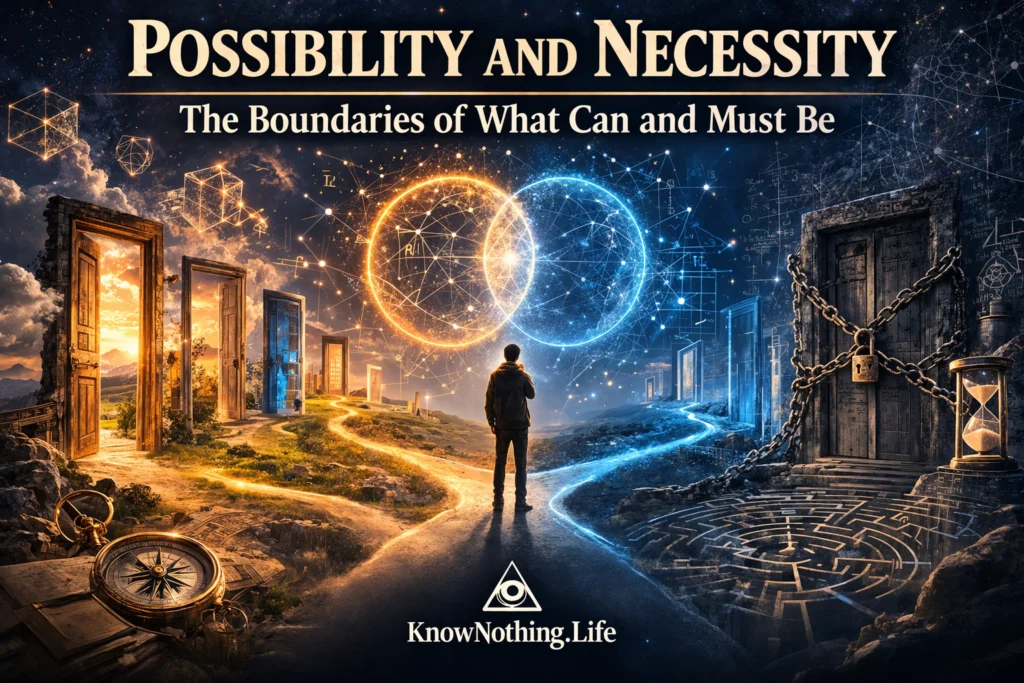
The concepts of possibility and necessity lie at the core of philosophical inquiry into reality. They shape how we understand not only what exists, but what could exist and what must exist. While everyday thinking often treats possibility as mere uncertainty and necessity as certainty, philosophy reveals a deeper structure underlying these ideas. They are not simply about knowledge, but about the nature of reality itself.
To say something is possible is to claim that it could be the case without contradiction. To say something is necessary is to claim that it could not be otherwise. Between these poles lies contingency—what happens to be true but might have been different. These distinctions form the backbone of modal philosophy, influencing logic, metaphysics, theology, and science. The exploration of possibility and necessity opens a broader horizon, extending inquiry beyond the actual world into the realm of potential and inevitability.
Aristotle and the Foundations of Modal Thinking
The systematic study of possibility and necessity begins with Aristotle, whose work in De Interpretatione and the Prior Analytics laid the groundwork for modal logic. Aristotle distinguished between what is necessary, what is possible, and what is contingent, recognizing that not all truths have the same modal status.
For Aristotle, necessity refers to what must be the case and cannot be otherwise, while possibility refers to what can occur without contradiction. He also introduced the idea of potentiality, suggesting that objects and events possess inherent capacities that may or may not be actualized. A seed, for example, has the potential to become a tree, illustrating how possibility is embedded in the nature of things.
Aristotle’s framework connects modality with causation and change. Possibility is not merely abstract but tied to the capacities and conditions that allow events to occur. This integration of modality with the natural world provides a foundation for later philosophical developments, emphasizing that possibility and necessity are not just logical categories but features of reality.
Medieval Philosophy: Necessity and the Divine
In medieval philosophy, possibility and necessity were closely linked to theological concerns, particularly the nature of God and creation. Thomas Aquinas developed a detailed account of these concepts in Summa Theologica, distinguishing between necessary and contingent beings.
Aquinas argued that necessary beings exist by their very nature and cannot fail to exist, while contingent beings depend on external causes. He famously wrote, “That which can not-be at some time is not.” This insight formed the basis of his cosmological argument, which posits that the existence of contingent beings requires a necessary being—God—as the ultimate cause.
This framework elevates necessity to a metaphysical principle. It suggests that necessity is not merely a feature of propositions but of existence itself. The distinction between necessary and contingent beings became central to medieval thought, influencing debates about creation, causation, and the structure of reality.
Leibniz and Possible Worlds
The concept of possible worlds, developed by Gottfried Wilhelm Leibniz, represents a major advancement in the understanding of possibility and necessity. In works such as Monadology, Leibniz proposed that reality consists of one actual world among many possible alternatives.
Leibniz distinguished between necessary truths, which are true in all possible worlds, and contingent truths, which are true only in the actual world. Necessary truths, such as those of logic and mathematics, cannot be otherwise. Contingent truths, by contrast, depend on the particular arrangement of the world and could have been different.
He famously asserted, “Nothing takes place without a sufficient reason.” This principle implies that even contingent events have explanations, though they are not necessary. Leibniz’s framework provides a powerful way of analyzing modality, linking it to logic, metaphysics, and theology. It also raises questions about the status of possible worlds—whether they are real entities or conceptual tools.
Kant and the Epistemology of Modality
Immanuel Kant offered a critical reinterpretation of possibility and necessity in Critique of Pure Reason. Rather than treating them as properties of objects, Kant argued that they are features of judgments—ways in which we relate to knowledge.
For Kant, possibility refers to what is consistent with the conditions of experience, necessity to what follows from the principles of understanding, and actuality to what is confirmed by experience. This approach shifts modality from metaphysics to epistemology, emphasizing the role of the human mind in shaping these concepts.
Kant’s analysis highlights the limits of modal knowledge. While we can determine what is possible or necessary within the framework of experience, we cannot extend these judgments to things-in-themselves. This introduces a boundary to philosophical inquiry, suggesting that our understanding of possibility and necessity is constrained by the structure of cognition.
Kripke and Modern Modal Logic
In the 20th century, Saul Kripke revolutionized the study of modality through the development of modern modal logic. In Naming and Necessity, Kripke challenged traditional assumptions about the relationship between necessity and knowledge.
Kripke introduced the idea that some truths are necessarily true even if they are discovered empirically. For example, the statement “Water is H₂O” is necessarily true, even though it was not known a priori. This distinction between metaphysical necessity and epistemic knowledge reshaped the understanding of modality.
His work also clarified the role of possible worlds in analyzing modal statements. By considering how things could have been different, philosophers can better understand the nature of necessity and possibility. Kripke’s contributions have had a lasting impact, providing a rigorous framework for exploring modal concepts.
Possibility, Necessity, and Human Thought
Beyond formal philosophy, possibility and necessity play a central role in human cognition. The ability to imagine alternative scenarios, consider hypothetical outcomes, and evaluate constraints is essential for reasoning and decision-making. Modal thinking allows individuals to navigate uncertainty and plan for the future.
Psychologically, humans are naturally attuned to modal distinctions. We distinguish between what must happen, what might happen, and what cannot happen, using these categories to interpret the world. This capacity reflects the deep integration of modality into human thought.
In language, modal expressions convey subtle differences in meaning. Words like “must,” “can,” and “might” encode distinctions between necessity and possibility, shaping how statements are understood. This linguistic dimension highlights the pervasive influence of modality across different domains of experience.
The Philosophical Significance of Modality
The study of possibility and necessity reveals the structure of reality beyond what is immediately observable. It allows philosophers to explore the boundaries of existence, considering not only what is actual but what could or must be. This broader perspective has implications for metaphysics, logic, and ethics.
The distinction between necessary and contingent truths influences debates about determinism, free will, and the nature of laws. If certain aspects of reality are necessary, they impose limits on what is possible. If others are contingent, they introduce flexibility and variation.
Philosophically, modality reflects the human capacity to transcend the immediate and consider alternative realities. It challenges us to think beyond the given, exploring the full range of what is conceivable and what is inevitable.
Conclusion
Possibility and necessity are fundamental concepts that shape our understanding of reality. From the foundational work of Aristotle to the theological insights of Thomas Aquinas, the rationalist framework of Gottfried Wilhelm Leibniz, and the modern contributions of Immanuel Kant and Saul Kripke, these ideas have evolved into a rich and complex field.
These perspectives demonstrate that modality is not merely a matter of language or logic but a deep feature of how reality is structured and understood. It reveals that the world is not limited to what is actual but includes a vast space of possibilities and necessities.
Ultimately, the exploration of possibility and necessity invites a broader vision of existence. It encourages us to consider not only what is, but what could be and what must be, expanding our understanding of the world and our place within it.