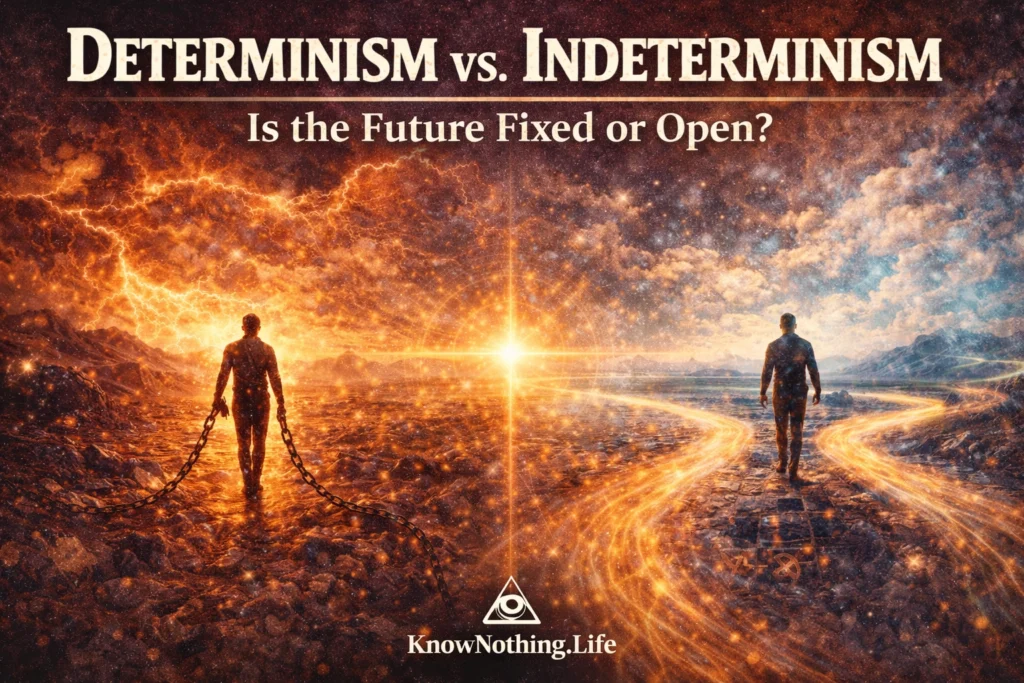
The debate between determinism and indeterminism addresses one of the most profound questions in philosophy: is the course of events fixed by prior causes, or is there genuine openness in how the future unfolds? Determinism holds that every event is necessitated by preceding conditions in accordance with laws of nature, while indeterminism allows for the possibility that not all events are strictly determined. This tension lies at the heart of metaphysics, physics, and ethics, shaping how we understand causation, freedom, and responsibility.
At an intuitive level, determinism offers a sense of order and predictability. If everything follows from prior causes, then the universe operates like a vast, interconnected system. Indeterminism, by contrast, introduces unpredictability and possibility, suggesting that the future is not fully constrained by the past. The philosophical challenge is to reconcile these competing intuitions while accounting for both scientific knowledge and human experience.
Classical Determinism: A Law-Governed Universe
The roots of determinism can be traced to classical philosophy and science, particularly in the work of Isaac Newton. In Philosophiæ Naturalis Principia Mathematica, Newton described a universe governed by precise laws of motion, where the state of the system at one moment determines its state at all future moments. This framework suggested a fully predictable universe, at least in principle.
This deterministic vision was later articulated more explicitly by Pierre-Simon Laplace, who imagined an intelligence capable of knowing all forces and positions of particles at a given time. Such an intelligence—often referred to as “Laplace’s demon”—could, in theory, predict the entire future and reconstruct the entire past. Laplace wrote that for such a being, “nothing would be uncertain and the future, like the past, would be present before its eyes.”
This classical view of determinism portrays the universe as a closed system in which every event is the inevitable result of prior conditions. It provides a powerful framework for scientific explanation but raises questions about the possibility of freedom and novelty.
Indeterminism and the Limits of Predictability
Indeterminism challenges the idea that all events are strictly determined. It suggests that some occurrences are not fully caused by prior states, allowing for genuine randomness or openness in the structure of reality. This perspective gained prominence with developments in modern physics, particularly quantum mechanics.
At the quantum level, events such as the decay of particles appear to occur probabilistically rather than deterministically. Even with complete knowledge of a system, outcomes can only be predicted in terms of probabilities. This undermines the classical deterministic framework and introduces a fundamental level of unpredictability.
Philosophically, indeterminism raises questions about the nature of causation and explanation. If events can occur without sufficient cause, how do we account for them? Some philosophers argue that indeterminism does not imply chaos but reflects a deeper layer of reality that cannot be captured by deterministic laws. It suggests that the universe may be more open and dynamic than previously thought.
Hume and the Nature of Necessity
The debate between determinism and indeterminism is closely tied to the concept of causation, particularly as analyzed by David Hume. In An Enquiry Concerning Human Understanding, Hume questioned whether we can ever observe necessity in the connection between events. He argued that what we call “causation” is based on habitual expectation rather than an observable force.
Hume’s skepticism undermines the foundation of determinism. If causal necessity cannot be directly observed, then the idea that every event is determined by prior causes becomes less certain. At the same time, Hume did not fully embrace indeterminism; instead, he highlighted the limits of human knowledge regarding causal relations.
His analysis suggests that the debate between determinism and indeterminism may be partly epistemological—concerned with what we can know—rather than purely metaphysical. It raises the possibility that the true nature of causation lies beyond direct observation, leaving room for multiple interpretations.
Kant and the Dual Perspective
Immanuel Kant offered a unique approach to the problem by distinguishing between the phenomenal and noumenal realms. In Critique of Pure Reason, Kant argued that in the realm of appearances (the phenomenal world), events are governed by deterministic laws. However, in the realm of things-in-themselves (the noumenal world), freedom may still exist.
This dual perspective allows for both determinism and indeterminism to coexist. From the standpoint of empirical science, determinism provides a necessary framework for understanding nature. From the standpoint of moral agency, however, individuals must be considered free in order to be held responsible for their actions.
Kant’s solution preserves the integrity of both scientific explanation and ethical responsibility. It suggests that the apparent conflict between determinism and indeterminism may arise from viewing reality from a single perspective, rather than recognizing the different contexts in which these concepts apply.
Free Will and Moral Responsibility
The debate between determinism and indeterminism has profound implications for free will. If determinism is true, then every action is the result of prior causes, raising the question of whether individuals can truly be said to choose freely. This has led to various positions, including compatibilism, which seeks to reconcile determinism with free will, and libertarianism, which asserts that free will requires indeterminism.
Compatibilists argue that freedom does not require the absence of causation but rather the ability to act according to one’s desires and intentions. From this perspective, even in a deterministic universe, individuals can be free as long as their actions are not coerced. Indeterminists, on the other hand, maintain that genuine freedom requires the possibility of alternative outcomes.
These debates highlight the connection between metaphysics and ethics. The nature of causation and determinism directly influences how responsibility is understood. If actions are predetermined, holding individuals accountable becomes more complex, challenging traditional notions of justice and moral evaluation.
Contemporary Perspectives and Scientific Developments
In contemporary philosophy and science, the debate between determinism and indeterminism remains active. Advances in physics, particularly quantum mechanics, have provided strong arguments for indeterminism at the micro level. However, some interpretations of quantum theory attempt to restore determinism through hidden variables or alternative frameworks.
Philosophers also explore the implications of complexity and chaos theory, which show that even deterministic systems can exhibit unpredictable behavior. This suggests that determinism does not necessarily imply practical predictability, blurring the distinction between deterministic and indeterministic models.
Additionally, developments in neuroscience raise questions about the nature of human decision-making. If brain processes can be explained in terms of physical causation, what does this imply for free will? These interdisciplinary discussions demonstrate that the debate extends beyond philosophy into the empirical sciences.
The Philosophical Significance of the Debate
The tension between determinism and indeterminism reflects a deeper philosophical concern with necessity and possibility. It challenges us to consider whether the universe is fundamentally ordered or open, whether events are fixed or flexible. This question shapes not only scientific inquiry but also personal perspectives on life and choice.
The debate also highlights the limits of human understanding. Both determinism and indeterminism offer compelling arguments, yet neither provides a complete account of reality. This suggests that the nature of causation and freedom may be more complex than either framework can fully capture. Philosophically, the issue invites ongoing reflection. It encourages a deeper examination of the assumptions underlying our understanding of the world and our place within it.
Conclusion
Determinism and indeterminism represent two contrasting visions of reality, each with profound implications for science, philosophy, and human experience. From the deterministic framework of Isaac Newton and Pierre-Simon Laplace to the challenges posed by David Hume and the nuanced perspective of Immanuel Kant, the debate has evolved across centuries.
These perspectives reveal that the nature of the universe may not be easily categorized as entirely determined or entirely open. Instead, it may involve a complex interplay of necessity and possibility, structure and freedom.
Ultimately, the question of whether the future is fixed or open remains unresolved. It continues to inspire inquiry, challenging assumptions and expanding understanding. In exploring this debate, we confront not only the nature of reality but also the nature of our own agency within it.