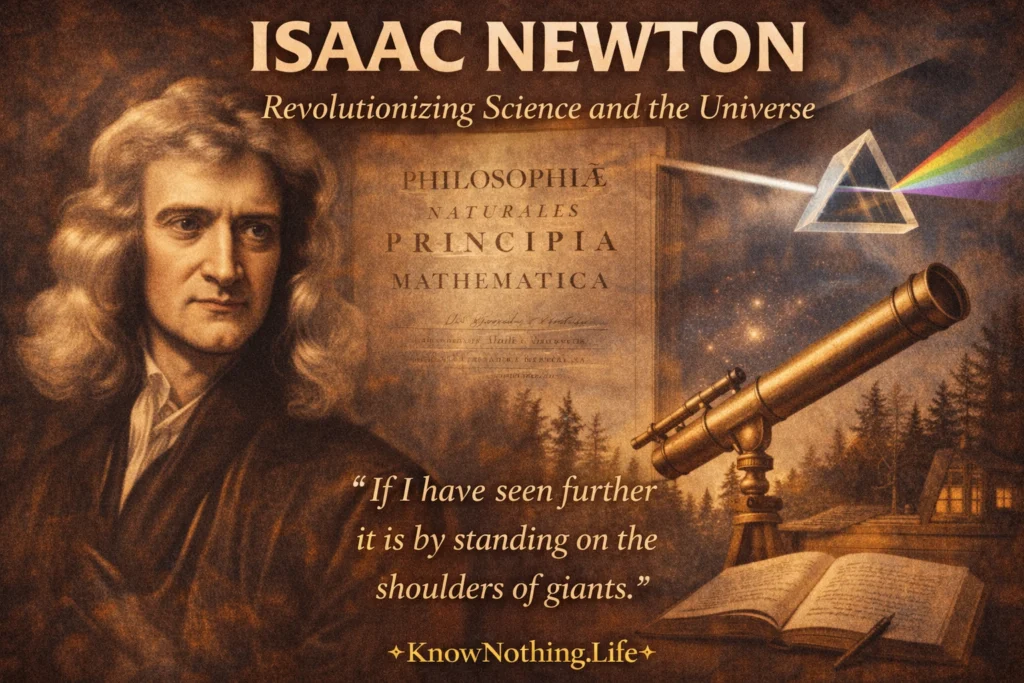
The scientific revolution reached one of its highest points in the work of Isaac Newton, whose ideas transformed humanity’s understanding of the natural world. Few figures in history have so profoundly reshaped multiple disciplines at once. Newton’s contributions to physics, mathematics, and astronomy established principles that governed scientific thought for centuries, earning him a place among the most influential thinkers of all time.
Born in 1643 in Woolsthorpe, Newton lived during a period of rapid intellectual change. The discoveries of Galileo Galilei and Johannes Kepler had already begun to challenge traditional views of the cosmos. Newton built upon these foundations, unifying them into a coherent system governed by mathematical laws. His work did not merely describe nature—it revealed the underlying order that made prediction and understanding possible.
Early Life and Education
Newton’s early life was marked by both isolation and intellectual curiosity. Born prematurely and raised in a rural environment, he spent much of his childhood alone, developing a fascination with mechanical devices and natural phenomena. This introspective disposition would later become a defining feature of his intellectual life.
He attended Trinity College, Cambridge, where he studied mathematics and natural philosophy. During this time, Newton was exposed to the works of earlier thinkers, including René Descartes and Galileo. However, it was not formal instruction that defined his education, but his own independent investigations. Newton’s approach was deeply self-directed, driven by a desire to uncover fundamental principles.
A pivotal period occurred during the Great Plague of 1665–1666, when Cambridge closed and Newton returned to Woolsthorpe. In relative isolation, he developed many of his most important ideas, including the foundations of calculus, theories of optics, and the concept of universal gravitation. This period has often been described as one of the most productive in the history of science.
The Laws of Motion
Newton’s formulation of the laws of motion represents one of the most significant achievements in the history of physics. These laws, presented in his groundbreaking work Philosophiæ Naturalis Principia Mathematica, provide a mathematical framework for understanding how objects move and interact.
The first law, often called the law of inertia, states that an object will remain at rest or in uniform motion unless acted upon by an external force. The second law establishes the relationship between force, mass, and acceleration, providing a quantitative basis for predicting motion. The third law asserts that for every action, there is an equal and opposite reaction.
Together, these laws transformed the study of motion from a qualitative description into a precise science. They allowed scientists to predict the behavior of objects ranging from falling apples to orbiting planets, unifying terrestrial and celestial mechanics under a single framework.
Universal Gravitation
Perhaps Newton’s most famous insight is his theory of universal gravitation, which explains the force that governs the motion of celestial bodies. According to this theory, every object in the universe exerts an attractive force on every other object, proportional to their masses and inversely proportional to the square of the distance between them.
This idea represented a profound shift in understanding. Prior to Newton, the motion of planets and objects on Earth were considered separate phenomena. Newton demonstrated that the same force responsible for an apple falling to the ground also governs the motion of the moon and planets. This unification of the cosmos marked a turning point in scientific thought.
The story of the falling apple, while often simplified, symbolizes this breakthrough. Whether or not the event occurred exactly as described, it captures the essence of Newton’s insight: the recognition that ordinary observations can reveal universal laws when approached with the right perspective.
Contributions to Mathematics
In addition to his work in physics, Newton made foundational contributions to mathematics, particularly through the development of calculus. Although his work was developed independently and contemporaneously with Gottfried Wilhelm Leibniz, Newton’s approach emphasized the analysis of change and motion.
Calculus provided the mathematical tools necessary to describe dynamic systems, enabling precise calculations of velocity, acceleration, and other physical quantities. It became an essential component of scientific inquiry, underpinning advances in physics, engineering, and beyond.
Newton also contributed to the study of infinite series and binomial expansions, further expanding the scope of mathematical analysis. His work established a new standard for rigor and precision, influencing generations of mathematicians.
Optics and the Nature of Light
Newton’s investigations into light and color revolutionized the field of optics. Through experiments with prisms, he demonstrated that white light is composed of a spectrum of colors, challenging the prevailing belief that color was a modification of light rather than an intrinsic property.
His work in optics is detailed in Opticks, where he explores the behavior of light, reflection, and refraction. These studies not only advanced scientific understanding but also introduced experimental methods that emphasized observation and reproducibility.
Newton’s approach to science combined theoretical insight with empirical evidence. His ability to design experiments and interpret their results exemplifies the scientific method, making his work a model for future researchers.
Quotes and Key Ideas
Newton’s writings contain statements that reflect both his intellectual humility and his profound insight. Among his most notable quotes:
- “If I have seen further it is by standing on the shoulders of giants.”
- “What we know is a drop, what we don’t know is an ocean.”
- “Truth is ever to be found in simplicity, and not in the multiplicity and confusion of things.”
- “I can calculate the motion of heavenly bodies, but not the madness of people.”
These quotes reveal a thinker who, despite his achievements, remained aware of the limits of human knowledge. They emphasize the importance of simplicity, curiosity, and the cumulative nature of scientific progress.
Newton’s key ideas—laws of motion, universal gravitation, calculus, and the nature of light—form the foundation of classical physics. They continue to influence modern science, even as new theories have expanded upon them.
Later Life and Public Role
In his later years, Newton became a prominent public figure. He served as President of the Royal Society and held a position at the Royal Mint, where he played a key role in reforming England’s currency. These roles reflect his influence beyond the realm of science.
Newton was knighted in 1705, becoming Sir Isaac Newton—a recognition of his contributions to both science and society. Despite his public success, he remained a deeply private individual, often engaged in solitary study and reflection.
His later work also included studies in alchemy and theology, areas that, while less influential than his scientific contributions, reveal the breadth of his intellectual interests. Newton’s curiosity extended beyond the physical world, encompassing questions of meaning and existence.
Legacy and Influence
Newton’s influence on science and philosophy is unparalleled. His work established the framework for classical mechanics, which dominated scientific thought until the development of relativity and quantum mechanics. Even today, his laws remain essential for understanding everyday phenomena.
His emphasis on mathematical description and empirical observation set the standard for scientific inquiry. The methods he developed continue to guide research across disciplines, from physics and engineering to economics and biology.
Newton’s legacy also extends to the broader cultural understanding of science. He represents the ideal of the scientist as both thinker and experimenter, someone who seeks to uncover the laws governing the universe through reason and observation.
Conclusion
Isaac Newton stands as one of the most transformative figures in the history of human thought. Through his work, he revealed a universe governed by consistent, mathematical laws, providing a foundation for modern science and technology. His ability to unify diverse phenomena into a coherent system reflects a level of insight that remains extraordinary. Beyond his specific discoveries, Newton’s legacy lies in his approach to knowledge.
He demonstrated that the natural world can be understood through careful observation, rigorous analysis, and intellectual curiosity. His work continues to inspire those who seek to explore the mysteries of the universe. In a world shaped by scientific advancement, Newton’s contributions remain a testament to the power of human inquiry. His vision of a lawful, comprehensible universe continues to guide our understanding of reality.