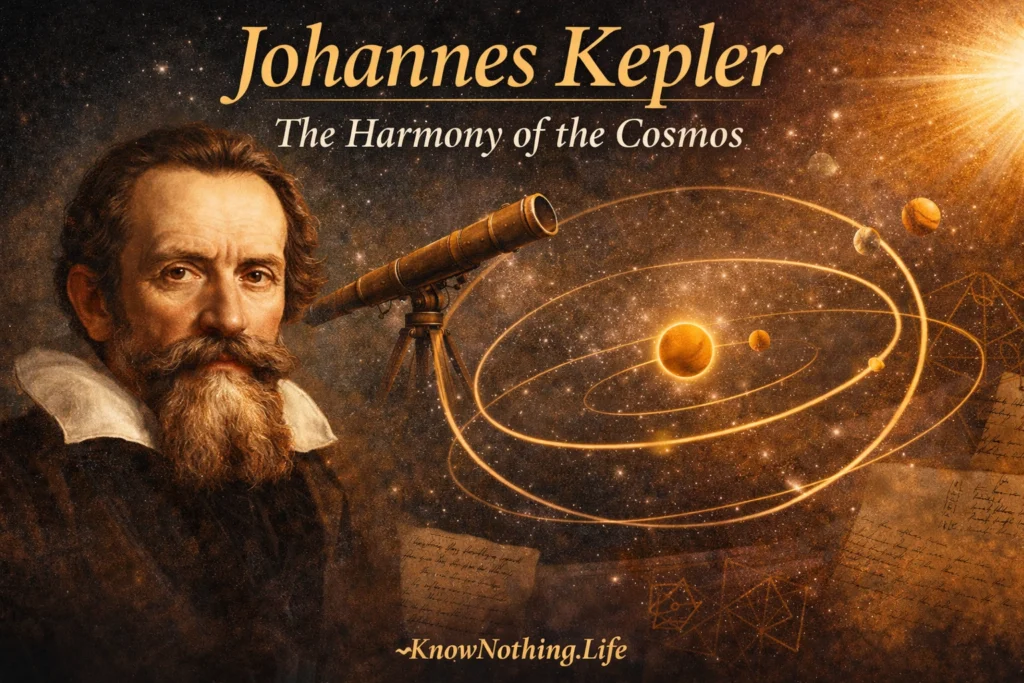
Johannes Kepler was born on December 27, 1571, in the small town of Weil der Stadt in the Holy Roman Empire. His early life was marked by hardship, both physical and social. As a child, he suffered from illnesses that left him with impaired vision and weakened hands—limitations that would later make observational astronomy difficult. Yet these challenges did not hinder his intellectual development. Raised in a modest household, Kepler was introduced early to the night sky by his mother, who reportedly showed him a comet in 1577 and a lunar eclipse in 1580. These formative experiences ignited a lifelong fascination with the cosmos.
Kepler’s academic path led him to the University of Tübingen, where he studied theology with the intention of becoming a Lutheran minister. However, his mathematical brilliance quickly set him apart. Under the guidance of the astronomer Michael Maestlin, he was introduced to the heliocentric model of Nicolaus Copernicus. While the Copernican system was still controversial, Kepler embraced it with conviction, not merely as a mathematical tool but as a reflection of divine order. For him, the structure of the universe was not random—it was a geometric expression of God’s design.
This fusion of science and spirituality became a defining feature of Kepler’s thinking. Unlike later scientists who separated empirical inquiry from metaphysical belief, Kepler saw no contradiction between the two. He believed that by studying the heavens, he was uncovering the mathematical blueprint of creation. This perspective gave his work a sense of purpose that extended beyond mere calculation, driving him to seek patterns and harmonies where others saw complexity.
The Quest for Cosmic Harmony
Kepler’s early work reflects his deep commitment to uncovering a hidden order within the universe. His first major publication, Mysterium Cosmographicum (1596), proposed that the distances between the planets could be explained through nested Platonic solids. Although this model was ultimately incorrect, it demonstrated his belief that the cosmos was governed by geometric principles. Rather than abandoning this idea when faced with inconsistencies, Kepler refined his approach, seeking a more accurate mathematical description of planetary motion.
His opportunity came when he joined the court of Tycho Brahe in Prague. Brahe possessed the most precise astronomical observations of the time, particularly of Mars. After Brahe’s death in 1601, Kepler inherited this invaluable data, which would become the foundation of his greatest discoveries. Unlike previous astronomers who attempted to fit observations into preexisting models, Kepler allowed the data to guide his conclusions, even when it challenged his own assumptions.
This period marked a turning point in the history of science. Kepler’s willingness to abandon circular orbits—long considered perfect and therefore necessary—led him to a revolutionary insight: planetary orbits are elliptical. This realization did not come easily; it required years of painstaking calculations and a willingness to question deeply ingrained beliefs. As Kepler later reflected, “If I had believed that we could ignore these eight minutes [of arc], I would have patched up my hypothesis accordingly. But, since it was not permissible to ignore, those eight minutes pointed the road to a complete reformation in astronomy.”
The Three Laws of Planetary Motion
Kepler’s most enduring contribution to science lies in his formulation of the three laws of planetary motion, which fundamentally reshaped humanity’s understanding of the solar system. These laws, derived from meticulous analysis of Brahe’s data, provided a precise mathematical framework for describing how planets move around the Sun.
The first law states that planets travel in elliptical orbits with the Sun at one focus. This insight broke with centuries of tradition that had favored circular motion as the ideal. The second law, often called the law of equal areas, describes how a planet’s speed varies depending on its distance from the Sun—it moves faster when closer and slower when farther away. The third law establishes a relationship between a planet’s orbital period and its distance from the Sun, revealing a harmonious proportionality across the solar system.
Together, these laws transformed astronomy from a descriptive discipline into a predictive science. They allowed astronomers to calculate planetary positions with unprecedented accuracy and laid the groundwork for the universal law of gravitation later developed by Isaac Newton. Kepler himself recognized the significance of his work, writing, “I much prefer the sharpest criticism of a single intelligent man to the thoughtless approval of the masses.”
What makes Kepler’s achievement particularly remarkable is the intellectual courage it required. By replacing circular orbits with ellipses, he challenged not only scientific tradition but also philosophical and theological assumptions about perfection in nature. His laws demonstrated that the universe operates according to principles that may defy human expectations, yet remain deeply coherent and mathematically elegant.
Major Works and Scientific Contributions
Kepler’s intellectual legacy is preserved in a series of groundbreaking works that extend beyond his laws of planetary motion. Astronomia Nova (1609) introduced his first two laws and presented a new approach to celestial mechanics based on physical causes rather than abstract geometry. This work marked a decisive shift toward a more modern understanding of science, emphasizing forces and interactions rather than purely mathematical descriptions.
In Harmonices Mundi (1619), Kepler explored the idea that the cosmos is governed by musical ratios and harmonic relationships. It was in this work that he introduced his third law, completing the framework of planetary motion. The book reflects his enduring belief that the universe is a manifestation of divine harmony, a concept that blends scientific rigor with philosophical depth. As he famously wrote, “Geometry is the archetype of the beauty of the world.”
Kepler also made significant contributions to optics, publishing Astronomiae Pars Optica (1604), which laid the foundation for modern optical science. He explained how the eye perceives light and developed theories that would later influence the design of telescopes. His work in this area complemented the observational advancements of Galileo Galilei, demonstrating how theoretical and experimental approaches could work in tandem.
Throughout his writings, Kepler exhibited a unique ability to bridge disciplines, combining mathematics, physics, astronomy, and philosophy into a unified vision. His works are not merely technical treatises; they are reflections of a mind seeking to understand the deeper structure of reality.
Personal Struggles and Resilience
Kepler’s life was not defined solely by intellectual triumph. He faced numerous personal and professional challenges, including financial instability, religious conflict, and family tragedy. Living during a time of intense sectarian division in Europe, he often found himself caught between competing religious authorities. As a Protestant in Catholic territories, his position was frequently precarious, forcing him to relocate multiple times throughout his career.
One of the most harrowing episodes of his life involved the trial of his mother, Katharina Kepler, who was accused of witchcraft. Johannes personally undertook her legal defense, studying law and constructing a detailed argument that ultimately secured her release after years of imprisonment. This experience underscores not only his intellectual versatility but also his deep sense of loyalty and responsibility.
Despite these hardships, Kepler remained steadfast in his pursuit of knowledge. His resilience is evident in his ability to continue working under difficult conditions, often without stable patronage or institutional support. He once wrote, “I am stealing the golden vessels of the Egyptians to build a tabernacle for my God,” a metaphor that captures his determination to transform knowledge into something meaningful and enduring.
Philosophical Impact and Legacy
Kepler’s contributions extend far beyond the specifics of astronomy. He played a crucial role in the Scientific Revolution, helping to establish a new framework for understanding the natural world. By demonstrating that planetary motion could be described through precise mathematical laws, he provided a model for scientific inquiry that would influence generations of thinkers.
His work also reshaped humanity’s conception of the universe. No longer seen as a system of perfect circles centered on Earth, the cosmos became a dynamic and mathematically structured entity. This shift had profound philosophical implications, challenging traditional notions of order and perfection while opening the door to new forms of understanding. Thinkers such as René Descartes would build upon these ideas, further integrating mathematics into philosophy and science.
Kepler’s legacy is inseparable from that of Newton, whose law of gravitation provided the physical explanation for Kepler’s mathematical descriptions. Together, their work represents a turning point in human history, marking the transition from speculative philosophy to empirical science. Yet Kepler’s unique contribution lies in his ability to see beauty and meaning in mathematical relationships, elevating science to a form of intellectual art.
Final Years and Enduring Influence
In his later years, Kepler continued to work on astronomical tables, culminating in the publication of the Rudolphine Tables (1627), which provided highly accurate planetary data and remained in use for decades. These tables demonstrated the practical power of his laws, enabling more precise navigation and reinforcing the reliability of his methods.
Kepler died on November 15, 1630, leaving behind a legacy that would shape the future of science. Though he did not live to see the full impact of his work, his ideas became foundational to the development of modern physics and astronomy. Today, he is remembered as one of the greatest scientific minds in history, a figure whose insights continue to influence our understanding of the universe.
His life stands as a testament to the power of perseverance, curiosity, and intellectual courage. In a world still bound by tradition and authority, Kepler dared to follow the evidence wherever it led, uncovering a cosmos governed not by assumption, but by law. As he once reflected, “I was merely thinking God’s thoughts after Him,” a statement that captures both the humility and ambition that defined his extraordinary career.