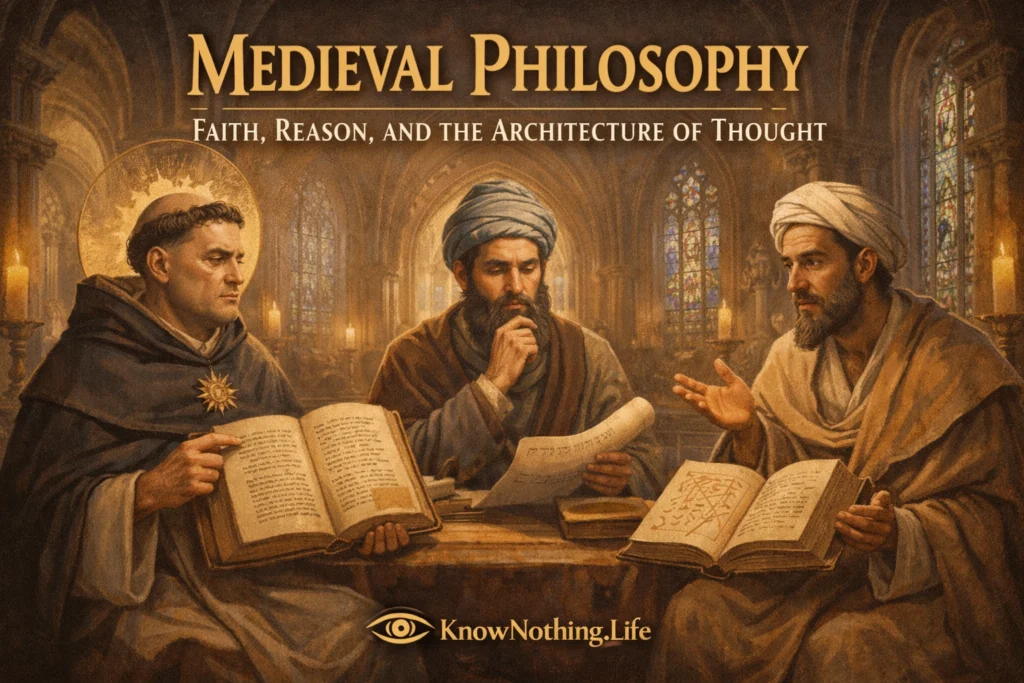
Medieval philosophy represents a profound period of intellectual synthesis, spanning roughly from the fall of the Western Roman Empire to the dawn of the Renaissance. During this era, philosophical inquiry becomes deeply intertwined with religious traditions, particularly Christianity, Islam, and Judaism. Rather than abandoning classical philosophy, medieval thinkers engage with and reinterpret the works of ancient Greek philosophers, especially Aristotle and Plato, integrating their ideas into theological frameworks.
The central concern of medieval philosophy is the relationship between faith and reason. Philosophers seek to understand whether religious belief can be justified through rational argument, and how divine revelation relates to human knowledge. This period is marked not by intellectual stagnation, as is sometimes assumed, but by rigorous debate, innovation, and cross-cultural exchange. Medieval philosophy develops sophisticated methods of logic and argumentation that would later influence the rise of modern science and philosophy.
Early Medieval Thought and the Influence of Augustine
The early medieval period is shaped by the work of Augustine of Hippo, whose writings bridge the gap between classical philosophy and Christian theology. In texts such as Confessions and The City of God, Augustine explores the nature of truth, the problem of evil, and the relationship between the human soul and God. Drawing heavily on Platonic ideas, he emphasizes the role of divine illumination in knowledge, arguing that true understanding comes from God rather than from the senses alone.
Augustine’s famous statement, “You have made us for yourself, O Lord, and our heart is restless until it rests in you,” captures his view of human existence as oriented toward the divine. For Augustine, philosophy is not merely an intellectual exercise but a spiritual journey, aimed at aligning the soul with eternal truth. His work establishes a framework in which faith and reason are not opposed but mutually reinforcing.
This synthesis of philosophy and theology sets the tone for much of medieval thought. Augustine’s influence extends across centuries, shaping discussions about knowledge, morality, and the nature of God. His emphasis on introspection and the inner life also contributes to the development of a more personal and reflective approach to philosophy.
Islamic Philosophy and the Preservation of Knowledge
While much of Europe experiences political and cultural fragmentation during the early medieval period, the Islamic world becomes a center of intellectual activity. Philosophers such as Avicenna and Averroes play a crucial role in preserving and expanding the works of ancient Greek philosophers. Their translations and commentaries ensure that the ideas of Aristotle and Plato remain accessible, influencing both Islamic and later European thought.
Avicenna, in works such as The Book of Healing, develops a comprehensive philosophical system that integrates metaphysics, logic, and medicine. He introduces the distinction between necessary and contingent beings, arguing that the existence of the universe depends on a necessary being, or God. This argument becomes influential in both Islamic and Christian philosophical traditions.
Averroes, known for his extensive commentaries on Aristotle, defends the compatibility of philosophy and religion. He argues that truth is unified, even if it can be approached through different methods. His work sparks significant debate in medieval Europe, particularly regarding the role of reason in understanding religious doctrine. The contributions of Islamic philosophers highlight the interconnectedness of medieval intellectual life, demonstrating that philosophical development is not confined to a single cultural context.
Scholasticism and the Systematization of Knowledge
The high medieval period is characterized by the rise of Scholasticism, a method of philosophical and theological inquiry that emphasizes logical analysis and systematic argumentation. At the center of this tradition is Thomas Aquinas, whose work Summa Theologica represents one of the most ambitious attempts to synthesize philosophy and theology.
Aquinas draws heavily on Aristotle, arguing that reason can be used to demonstrate certain truths about God and the natural world. His famous “Five Ways” offer arguments for the existence of God based on observation and logical reasoning. Aquinas maintains that while some truths are accessible through reason, others require revelation, preserving a distinction between philosophy and theology while affirming their compatibility.
Scholasticism is not limited to Aquinas but includes a wide range of thinkers who engage in debates about universals, the nature of existence, and the limits of human knowledge. The scholastic method, characterized by careful definition, argument, and counterargument, becomes a defining feature of medieval philosophy. It reflects a commitment to clarity and rigor that continues to influence academic inquiry.
Jewish Philosophy and the Harmony of Faith and Reason
Medieval Jewish philosophy also plays a significant role in the development of philosophical thought, particularly through the work of Maimonides. In his influential text The Guide for the Perplexed, Maimonides seeks to reconcile Aristotelian philosophy with Jewish theology, addressing questions about the nature of God, creation, and the interpretation of religious texts.
Maimonides emphasizes the importance of rational understanding, arguing that apparent contradictions between philosophy and scripture can be resolved through careful interpretation. He advocates for a negative theology, suggesting that God’s essence is beyond human comprehension and can only be described in terms of what it is not. This approach reflects a deep respect for both reason and revelation, highlighting their complementary roles.
The contributions of Jewish philosophers further illustrate the diversity and richness of medieval thought. By engaging with both Islamic and Christian traditions, they contribute to a broader intellectual dialogue that transcends cultural boundaries. Their work underscores the shared concerns of medieval philosophy, particularly the quest to harmonize faith and reason.
Debates on Universals and the Nature of Reality
One of the most significant philosophical debates of the medieval period concerns the problem of universals—the question of whether general concepts such as “redness” or “humanity” have real existence or are merely names. Realists, influenced by Platonic thought, argue that universals exist independently of particular objects, while nominalists contend that they are simply linguistic constructs.
Thinkers such as William of Ockham advocate for nominalism, emphasizing simplicity and economy in explanation. Ockham’s principle, often summarized as “entities should not be multiplied beyond necessity,” becomes known as Ockham’s Razor. This idea encourages the elimination of unnecessary assumptions, influencing both philosophical and scientific reasoning.
These debates reflect broader questions about the nature of reality and the limits of human knowledge. By examining the relationship between language, thought, and existence, medieval philosophers contribute to the development of metaphysics and epistemology. Their work demonstrates the depth and sophistication of medieval inquiry, challenging the notion that this period lacks intellectual vitality.
The Transition to Modern Philosophy
As the medieval period draws to a close, new intellectual movements begin to emerge, setting the stage for the Renaissance and the development of modern philosophy. The emphasis on reason, empirical observation, and individual inquiry begins to shift the focus away from purely theological concerns. However, this transition is not a rejection of medieval thought but an evolution of its ideas and methods.
The legacy of medieval philosophy is evident in its contributions to logic, ethics, and the philosophy of religion. Its emphasis on rigorous argumentation and the integration of diverse perspectives provides a foundation for later developments. The debates and insights of medieval thinkers continue to influence contemporary discussions, particularly in areas such as metaphysics and theology.
Ultimately, medieval philosophy represents a crucial chapter in the history of thought, characterized by its attempt to reconcile faith and reason in a complex and changing world. Its enduring significance lies in its ability to engage deeply with fundamental questions, offering insights that remain relevant across time and culture.