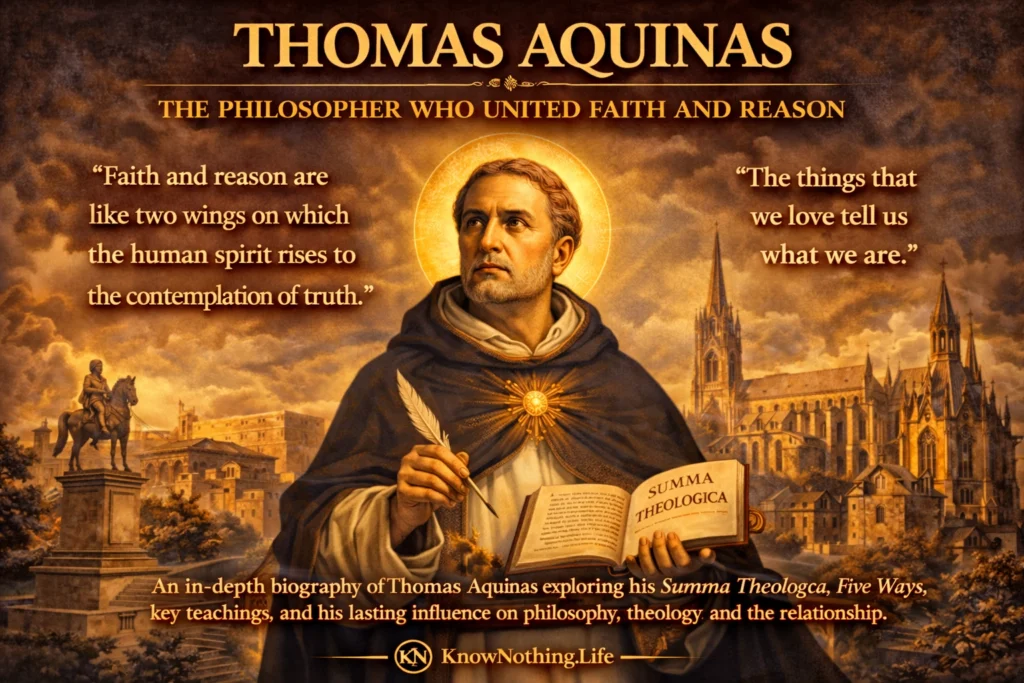
Few thinkers have shaped the intellectual foundation of Western theology and philosophy as profoundly as Thomas Aquinas. Living in the 13th century, Aquinas stands as a central figure in the development of medieval thought, known for synthesizing classical philosophy—especially that of Aristotle—with Christian doctrine. His work represents one of the most ambitious and successful efforts to reconcile faith with reason, demonstrating that religious belief and rational inquiry are not opposing forces but complementary paths to truth.
What distinguishes Aquinas is the clarity, structure, and depth of his thinking. He approached philosophical and theological questions with systematic precision, addressing complex issues such as the existence of God, the nature of morality, and the relationship between human intellect and divine revelation. His writings continue to influence theology, philosophy, ethics, and education, making him one of the most enduring intellectual figures in history.
Early Life and Education
Thomas Aquinas was born around 1225 in the Kingdom of Sicily, into a noble family with strong political connections. His early life was shaped by expectations that he would pursue a career aligned with his family’s status, possibly within the Church hierarchy. At a young age, he was sent to the Abbey of Monte Cassino, where he received his initial education and was exposed to religious life.
As he matured, Aquinas pursued further studies at the University of Naples, where he encountered a broader intellectual environment. It was here that he was introduced to the works of Aristotle, which had recently been rediscovered and translated into Latin. These texts would have a profound impact on his thinking, providing a philosophical framework that he would later integrate into his theological work.
Against his family’s wishes, Aquinas joined the Dominican Order, a decision that reflected his commitment to a life of study and teaching rather than political advancement. His family strongly opposed this choice, even detaining him for a period in an attempt to dissuade him. Despite this resistance, Aquinas remained steadfast, eventually continuing his studies under the guidance of Albertus Magnus, one of the leading scholars of the time.
Intellectual Formation and Scholastic Method
Aquinas’s intellectual development took place within the context of Scholasticism, a method of learning that emphasized rigorous analysis, debate, and the reconciliation of different sources of knowledge. This approach sought to harmonize classical philosophy with Christian theology, using logic and reason to explore questions of faith.
Central to Aquinas’s method was the practice of posing questions, presenting objections, and then offering carefully reasoned responses. This dialectical structure allowed him to address complex issues in a systematic and comprehensive way. Rather than dismissing opposing viewpoints, he engaged with them directly, demonstrating both intellectual rigor and openness.
His engagement with Aristotle was particularly significant. While some thinkers viewed Aristotle’s philosophy as incompatible with Christian doctrine, Aquinas saw it as a valuable tool for understanding the natural world and human reason. By integrating Aristotelian concepts with theological principles, he created a framework that allowed for a deeper exploration of both philosophy and faith.
The Summa Theologica and Major Works
Aquinas’s most famous work is the Summa Theologica, an extensive and systematic presentation of Christian theology. Although unfinished at the time of his death, the Summa remains one of the most important texts in the history of philosophy and theology. It is structured as a series of questions and answers, covering topics such as God, creation, human nature, ethics, and salvation.
In addition to the Summa Theologica, Aquinas wrote the Summa Contra Gentiles, a work aimed at explaining and defending Christian beliefs to a broader audience, including non-Christians. This text demonstrates his ability to engage with different intellectual traditions while maintaining a clear and coherent argument.
His writings are characterized by clarity, precision, and depth. He sought not only to explain theological concepts but to demonstrate their rational foundation. By doing so, he provided a model for intellectual inquiry that continues to influence academic and religious thought.
The Existence of God and the Five Ways
One of Aquinas’s most well-known contributions is his argument for the existence of God, often referred to as the “Five Ways.” These arguments are presented in the Summa Theologica and are based on observations about the natural world. Rather than relying solely on scripture, Aquinas uses reason and empirical evidence to support his conclusions.
The Five Ways include arguments from motion, causation, contingency, degrees of perfection, and teleology (design). Each argument seeks to demonstrate that the existence of the world points to a necessary first cause or ultimate source, which Aquinas identifies as God. These arguments reflect his belief that reason can lead to an understanding of divine reality, even in the absence of revelation.
Aquinas famously stated: “To one who has faith, no explanation is necessary. To one without faith, no explanation is possible.” While this quote highlights the role of faith, his work consistently shows that he did not see faith and reason as mutually exclusive. Instead, he viewed them as complementary, with reason providing a foundation for belief.
Ethics, Natural Law, and Human Purpose
Aquinas’s contributions to ethics are grounded in his concept of natural law, which he developed by drawing on both Christian theology and Aristotelian philosophy. According to Aquinas, natural law is the participation of human reason in the eternal law of God. It provides a framework for understanding right and wrong based on the nature of human beings and the world.
He argued that all humans share a common purpose, which is to achieve fulfillment through the development of their rational and moral capacities. This fulfillment, or “beatitude,” ultimately involves union with God. However, even within the natural world, individuals can discern moral principles through reason, guiding their actions toward the common good.
Aquinas also emphasized the importance of virtues, including prudence, justice, temperance, and fortitude. These virtues enable individuals to live in accordance with reason and to achieve a balanced and ethical life. His ethical framework has had a lasting influence on both religious and secular moral philosophy.
Key Teachings and Quotes
Aquinas’s writings contain numerous insights that continue to resonate. One of his most well-known statements is: “The things that we love tell us what we are.” This reflects his belief that human identity is shaped by desire and intention, emphasizing the importance of directing one’s love toward what is good and true.
Another significant teaching is: “Faith and reason are like two wings on which the human spirit rises to the contemplation of truth.” Although often associated with later interpretations, this idea captures the essence of Aquinas’s philosophy. He believed that both faith and reason are necessary for a complete understanding of reality.
He also observed: “There is nothing on this earth more to be prized than true friendship.” This statement highlights his recognition of the social and relational dimensions of human life. For Aquinas, friendship is not merely a personal bond but a reflection of shared values and mutual pursuit of the good.
Influence and Legacy
The influence of Thomas Aquinas extends across centuries, shaping the development of Christian theology, philosophy, and education. His work became central to the intellectual tradition of the Catholic Church, and he was later declared a Doctor of the Church, a title given to those whose teachings have had a significant and lasting impact.
In the medieval period, his ideas helped establish a framework for understanding the relationship between faith and reason, influencing scholars and institutions throughout Europe. His integration of Aristotelian philosophy into Christian thought also contributed to the development of Western intellectual traditions.
In modern times, Aquinas’s work continues to be studied and debated. His contributions to ethics, metaphysics, and epistemology remain relevant in discussions of philosophy and theology. His emphasis on rational inquiry and intellectual rigor provides a model for engaging with complex questions in a thoughtful and systematic way.
Conclusion
Thomas Aquinas stands as a monumental figure in the history of philosophy and theology, whose work represents a remarkable synthesis of faith and reason. Through his writings, he demonstrated that intellectual inquiry and religious belief can coexist and enrich one another, offering a comprehensive vision of truth.
His contributions extend beyond specific doctrines, providing a framework for understanding the world and humanity’s place within it. By emphasizing the role of reason, the importance of virtue, and the pursuit of ultimate fulfillment, Aquinas offers insights that continue to guide and inspire.
In a world often divided between belief and skepticism, Aquinas’s philosophy serves as a reminder that these perspectives need not be in conflict. Instead, they can work together to deepen our understanding of reality, leading toward a more complete and meaningful engagement with the world.