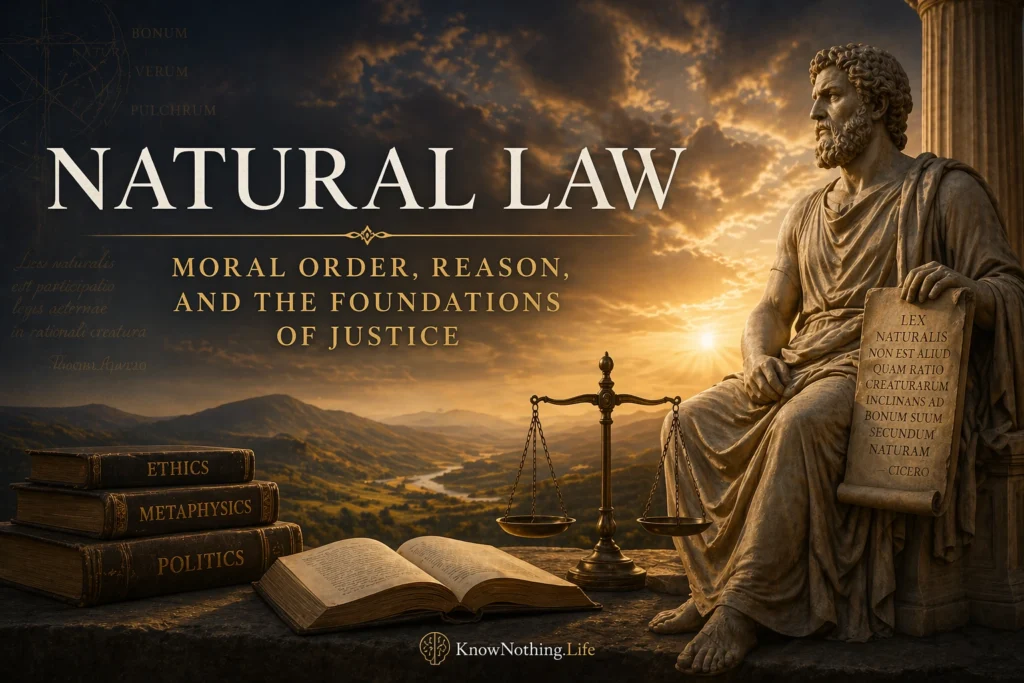
Natural law is one of the oldest and most enduring ideas in the history of philosophy, rooted in the belief that there exists a universal moral order discoverable through human reason. Unlike systems that ground law solely in human authority or social convention, natural law theory maintains that certain principles of right and wrong are inherent in the nature of reality itself. These principles are not invented but uncovered—embedded in human nature, rationality, and, for many thinkers, the structure of the cosmos.
From ancient philosophy to modern political theory, natural law has served as a foundation for debates about justice, rights, and legitimacy. Thinkers such as Aristotle, Thomas Aquinas, and later John Locke each developed distinct versions of natural law, yet all shared the conviction that moral truth is not merely subjective or culturally relative. Instead, it reflects objective standards that human beings can understand and apply, providing a framework for evaluating both individual conduct and the laws of society.
The Origins and Classical Foundations of Natural Law
The origins of natural law can be traced to ancient Greek philosophy, where early thinkers sought to understand the relationship between nature, reason, and human conduct. For Aristotle, the concept of nature was central to ethics and politics. He argued that everything has a purpose, or telos, and that human beings achieve fulfillment by living in accordance with their rational nature. While Aristotle did not present a fully developed theory of natural law in the later sense, his emphasis on reason and natural purpose laid essential groundwork.
The Stoic philosophers further developed these ideas, proposing that the universe is governed by a rational order accessible to human reason. According to the Stoics, all people share in this rationality, making them part of a universal moral community. This view introduced the idea that moral law transcends political boundaries, applying equally to all human beings regardless of their social or cultural context. It also helped shape the Roman legal tradition, which incorporated elements of natural law into its understanding of justice and governance.
These classical foundations established key themes that would persist throughout the history of natural law: the universality of moral principles, the role of reason in discovering them, and the connection between law and human flourishing. Even as later thinkers modified or challenged these ideas, the core intuition—that there is a moral order grounded in nature—remained a powerful and influential concept.
Natural Law in Medieval Thought
Natural law reached its most systematic and influential expression in the work of Thomas Aquinas, whose synthesis of Aristotelian philosophy and Christian theology shaped centuries of legal and moral thought. For Aquinas, natural law is part of a broader hierarchy of laws, including eternal law (the divine order governing the universe) and human law (the rules created by societies). Natural law occupies a middle position, representing the participation of human reason in the eternal law.
According to Aquinas, natural law consists of basic principles that are self-evident to human reason, such as the preservation of life, the pursuit of knowledge, and the promotion of social order. These principles provide a moral framework for evaluating human laws: a law that contradicts natural law is unjust and lacks true authority. This idea had profound implications, suggesting that legal systems are not beyond moral critique but must be measured against higher standards.
Medieval natural law theory also emphasized the rational accessibility of moral truth. While grounded in a theological worldview, Aquinas maintained that natural law could be understood through reason alone, without reliance on revelation. This aspect of his theory allowed natural law to remain relevant even as philosophical and political thought moved beyond its medieval context, influencing later secular theories of rights and justice.
Natural Law and the Emergence of Rights
In the early modern period, natural law theory underwent a significant transformation as philosophers began to focus more explicitly on individual rights and political authority. Thinkers such as John Locke argued that natural law grants individuals certain inalienable rights, including life, liberty, and property. These rights exist prior to and independently of government, placing limits on political power.
Locke’s version of natural law played a crucial role in the development of liberal political theory and constitutional government. By grounding rights in nature rather than in the will of rulers, he provided a powerful justification for resistance against unjust authority. Governments, in this view, derive their legitimacy from their ability to protect natural rights; when they fail to do so, they forfeit their claim to obedience.
This shift toward rights-based natural law had far-reaching consequences, influencing key historical documents such as the American Declaration of Independence. The idea that individuals possess inherent rights became a cornerstone of modern political and legal systems, shaping debates about freedom, equality, and justice that continue to this day.
Natural Law vs. Legal Positivism
One of the central debates in the philosophy of law is the conflict between natural law theory and legal positivism. While natural law asserts that law is inherently connected to morality, legal positivism maintains that the validity of law depends solely on its source—whether it has been properly enacted according to established procedures.
Legal positivists, including H. L. A. Hart, argue that separating law from morality allows for clearer analysis and avoids conflating descriptive and normative questions. According to this view, a law can be legally valid even if it is morally unjust. This distinction is particularly important for understanding how legal systems function in practice, especially in societies where laws may conflict with moral principles.
Natural law theorists reject this separation, insisting that unjust laws lack true legitimacy. For them, the authority of law is inseparable from its moral content. This debate is not merely theoretical; it has real-world implications for issues such as civil disobedience, human rights, and the legitimacy of legal systems. The tension between these perspectives continues to shape contemporary legal and political discourse.
Criticisms and Challenges to Natural Law
Despite its enduring influence, natural law theory has faced significant criticism. One major challenge concerns the concept of “nature” itself. Critics argue that appeals to nature can be vague or ambiguous, making it difficult to derive specific moral principles. What counts as natural behavior, and how does it translate into moral obligations? Without clear answers, natural law risks becoming either overly abstract or susceptible to interpretation.
Another criticism comes from moral relativism and cultural diversity. If moral principles are truly universal, why do different societies have such varied moral and legal systems? Skeptics contend that what is often presented as natural law may simply reflect particular cultural or historical perspectives rather than objective truths.
Modern philosophers have also questioned whether reason alone can provide a sufficient foundation for morality. While natural law emphasizes rationality, critics argue that human reasoning is influenced by emotions, biases, and social contexts. These challenges have led to ongoing efforts to refine and reinterpret natural law theory, ensuring its relevance in a complex and pluralistic world.
Natural Law in Contemporary Thought
In contemporary philosophy, natural law has not disappeared but evolved, often taking new forms that address modern concerns. Some theorists, such as John Finnis, have sought to revive natural law by grounding it in basic human goods—such as life, knowledge, and community—that are considered universally valuable. This approach emphasizes practical reasoning and human flourishing rather than metaphysical assumptions about nature.
Natural law continues to play a role in debates about human rights, bioethics, and international law. Its emphasis on universal moral standards provides a framework for addressing global issues that transcend cultural and political boundaries. For example, arguments against practices such as torture or discrimination often appeal to principles that resemble natural law, even if they are not explicitly labeled as such.
At the same time, natural law faces the challenge of adapting to a world characterized by diversity and disagreement. Its future depends on its ability to engage with competing perspectives while maintaining its core commitment to objective moral truth. Whether embraced, modified, or contested, natural law remains a vital part of philosophical inquiry into the nature of justice and the foundations of legal order.
Final Thoughts
Natural law represents a profound attempt to ground morality and law in something deeper than human convention. By appealing to reason, nature, and universal principles, it offers a vision of justice that transcends individual societies and historical contexts. This vision has inspired centuries of philosophical reflection and continues to influence modern legal and political thought.
Yet natural law is not without its difficulties. Its claims to universality and objectivity invite scrutiny, and its reliance on concepts like nature and reason raises complex questions about interpretation and application. These challenges, however, are part of what makes natural law philosophically rich and enduring.
In the ongoing search for justice and legitimacy, natural law serves as both a guide and a provocation. It challenges us to consider whether our laws align with deeper moral truths and whether those truths can be known. In doing so, it keeps alive the fundamental question at the heart of legal philosophy: not just what the law is, but what it ought to be.