Arguments for the existence of God have been central to philosophy for centuries, spanning traditions from ancient metaphysics to modern analytic thought. These arguments aim to show, through reason rather than revelation alone, that belief in a divine being is justified. While they differ in method and conclusion, they share a common goal: to demonstrate that the existence of God is not merely a matter of faith, but can be supported by rational inquiry.
Philosophers have developed a wide range of arguments, each grounded in different aspects of experience—causation, order, morality, consciousness, and existence itself. Some seek to prove God’s existence with logical necessity, while others aim to show that belief in God is the best explanation for certain features of the world. Though none are universally accepted, these arguments continue to shape debates about religion, metaphysics, and the limits of human reason.
The Cosmological Argument
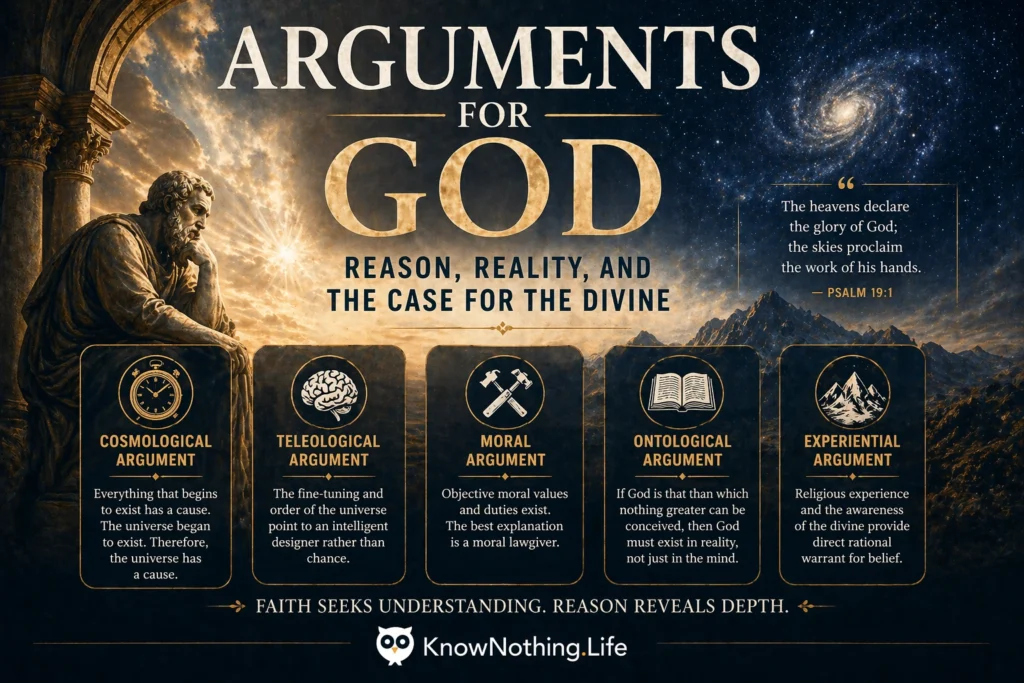
The cosmological argument is one of the oldest and most influential arguments for God’s existence. It begins with the observation that things in the world exist and are caused by other things. From this, it asks whether there must be a first cause or necessary being that explains why anything exists at all.
Philosophers such as Aristotle introduced the idea of an “unmoved mover,” a being that initiates motion without itself being moved. Later, Thomas Aquinas developed this idea into a more formal argument, proposing that the chain of causes cannot regress infinitely and must terminate in a first cause, which he identified as God.
Modern versions of the cosmological argument often focus on contingency. They argue that everything in the universe is contingent—dependent on something else for its existence—and therefore requires a necessary being that exists independently. This line of reasoning seeks to explain not just the origin of the universe, but the fact that there is something rather than nothing.
The Teleological Argument
The teleological argument, or argument from design, is based on the apparent order and purpose found in the natural world. It suggests that the complexity and functionality of the universe are best explained by an intelligent designer rather than by chance or necessity.
William Paley famously illustrated this argument with the analogy of a watch. Just as the intricate design of a watch implies a watchmaker, the complexity of biological organisms and the fine-tuning of the universe imply a divine designer. This argument has been particularly influential in discussions of biology and cosmology.
In contemporary philosophy, the teleological argument has been reformulated in terms of fine-tuning. The physical constants of the universe appear to be precisely calibrated to allow for the existence of life. Some philosophers argue that this fine-tuning is unlikely to be the result of chance, suggesting instead that it points to intentional design. Critics, however, propose alternative explanations, such as the multiverse hypothesis.
The Ontological Argument
The ontological argument is unique among arguments for God in that it is purely a priori, relying on reason rather than empirical observation. It seeks to demonstrate that the very concept of God entails existence.
Anselm of Canterbury formulated the classic version of this argument, defining God as “that than which nothing greater can be conceived.” He argued that a being that exists in reality is greater than one that exists only in the mind, and therefore God must exist in reality. This reasoning attempts to show that denying God’s existence is logically inconsistent.
Later philosophers, such as René Descartes, offered variations of the argument, linking existence to the essence of a perfect being. However, the ontological argument has faced significant criticism, notably from Immanuel Kant, who argued that existence is not a property that can be included in a definition. Despite these critiques, the argument remains a topic of ongoing debate.
The Moral Argument
The moral argument is based on the existence of objective moral values and duties. It asks whether moral truths can be explained without reference to a higher authority. If moral values are objective and binding, then they may require a foundation beyond human preferences or social conventions.
Philosophers such as Immanuel Kant argued that moral law points toward a higher moral order. While Kant did not claim that morality proves God’s existence in a strict sense, he suggested that belief in God provides a framework for understanding the ultimate significance of moral obligations.
Contemporary versions of the moral argument often emphasize that objective morality is difficult to explain within a purely naturalistic worldview. If moral values are real and not merely subjective, then they may require a grounding in a transcendent source. Critics, however, argue that morality can be explained through evolutionary, social, or rational processes without invoking a divine being.
The Argument from Consciousness
Another line of reasoning focuses on the nature of consciousness and the human mind. Consciousness involves subjective experience, intentionality, and self-awareness—features that are difficult to explain in purely physical terms. Some philosophers argue that these features point to a non-material dimension of reality.
The argument from consciousness suggests that if the mind cannot be fully reduced to physical processes, then there may be a deeper, possibly divine, source of mental reality. This perspective aligns with certain forms of dualism, which posit a distinction between mind and matter.
While not as widely discussed as other arguments, this approach highlights the connection between metaphysical questions about the mind and theological considerations. It suggests that understanding consciousness may have implications for understanding the nature of reality itself.
The Argument from Religious Experience
Religious experience provides another basis for belief in God. Many individuals report experiences of transcendence, unity, or encounter with a divine presence. These experiences can be powerful and transformative, leading some to view them as evidence of a higher reality.
Philosophers such as William James studied religious experiences from a psychological and philosophical perspective, emphasizing their significance in human life. While such experiences are subjective, proponents argue that they should be taken seriously as a form of evidence.
Critics, however, point out that religious experiences can vary widely and may be influenced by cultural or psychological factors. They argue that such experiences do not provide reliable evidence for the existence of God. The debate over religious experience reflects broader questions about the nature of evidence and the role of subjectivity in knowledge.
Critiques and Counterarguments
Each argument for God has been met with substantial criticism. Philosophers have challenged the assumptions, logic, and conclusions of these arguments, offering alternative explanations for the phenomena they address. For example, the problem of evil questions how a benevolent and omnipotent God can coexist with suffering in the world.
Empirical explanations, such as those provided by science, have also been used to challenge traditional arguments. Evolutionary theory, for instance, offers an account of biological complexity without invoking design. Similarly, cosmological models seek to explain the origins of the universe through natural processes.
These critiques do not necessarily refute the arguments for God but highlight their limitations and the complexity of the issues involved. The debate remains open, with ongoing discussions about the nature of evidence, explanation, and belief.
Conclusion
Arguments for the existence of God represent a rich and diverse tradition of philosophical inquiry. From the cosmological reasoning of Thomas Aquinas to the moral reflections of Immanuel Kant, these arguments explore fundamental questions about existence, order, morality, and consciousness.
While no single argument has achieved universal acceptance, together they provide a framework for considering the possibility of a divine reality. Whether one finds them persuasive or not, they continue to play a central role in philosophical discussions about the nature of existence and the limits of human understanding.