Modal logic extends classical logic by introducing the concepts of necessity and possibility—allowing us to reason not only about what is true, but about what must be true, what could be true, and what cannot be true. Where traditional logic deals with fixed truth values, modal logic opens a richer landscape of meaning, capturing the subtleties of statements like “It is necessary that 2 + 2 = 4” or “It is possible that it will rain tomorrow.” These distinctions are central to philosophy, mathematics, linguistics, and even computer science.
The origins of modal logic trace back to Aristotle, who explored modal concepts in his analysis of necessity and contingency. However, modern modal logic emerged in the 20th century through the work of thinkers such as C. I. Lewis, who developed formal systems for modal reasoning, and Saul Kripke, whose semantics revolutionized the field. Modal logic thus represents a profound expansion of logical inquiry, providing tools to analyze not just what is, but what could or must be.
The Core Concepts: Necessity and Possibility
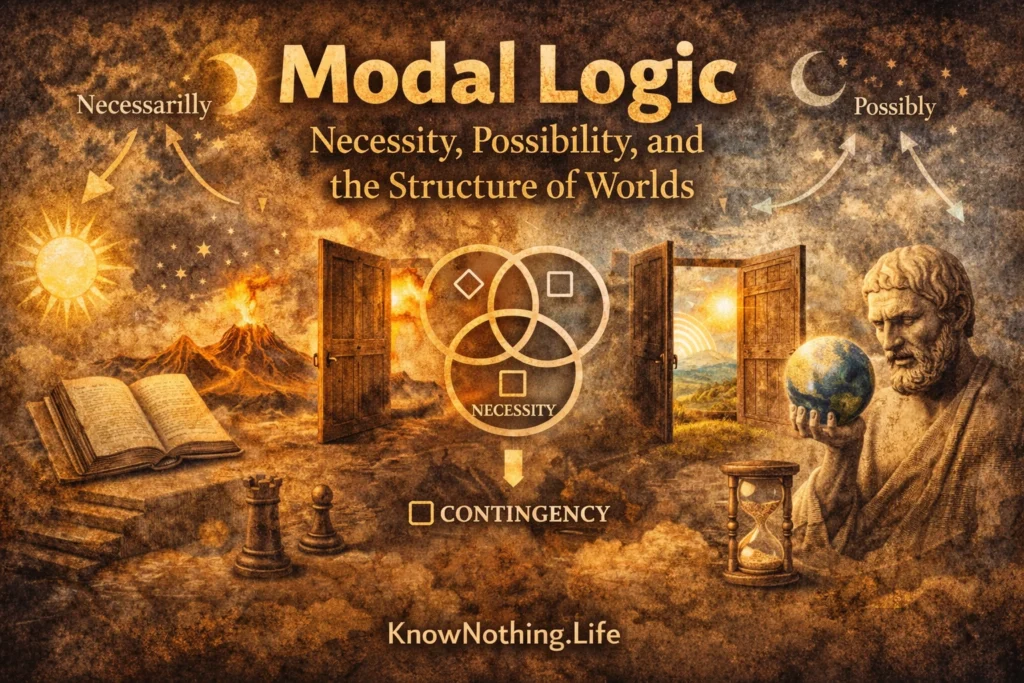
At the heart of modal logic are two fundamental operators: necessity (□) and possibility (◇). A statement is necessarily true if it holds in all relevant circumstances, while it is possibly true if it holds in at least one. These operators allow logicians to distinguish between different modes of truth, enriching the expressive power of logical systems.
The intuitive appeal of these concepts lies in their ubiquity. We routinely make modal judgments in everyday language, considering what might happen, what must be the case, or what cannot occur. Modal logic formalizes these intuitions, providing a precise framework for analyzing such statements. For example, the claim “It is necessary that all bachelors are unmarried” reflects a logical necessity, while “It is possible that life exists on other planets” expresses a contingent possibility.
C. I. Lewis was instrumental in formalizing these ideas, introducing systems of modal logic that distinguished between strict implication and material implication. In Symbolic Logic, co-authored with Clarence Irving Lewis, he sought to capture the nuances of necessity in a formal system. Lewis emphasized that necessity is not merely about truth but about the manner in which truth is established, marking a significant departure from classical logic.
Possible Worlds Semantics
One of the most influential developments in modal logic is the concept of possible worlds, introduced and formalized by Saul Kripke. According to this framework, a statement is necessarily true if it is true in all possible worlds, and possibly true if it is true in at least one. This idea provides a powerful and intuitive way of understanding modal concepts.
Possible worlds are not literal alternate universes but abstract representations of different ways things could be. They allow logicians to model variation and contingency, capturing the idea that reality could have been different. This framework has proven immensely influential, shaping not only logic but also metaphysics and the philosophy of language.
Kripke’s work transformed modal logic by providing a formal semantics that linked syntax with interpretation. As he noted, “A possible world is given by the descriptive conditions we associate with it,” emphasizing that these worlds are tools for understanding modal relationships. His approach clarified longstanding issues in modal reasoning and established a foundation for further developments in the field.
Systems of Modal Logic
Modal logic encompasses a variety of systems, each defined by different axioms and rules governing the behavior of necessity and possibility. Among the most well-known systems are K, T, S4, and S5, each capturing different intuitions about modality. For example, system T includes the principle that if something is necessary, then it is true, while S5 assumes that necessity and possibility are symmetrical across all possible worlds.
These systems reflect different philosophical assumptions about the nature of necessity. Some systems treat necessity as relative to a particular context or set of conditions, while others view it as absolute. The choice of system depends on the domain of application, whether it be metaphysics, epistemology, or computer science.
The diversity of modal systems highlights the flexibility of modal logic as a framework. It is not a single theory but a family of related systems, each tailored to specific kinds of reasoning. This adaptability has made modal logic a central tool in many areas of inquiry, allowing for precise analysis of concepts such as knowledge, obligation, and time.
Modal Logic and Philosophy
Modal logic has profound implications for philosophy, particularly in the study of metaphysics and epistemology. It provides a formal framework for analyzing concepts such as necessity, possibility, and identity, which are central to philosophical inquiry. Questions about what could have been, what must be, and what is contingent are all illuminated by modal reasoning.
One of the most significant applications of modal logic is in the analysis of necessity and identity, explored by Saul Kripke in Naming and Necessity. Kripke argued that certain truths, such as “Water is H2O,” are necessarily true even though they are discovered empirically. This challenged traditional distinctions between necessary and a priori truths, reshaping the philosophy of language and metaphysics.
Modal logic also plays a role in epistemology, where it is used to analyze concepts such as knowledge and belief. For example, epistemic modal logic examines what it means to say that something is known or believed, using modal operators to represent different states of knowledge. This application demonstrates the versatility of modal logic as a tool for philosophical analysis.
Applications in Computer Science and Linguistics
Beyond philosophy, modal logic has found important applications in computer science and linguistics. In computer science, it is used in the design of programming languages, formal verification, and artificial intelligence. Modal systems allow for the representation of dynamic processes, such as changes over time or the behavior of systems under different conditions.
Temporal logic, a branch of modal logic, is particularly significant in this context. It enables reasoning about sequences of events, making it essential for verifying the correctness of software and hardware systems. By modeling how systems evolve over time, temporal logic provides a framework for ensuring reliability and consistency.
In linguistics, modal logic is used to analyze the semantics of natural language, particularly modal expressions such as “must,” “might,” and “could.” The work of David Lewis extended possible worlds semantics to natural language, providing a unified account of modality. Lewis famously remarked, “I believe in a plurality of worlds,” reflecting his commitment to the explanatory power of possible worlds theory.
Challenges and Critiques
Despite its strengths, modal logic faces several challenges and philosophical debates. One major issue concerns the interpretation of possible worlds. While they are useful as theoretical constructs, their ontological status remains controversial. Are possible worlds real entities, as David Lewis suggested, or are they merely abstract tools for reasoning?
Another challenge lies in the complexity of modal systems. The introduction of modal operators and possible worlds significantly increases the complexity of logical analysis, making it more difficult to apply in practice. This has led to ongoing efforts to refine and simplify modal frameworks while preserving their expressive power.
Critics have also questioned whether modal logic fully captures the nuances of natural language and human reasoning. While it provides a powerful formal framework, it may overlook contextual and pragmatic aspects of modality. These critiques highlight the need for continued development and integration with other approaches to logic and language.
Conclusion
Modal logic represents a profound expansion of logical thought, introducing the concepts of necessity and possibility into the analysis of reasoning. From its roots in the work of Aristotle to its modern development by C. I. Lewis and Saul Kripke, it has transformed our understanding of truth and inference.
By providing a framework for reasoning about different ways the world could be, modal logic opens new avenues for inquiry in philosophy, science, and technology. It reveals that truth is not a monolithic concept but a spectrum of possibilities and necessities, each with its own logical structure.
Ultimately, modal logic shows that reasoning extends beyond the actual into the realm of the possible. It challenges us to think not only about what is true, but about what could be true—and why. In doing so, it deepens our understanding of logic, language, and the nature of reality itself.