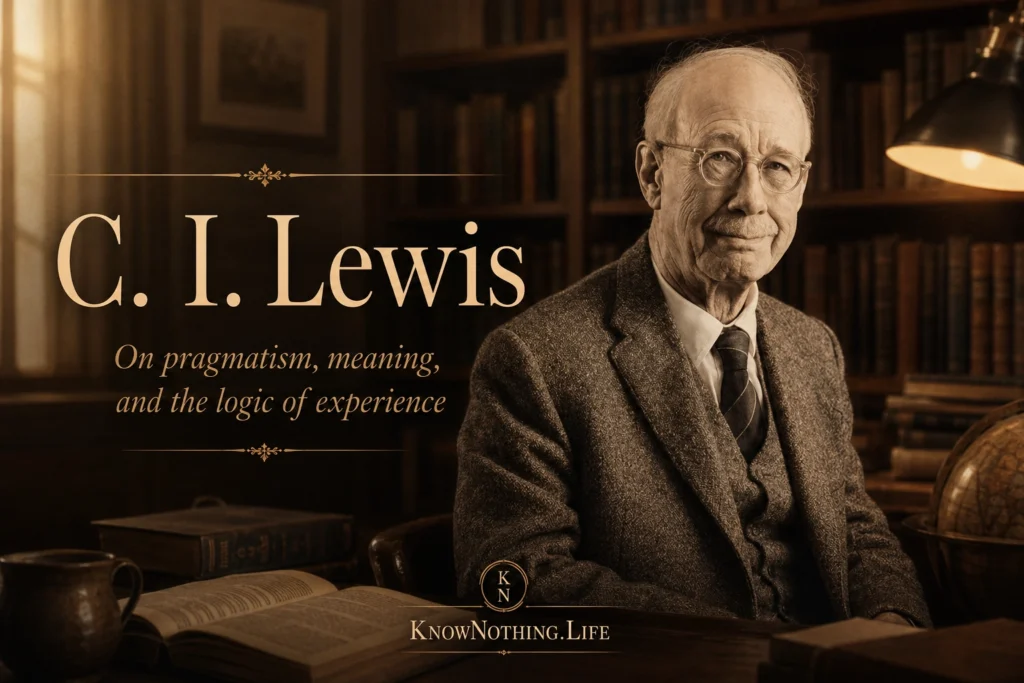
Clarence Irving Lewis, usually known as C. I. Lewis, was born on April 12, 1883, in Stoneham, Massachusetts. He came from modest circumstances, far from the old image of philosophy as a leisure pursuit for the privileged. His father worked in the shoe industry, and Lewis learned early that education required discipline, sacrifice, and self-direction. That background mattered because his philosophy would later combine technical rigor with a practical concern for how thought guides action.
Lewis discovered philosophy as a teenager and was especially drawn to the ancient Greeks and to Immanuel Kant. Kant became one of the decisive influences of his intellectual life. Lewis later wrote that “nothing comparable in importance” happened to him until he encountered Kant, adding that Kant “compelled” him. This was not mere admiration. Kant gave Lewis a problem that would shape his career: how can experience be structured by concepts while still answering to what is given in experience?
Harvard, Royce, and the Study of Logic
Lewis entered Harvard University in 1902, supporting himself through part-time work while studying with some of the leading American philosophers of the period. He earned his bachelor’s degree in 1905 and later completed his Ph.D. at Harvard in 1910. Josiah Royce supervised his doctoral work, and William James also formed part of the broader philosophical environment in which Lewis developed. From Royce, Lewis inherited seriousness about logic and system; from James and pragmatism, he inherited concern for experience, practice, and consequences.
His dissertation, The Place of Intuition in Knowledge, already pointed toward questions that would remain central in his later work. Lewis wanted to understand what is immediately present in experience and what is contributed by interpretation, concept, and judgment. He was not satisfied with either naïve empiricism or pure rationalism. Knowledge, he believed, requires both the given content of experience and the conceptual structures by which that content becomes intelligible.
Early Career and A Survey of Symbolic Logic
Lewis taught at several institutions before returning to Harvard, including the University of California and other appointments that helped establish him as a serious logician. His first major book, A Survey of Symbolic Logic, appeared in 1918. At that time, symbolic logic was still a developing field in the English-speaking world, shaped by figures such as George Boole, Gottlob Frege, Bertrand Russell, Alfred North Whitehead, and Charles Sanders Peirce. Lewis helped introduce, organize, and extend this new logical landscape for American readers.
The book was important not only as a survey but as a contribution. Lewis was dissatisfied with the treatment of implication in the logic of Russell and Whitehead. Material implication allowed statements to count as true in ways that seemed odd when translated into ordinary “if-then” reasoning. Lewis thought logical implication should capture a stronger relation than the mere truth-functional pattern of “not both antecedent true and consequent false.” This dissatisfaction led him toward one of his most important achievements: strict implication and modern modal logic.
Modal Logic and Strict Implication
Lewis’s work on strict implication made him a founder of modern modal logic. Modal logic studies notions such as necessity, possibility, impossibility, and strict implication. Instead of asking only whether a statement is true or false, modal logic asks whether it must be true, could be true, or follows necessarily from another claim. Lewis developed systems that later became known as S1 through S5, with S4 and S5 becoming especially important in later mathematical and philosophical logic.
In Symbolic Logic, written with Cooper Harold Langford and published in 1932, Lewis presented these systems more fully. His achievement was not merely technical. He reopened questions about necessity, meaning, entailment, and the structure of valid inference. Later developments in possible-world semantics would transform modal logic further, but Lewis supplied the early formal architecture. He helped make necessity and possibility legitimate objects of symbolic analysis again.
Mind and the World Order
Lewis’s greatest philosophical book, Mind and the World Order, was published in 1929. It established him as a major figure in American philosophy and gave mature form to his conceptual pragmatism. The book argues that knowledge involves two elements: the sensory or qualitative given and the conceptual interpretation by which experience becomes an ordered world of objects. Lewis did not think the mind passively copies reality. Nor did he think the mind invents reality freely. Knowledge arises through the meeting of what is given and how it is conceptually organized.
One of Lewis’s famous claims is that “the given is ineffable.” By this he meant that what is immediately present in experience, before conceptual interpretation, cannot be fully captured in language without already transforming it. Yet the given is not useless or unreal. It is the element experience supplies, the stubborn content that interpretation must answer to. Lewis also helped introduce the term “qualia” into modern philosophy, using it to refer to recognizable qualitative characters of experience. Long before late twentieth-century debates about consciousness, Lewis had already made qualitative experience central to epistemology.
Conceptual Pragmatism
Lewis called his position conceptual pragmatism. The view combines Kantian and pragmatist themes. From Kant, Lewis accepted that knowledge depends on conceptual frameworks. From pragmatism, he accepted that concepts must be judged by their use, consequences, and role in guiding action. The a priori, for Lewis, is not a set of eternal truths forced on the mind by metaphysical necessity. It is a structure of principles, meanings, and classifications that we adopt because they help organize experience effectively.
This made Lewis different from both traditional rationalists and logical positivists. He rejected the idea that knowledge could be reduced to raw sense data, but he also rejected empty metaphysical speculation. Concepts are human instruments, but not arbitrary inventions. They must work in experience. The mind contributes order, but experience tests that order. Lewis’s philosophy therefore stands between fixed absolutism and loose relativism: our frameworks are chosen, but they are chosen under pressure from the world.
Knowledge, Valuation, and Ethics
In 1946, Lewis published An Analysis of Knowledge and Valuation, another major work that extended his epistemology into value theory. He argued that knowledge and value are connected because human beings do not merely register facts; they evaluate, choose, act, and commit themselves. Valuation is not a decorative addition to cognition. It is part of the practical life of reason. To know the world is also to understand the possibilities it presents for action.
Lewis later turned more directly to ethics in works such as The Ground and Nature of the Right and Our Social Inheritance. His ethical thought retained the same disciplined pragmatist spirit. Moral principles guide conduct, but they must be tested by their role in human life. He did not reduce ethics to feeling, command, or social habit. He wanted moral philosophy to be rational while still connected to lived practice, social inheritance, and the consequences of action.
Harvard Career and Influence
Lewis returned to Harvard in 1920 and became one of the most influential American philosophers of his generation. He taught there for decades and helped shape the intellectual formation of students who would later become major figures, including Nelson Goodman, W. V. Quine, Roderick Chisholm, Roderick Firth, and others. His influence was both direct and indirect: direct through teaching and technical work, indirect through the problems he left for later philosophers to revise, reject, or transform.
His place in twentieth-century philosophy is unusual. He belongs partly to pragmatism, partly to analytic philosophy, partly to logic, partly to epistemology, and partly to value theory. Because he does not fit neatly into one school, he has sometimes been less widely read than figures such as Russell, Carnap, Quine, or Wittgenstein. Yet this in-between position is precisely what makes him important. Lewis stands at the crossroads where American pragmatism met symbolic logic and modern epistemology.
Later Years and Lasting Legacy
C. I. Lewis retired from Harvard in 1953 but continued writing and thinking about ethics, value, and knowledge. He died on February 3, 1964, in Menlo Park, California. By then, philosophy had moved into new debates, and some of his ideas about the given were criticized by later thinkers, especially those suspicious of foundationalism. Yet even where his views were rejected, they remained formative. Quine, Sellars, Goodman, and others developed their own positions partly against the background Lewis had created.
Lewis’s lasting importance lies in the range and seriousness of his project. He helped found modern modal logic, deepened American pragmatism, shaped analytic epistemology, introduced qualia into philosophical vocabulary, and insisted that knowledge must include both structure and experience. He understood that human beings do not encounter a ready-made world without interpretation, but neither do they live inside pure conceptual fantasy. C. I. Lewis remains essential because he asked one of philosophy’s most enduring questions with unusual rigor: how does the mind make experience intelligible while remaining answerable to reality?