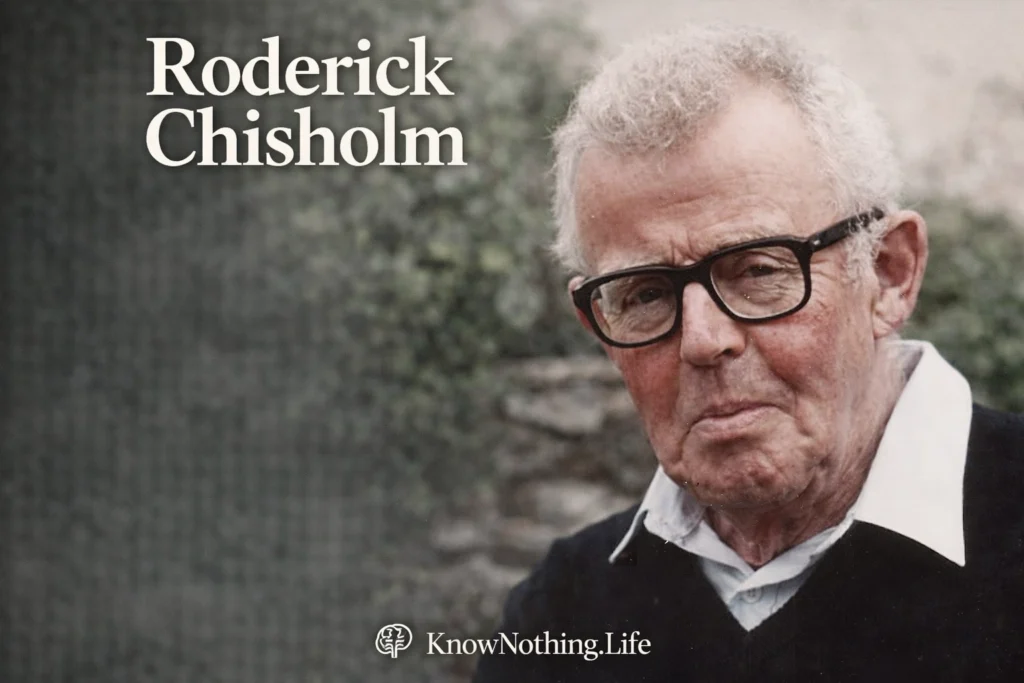
Roderick Milton Chisholm was born on November 27, 1916, in North Attleboro, Massachusetts, and became one of the most important American philosophers of the twentieth century. His work reached across epistemology, metaphysics, ethics, philosophy of mind, philosophy of language, and the theory of action. Unlike philosophers who became famous for one doctrine or one book, Chisholm built a large, interconnected philosophical system. He was a careful analytic thinker, but his concerns were old and permanent: What do we know? What are persons? What makes an action free? What is the difference between the mental and the physical?
Chisholm studied philosophy at Brown University, graduating in 1938, then earned his Ph.D. from Harvard University in 1942. At Harvard, he studied with C. I. Lewis and Donald C. Williams, and he was influenced by the visits of Bertrand Russell and G. E. Moore. Through Russell and Moore, Chisholm became increasingly interested in Franz Brentano and Alexius Meinong, two figures whose work on intentionality, value, and objects of thought would shape his own philosophy. After serving in the Army during World War II, mainly as a psychological tester, Chisholm briefly taught at the Barnes Foundation before returning to Brown, where he spent nearly all of his long academic career.
Brown University and Philosophical Method
Chisholm’s career at Brown University made him not only a major writer, but also a major teacher. He remained at Brown for decades, became one of the central figures in American analytic philosophy, and trained many students who later became influential philosophers in their own right. He was known for a classroom style that welcomed objections rather than avoiding them. This mattered because Chisholm’s philosophy was never static. He repeatedly revised his positions, refined his terminology, and answered critics with new distinctions. His work gives the impression of a thinker always rebuilding his system while refusing to abandon the deepest questions.
His philosophical method was marked by respect for common sense, but not in a casual or anti-intellectual way. Chisholm believed that certain starting points of ordinary thought are “innocent until proven guilty.” We seem to know many things. We seem to be persons who persist through time. We seem to act freely. We seem to have direct awareness of our own mental states. Instead of dismissing these appearances as naïve, Chisholm treated them as data that philosophy must either preserve or explain away with very strong reasons. This made him a defender of traditional philosophical seriousness in an era increasingly shaped by naturalism, behaviorism, and linguistic analysis.
The Problem of the Criterion
Chisholm’s most famous contribution to epistemology is his treatment of the problem of the criterion. In The Problem of the Criterion and Theory of Knowledge, he argued that epistemology faces two fundamental questions: “What can we know?” and “What are the criteria of knowledge?” The difficulty is that each question seems to require an answer to the other. To know what we know, we need a criterion for separating knowledge from error. But to establish a criterion, we seem to need examples of knowledge from which the criterion can be drawn.
Chisholm described three broad responses. The skeptic says we cannot escape the circle. The methodist begins with a criterion and then decides what counts as knowledge. The particularist begins with particular cases of knowledge and then uses them to think about criteria. Chisholm chose particularism, following the common-sense tradition of Thomas Reid and G. E. Moore. He did not pretend this solved every skeptical challenge from neutral ground. In fact, he admitted that the problem could be answered only by “begging the question” in some sense. His point was that philosophy must begin somewhere, and it is more reasonable to begin with clear cases of knowledge than with radical doubt.
Foundationalism and Internalism
Chisholm was one of the great defenders of foundationalism in twentieth-century epistemology. Foundationalism is the view that justified belief rests on basic beliefs that do not depend on other beliefs for their justification. For Chisholm, some mental states are self-presenting: if a person is in such a state and believes they are in it, the belief is directly justified. If I am appeared to redly, or if I am thinking, hoping, fearing, or wondering, my awareness of that state does not need to be inferred from external evidence. It is given from the inside.
This led to Chisholm’s strong form of epistemic internalism. He believed that justification must be accessible from the subject’s own point of view. In Theory of Knowledge, he described the internalist as someone who can determine justification by reflection, “without calling for any outside assistance.” His famous phrase, “one need only consider one’s own state of mind,” captures the center of his view. This placed him in opposition to externalist theories such as reliabilism, which explain justification partly through factors outside the subject’s awareness. For Chisholm, knowledge was not merely a matter of being connected to truth in the right external way. It involved responsibility, evidence, and reflective access.
Intentionality and the Mental
Chisholm also played a major role in bringing Brentano’s concept of intentionality into Anglo-American philosophy. Intentionality is the “aboutness” of mental states: beliefs are about something, hopes are for something, fears are of something, desires are directed toward something. In works such as Perceiving, “Sentences about Believing,” and The First Person, Chisholm tried to show that intentional language has features that distinguish it from ordinary descriptions of physical events. A person can think about Pegasus without Pegasus existing. Someone can believe that the morning star is bright without believing that the evening star is bright, even if both terms refer to Venus.
This work mattered because it challenged reductive accounts of mind. Chisholm did not think psychological reality could be fully captured in the language of physical behavior. Mental life involves reference, appearance, belief, desire, and first-person attribution. His work on intentionality influenced later debates in philosophy of mind, philosophy of language, and cognitive science. Even philosophers who rejected his conclusions inherited the problem he helped sharpen: how can a physical world contain states that are about things, including things that do not exist?
Persons, Free Will, and Agent Causation
In Person and Object, published in 1976, Chisholm developed one of his most ambitious metaphysical views. He argued that persons are genuine substances, not merely bundles of perceptions, bodies, or psychological events. He rejected the idea that the self is just a convenient fiction. Human beings, in his view, are subjects who have thoughts, possess bodies, remember the past, and intentionally bring about actions. This was part of his larger resistance to philosophical theories that dissolve ordinary persons into impersonal processes.
His view of free will was equally bold. Chisholm defended agent causation, the idea that a person, not merely an event inside the person, can causally contribute to an action. If free action is real, then a person must sometimes be able to do otherwise in a meaningful sense. Chisholm believed that purely event-causal accounts could not fully explain moral responsibility. If every action is caused only by prior events sufficient to produce it, then the agent seems to disappear from the explanation. His theory tried to preserve the person as an originator of action, not merely a location where events happen.
Ethics, Value, and Major Works
Although Chisholm is best known for epistemology and metaphysics, he also made important contributions to ethics and value theory. In essays such as “The Ethics of Requirement,” “Contrary-to-Duty Imperatives and Deontic Logic,” and “The Defeat of Good and Evil,” he examined obligation, intrinsic value, moral requirement, and the way good or evil can be changed by context. Influenced by Brentano and G. E. Moore, he treated value as a serious philosophical subject rather than a matter of mere preference or emotion.
His major books include Perceiving: A Philosophical Study, Theory of Knowledge, Person and Object, The First Person, The Foundations of Knowing, Brentano and Intrinsic Value, On Metaphysics, and A Realistic Theory of Categories. Across these works, Chisholm pursued a remarkably consistent project: to defend the reality of knowledge, persons, intentionality, evidence, value, and agency against theories that seemed to reduce them away. His philosophy was analytic in method, but deeply metaphysical in ambition.
Legacy and Lasting Importance
Roderick Chisholm died on January 19, 1999, in Providence, Rhode Island. By then, he had become one of the defining figures of American philosophy. He served as president of the Eastern Division of the American Philosophical Association, president of the Metaphysical Society of America, editor of Philosophy and Phenomenological Research, and the subject of a volume in the Library of Living Philosophers. His written work was enormous, and his teaching influence extended through generations of students and critics.
Chisholm’s lasting importance lies in his defense of philosophical responsibility. He refused to let skepticism erase knowledge, reductionism erase persons, behaviorism erase intentionality, or determinism erase agency. He did not always offer easy answers, and many of his views remain controversial. But he gave later philosophers sharper tools for asking the right questions. In an age tempted to explain the human being from the outside alone, Chisholm insisted that the inner life—evidence, awareness, intention, value, and action—must remain philosophically central.