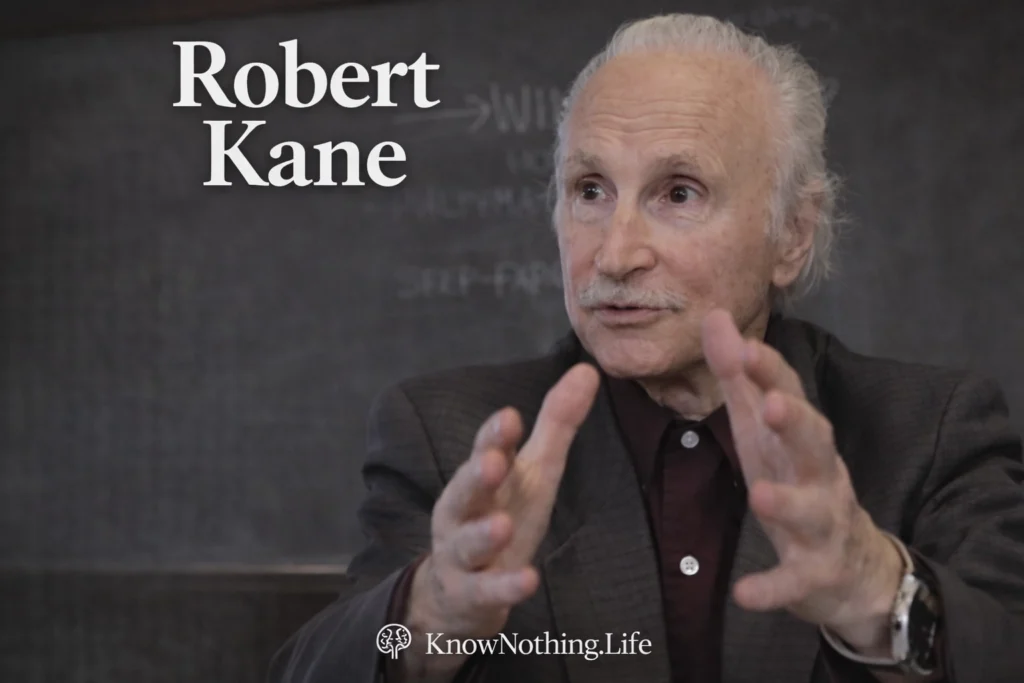
Robert Hilary Kane was born on November 25, 1938, in Boston, Massachusetts, and became one of the most important contemporary defenders of libertarian free will. He grew up in Maynard, Massachusetts, and studied philosophy at the College of the Holy Cross, where he received his bachelor’s degree in 1960. He also studied at the University of Vienna, an experience that placed him in contact with European philosophical traditions before he completed graduate study in the United States. Kane earned his M.A. and Ph.D. from Yale University, where his philosophical formation took place during a period of intense debate about action, mind, value, and moral responsibility.
Kane’s career was shaped by one of philosophy’s oldest and most difficult problems: whether human beings can be genuinely free and morally responsible in a world increasingly described by science. He taught at Fordham University and Haverford College before joining the University of Texas at Austin, where he spent the central decades of his academic life. At Texas, he became University Distinguished Teaching Professor of Philosophy Emeritus and also held a position as professor of law. That combination of philosophy and law mattered, because Kane’s work on free will was never merely abstract. It reached into questions of responsibility, punishment, moral conflict, political life, religion, and the meaning of human agency.
The Free Will Problem
The problem of free will begins with a tension. If our choices are fully determined by prior causes, then it can seem that we could never have done otherwise. But if our choices are undetermined, then they may appear random, and randomness does not look like responsibility either. This dilemma has haunted philosophy from ancient debates about fate to modern discussions of neuroscience. Kane’s work became influential because he refused both easy answers. He rejected the idea that free will can be reduced to ordinary freedom from coercion, but he also rejected the idea that indeterminism must make action irrational or accidental.
Kane defended an incompatibilist and libertarian account of free will. In ordinary language, libertarian free will means that some human choices are not determined by the past and the laws of nature, yet are still genuinely ours. Kane wanted to show that this kind of freedom could be made intelligible without appealing to mystery or supernatural interruption. His project was to reconcile a traditional desire for ultimate responsibility with modern science. He did not claim that every ordinary decision is radically undetermined. Instead, he focused on special moments when people help form the character and motives from which later actions flow.
Ultimate Responsibility
One of Kane’s central ideas was ultimate responsibility. A person is not fully responsible, in the deepest sense, merely because an action came from their desires. The harder question is whether the person is responsible for having the will, values, and character from which the action came. Kane believed that free will requires more than acting according to one’s motives; it requires that, at some point, the agent played an undetermined role in shaping those motives. He famously defined free will as “the power to be the ultimate creator and sustainer of one’s own ends or purposes.”
This idea gave Kane’s philosophy its moral seriousness. Many compatibilist philosophers argue that freedom is acting according to one’s own reasons, desires, or values without external compulsion. Kane agreed that such freedoms are important, but he thought they did not go far enough. If my desires and values were entirely formed by heredity, environment, and past causes outside my control, then in what sense am I ultimately responsible for them? Kane’s answer was that responsibility reaches back to character-forming choices. These are not every choices, but crucial moments in which the self is partly made.
Self-Forming Actions
Kane called these crucial moments self-forming actions, often abbreviated as SFAs. A self-forming action occurs when a person is torn between competing motivations, each of which has real force. Someone may struggle between ambition and honesty, loyalty and self-interest, courage and safety, compassion and resentment. In such moments, the person is not merely selecting from preferences already settled. The person is helping determine what kind of self they will become. For Kane, these conflicted decisions are where indeterminism can enter without turning action into pure chance.
The key to Kane’s theory is that indeterminism does not have to be external to the agent’s effort. In a self-forming action, the uncertainty arises within the person’s own divided will. The agent is trying to resolve a real moral or practical conflict, and either outcome may express something about that person. If the agent chooses courage over fear, or honesty over advantage, that choice helps strengthen one pathway of character. Later actions may become more settled, but they can still be free in a derivative sense because they flow from a will the person helped form. Kane’s theory therefore treats freedom as a developmental achievement, not merely a momentary power.
Major Works and Philosophical Development
Kane’s major works include Free Will and Values, published in 1985; Through the Moral Maze, published in 1994; The Significance of Free Will, published in 1996; A Contemporary Introduction to Free Will, published in 2005; and Ethics and the Quest for Wisdom, published in 2010. He also edited The Oxford Handbook of Free Will, one of the most important collections in contemporary free will studies, and contributed to Four Views on Free Will with John Martin Fischer, Derk Pereboom, and Manuel Vargas. Near the end of his life, he published The Complex Tapestry of Free Will: A Free Will Odyssey, which revisited and revised themes from decades of debate.
The Significance of Free Will remains his defining book. It offered a comprehensive defense of libertarianism while responding to major challenges from determinism, compatibilism, luck, moral psychology, and science. Kane’s writing is demanding because he tries to satisfy two audiences at once: philosophers who want rigor and ordinary human beings who feel that responsibility must mean something deeper than being a link in a causal chain. His work matters because it does not treat free will as a slogan. It treats it as a problem requiring metaphysics, ethics, psychology, and moral experience.
Critics, Luck, and Scientific Pressure
Kane’s theory attracted serious criticism, especially around the problem of luck. If a self-forming action is undetermined, critics ask, why is the outcome not partly a matter of luck? If the exact same past could lead either to honesty or dishonesty, then what explains why one rather than the other occurs? Kane’s answer was that both possible outcomes can be grounded in the agent’s own competing reasons and efforts. The indeterminism does not come from outside the person like a random coin toss. It is located in the struggle of the will itself.
This response did not convince everyone. Compatibilists often argued that moral responsibility does not require ultimate authorship in Kane’s strong sense. Hard determinists and free will skeptics argued that Kane had not escaped the dilemma between causation and randomness. Yet the power of his work is that he forced all sides to become clearer. He showed that libertarian free will could be developed as a serious philosophical position rather than dismissed as pre-scientific instinct. Even critics had to engage with his concepts of self-forming actions, ultimate responsibility, and plural voluntary control.
Teaching, Law, and Public Philosophy
Kane was also known as an exceptional teacher. At the University of Texas at Austin, he received many major teaching awards and was named one of the inaugural members of the university’s Academy of Distinguished Teachers. His reputation as a teacher is important because free will is not a narrow technical topic. It is a question students immediately recognize as personal. Kane had the rare ability to connect ancient philosophical problems with everyday moral experience: blame, guilt, regret, aspiration, weakness, courage, and responsibility.
His appointment in law also reflected the practical stakes of his thought. Legal systems depend heavily on assumptions about agency and responsibility. Courts ask whether people acted knowingly, voluntarily, intentionally, negligently, or under compulsion. Kane’s philosophy did not translate into simple legal formulas, but it deepened the background question: what does it mean for a person to deserve praise or blame? His work helped keep moral responsibility connected to lived human struggle rather than reducing it to behavior alone.
Legacy and Lasting Importance
Robert Kane died on April 20, 2024, in Guilford, Connecticut, at the age of eighty-five. By then, he had become one of the leading philosophers of free will in the English-speaking world. His influence rests not only on defending libertarianism, but on giving it a detailed modern form. He tried to show how freedom could involve indeterminism without collapsing into randomness, how responsibility could involve self-creation without denying science, and how moral life could retain depth in a world of causes.
Kane’s lasting importance lies in the seriousness with which he treated human agency. He understood that free will is not merely a puzzle about physics or logic. It is a question about whether our efforts matter in forming who we become. His answer was demanding: freedom is not simply doing what we want, but participating in the making of the will from which our wants arise. Whether one accepts his theory or not, Robert Kane remains essential because he made the case that human beings are not only products of causes, but possible authors of character.