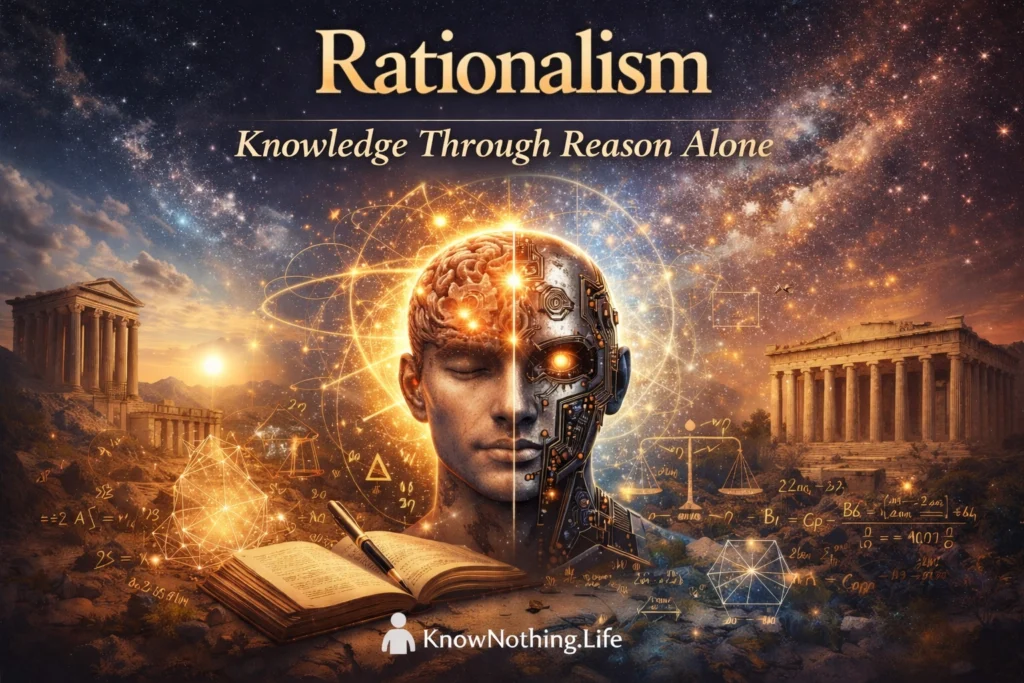
Rationalism is one of the central traditions in epistemology, asserting that reason is the primary source of knowledge. While experience may inform our understanding of the world, rationalists argue that certain truths can be known independently of sensory input. These truths are often described as a priori—known through intellect alone rather than through observation. Rationalism stands in contrast to empiricism, which emphasizes the role of experience, yet the tension between the two has driven philosophical inquiry for centuries.
The roots of rationalism extend back to ancient philosophy, particularly in the work of Plato, who argued that knowledge of eternal truths exists beyond the changing sensory world. However, rationalism reached its fullest development in the early modern period through thinkers such as René Descartes, Baruch Spinoza, and Gottfried Wilhelm Leibniz. These philosophers sought certainty in knowledge by grounding it in reason rather than in the potentially unreliable senses.
At its core, rationalism is motivated by a desire for certainty. Sensory experience can be deceptive, incomplete, or inconsistent, but reason offers the possibility of universal and necessary truths. Mathematics, logic, and certain metaphysical principles are often cited as examples of knowledge that do not depend on experience. Rationalism thus presents a powerful vision of human cognition: the mind is not merely a passive receiver of information, but an active source of knowledge.
The Foundations of Rationalist Thought
The rationalist tradition begins with the recognition that not all knowledge can be derived from experience. Plato famously argued that the sensory world is a realm of change and illusion, while true knowledge concerns unchanging forms or ideas. In dialogues such as Meno, Plato suggests that learning is a process of recollection, implying that the soul already possesses knowledge prior to experience.
This idea of innate knowledge was later developed by early modern rationalists. René Descartes sought to establish a secure foundation for knowledge by doubting everything that could be called into question. In Meditations on First Philosophy, he arrived at the famous conclusion, “Cogito, ergo sum” (“I think, therefore I am”), which he regarded as indubitable. This insight demonstrated, for Descartes, that reason alone could yield certain knowledge.
Rationalists argue that some ideas are innate, meaning they are present in the mind independently of experience. These include concepts such as mathematical truths, logical principles, and the idea of perfection or infinity. Gottfried Wilhelm Leibniz expressed this view succinctly when he wrote, “Nothing is in the intellect that was not first in the senses—except the intellect itself.” This statement captures the rationalist belief that the mind contributes essential structure to knowledge.
Descartes and the Search for Certainty
No figure is more closely associated with rationalism than René Descartes. His philosophical project was driven by a desire to find a foundation for knowledge that could not be doubted. By systematically questioning the reliability of the senses, Descartes sought to strip away all uncertain beliefs and identify those that remain absolutely certain.
In Meditations on First Philosophy, Descartes introduces the method of radical doubt, imagining scenarios in which even the most basic assumptions could be false. He famously considers the possibility of an evil demon deceiving him about everything he perceives. Yet even in this extreme skepticism, Descartes finds one truth that cannot be doubted: the existence of his own thinking mind.
From this foundation, Descartes attempts to rebuild knowledge using reason. He argues that clear and distinct ideas—those that are immediately evident to the mind—provide a reliable basis for knowledge. This emphasis on intellectual clarity reflects the rationalist conviction that reason, when properly applied, can lead to certainty. Descartes’ approach set the stage for subsequent rationalists, who expanded and refined his ideas.
Spinoza and the Geometric Method
Baruch Spinoza represents a distinctive development within rationalism, applying mathematical reasoning to philosophy itself. In his work Ethics, Spinoza presents his arguments in a geometric format, using definitions, axioms, and propositions to derive conclusions about reality.
Spinoza’s rationalism is grounded in the belief that the universe operates according to necessary principles that can be understood through reason. He identifies God with nature, arguing that everything follows from the nature of a single substance. This deterministic view reflects the rationalist commitment to uncovering universal truths through logical deduction.
One of Spinoza’s most striking claims is that true understanding leads to freedom. By grasping the necessary structure of reality, individuals can overcome the illusions of contingency and randomness. As he writes, “The more you struggle to live, the less you live. Give up the notion that you must be sure of what you are doing.” This perspective highlights the transformative potential of rational knowledge.
Leibniz and Innate Ideas
Gottfried Wilhelm Leibniz further developed rationalist thought by offering a sophisticated account of innate ideas and necessary truths. In works such as Monadology, Leibniz argues that the universe consists of simple substances called monads, each reflecting the entire cosmos from its own perspective.
Leibniz distinguishes between necessary truths, which are true in all possible worlds, and contingent truths, which depend on particular circumstances. Necessary truths, such as those found in mathematics and logic, are known through reason alone. This distinction reinforces the rationalist claim that some knowledge is independent of experience.
Leibniz also introduces the principle of sufficient reason, which states that nothing happens without a reason. This principle reflects the rationalist belief that reality is fundamentally intelligible and that reason can uncover the underlying causes of all phenomena. Leibniz’s work represents a culmination of rationalist thought, integrating metaphysics, logic, and epistemology into a unified system.
Rationalism vs. Empiricism
The rise of rationalism was accompanied by a parallel development: empiricism, which challenged the idea that knowledge could be derived from reason alone. Philosophers such as John Locke and David Hume argued that all knowledge originates in sensory experience, rejecting the notion of innate ideas.
This debate between rationalism and empiricism became one of the defining features of early modern philosophy. Rationalists emphasized certainty and necessity, while empiricists focused on observation and probability. Each perspective highlighted important aspects of knowledge, but neither provided a complete account on its own.
The tension between these views was addressed by Immanuel Kant, who sought to reconcile rationalism and empiricism in Critique of Pure Reason. Kant argued that knowledge arises from the interaction between sensory input and the mind’s inherent structures. As he famously stated, “Thoughts without content are empty, intuitions without concepts are blind.” This synthesis represents a turning point in the history of epistemology.
Contemporary Rationalism and Its Legacy
Although the classical rationalist system has been modified and challenged, its core insights continue to influence contemporary philosophy. Modern discussions of logic, mathematics, and analytic philosophy often rely on the idea that certain truths are accessible through reason alone. Rationalist themes also appear in debates about the nature of consciousness, language, and artificial intelligence.
Philosophers such as Noam Chomsky have revived aspects of rationalism by arguing for innate structures in the human mind, particularly in the context of language acquisition. Chomsky’s theory of universal grammar suggests that the ability to learn language depends on inborn cognitive frameworks, echoing the rationalist emphasis on innate ideas.
At the same time, contemporary epistemology has become more pluralistic, recognizing that knowledge arises from multiple sources, including reason, experience, and social interaction. Rationalism remains a vital part of this broader landscape, providing a framework for understanding the role of intellect in shaping knowledge.
Conclusion
Rationalism offers a powerful account of knowledge as something grounded in reason rather than experience. From Plato’s theory of forms to René Descartes’ search for certainty, the rationalist tradition has sought to uncover truths that are universal, necessary, and independent of the senses.
While challenged by empiricism and refined by later thinkers such as Immanuel Kant, rationalism continues to shape philosophical inquiry. Its emphasis on clarity, logic, and intellectual rigor remains central to the pursuit of knowledge.
As Gottfried Wilhelm Leibniz observed, “The human mind is capable of discovering truths that transcend experience.” This belief captures the enduring appeal of rationalism: the idea that within the human intellect lies the power to grasp the fundamental structure of reality itself.