Pragmatism is a philosophical tradition that reorients inquiry away from abstract speculation and toward practical consequences. Rather than asking what ideas are in isolation, pragmatism asks what ideas do—how they function in experience, how they guide action, and how they help solve real problems. This shift reflects a broader commitment to viewing knowledge as dynamic, evolving, and inseparable from human activity.
Emerging in the late 19th and early 20th centuries, pragmatism developed as a response to both rigid rationalism and strict empiricism. It challenged the notion that truth is fixed and independent of human experience, proposing instead that truth is something that emerges through interaction with the world. By focusing on outcomes and usefulness, pragmatism offers a flexible and adaptive approach to philosophical inquiry, one that emphasizes experimentation, revision, and the continuous pursuit of improvement.
Origins and Key Thinkers
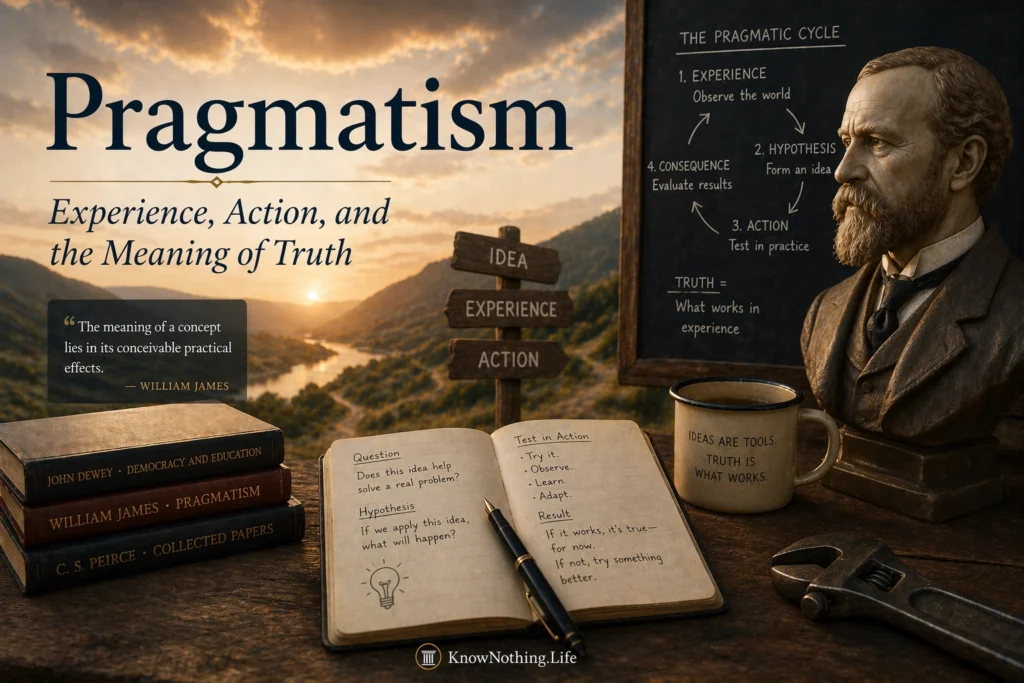
The foundations of pragmatism were established by thinkers such as Charles Sanders Peirce, who introduced the pragmatic maxim as a method for clarifying concepts. According to this principle, the meaning of an idea lies in its practical effects—what difference it makes in experience. This approach shifts attention from abstract definitions to observable consequences, providing a concrete way to evaluate ideas.
Building on Peirce’s work, William James expanded pragmatism into a broader philosophical framework. James emphasized the role of individual experience and the importance of beliefs in shaping action. Later, John Dewey developed pragmatism into a comprehensive theory of inquiry, education, and democracy, highlighting the social and experimental dimensions of knowledge. Together, these thinkers established pragmatism as a distinct and influential philosophical tradition.
Truth as Practical Success
One of the most distinctive features of pragmatism is its account of truth. Rather than viewing truth as a static correspondence between statements and reality, pragmatists understand truth in terms of practical success. A belief is considered true if it works—if it helps us navigate experience, solve problems, and achieve desired outcomes.
This does not mean that truth is arbitrary or merely subjective. Pragmatists argue that ideas must be tested through experience and that their validity depends on their ability to withstand such testing. Truth, in this sense, is provisional and open to revision, reflecting the evolving nature of knowledge. This perspective challenges traditional notions of certainty, emphasizing that understanding is always a process rather than a final state.
Inquiry and Experimentation
Pragmatism places a strong emphasis on inquiry as an active and experimental process. Knowledge is not something that is passively received but something that is constructed through engagement with the world. Inquiry begins with a problem or a situation of uncertainty, prompting investigation and the formulation of hypotheses.
Through experimentation and reflection, these hypotheses are tested and refined. This process mirrors the scientific method but extends beyond it, applying to all areas of human activity. For pragmatists, inquiry is ongoing, with each solution leading to new questions and challenges. This dynamic approach highlights the importance of adaptability and openness in the pursuit of knowledge.
Experience and Reality
Experience plays a central role in pragmatist philosophy, serving as the foundation for understanding reality. Rather than separating mind and world, pragmatists view experience as the point where these elements interact. Reality is not something entirely independent of human perception, nor is it purely constructed by the mind; it emerges through the interplay between the two.
This emphasis on experience leads to a rejection of rigid dualisms, such as the division between theory and practice. For pragmatists, ideas are tools that arise from and are tested within experience. This perspective encourages a holistic view of knowledge, where understanding is grounded in the lived realities of individuals and communities.
Ethics and Values
Pragmatism also offers a distinctive approach to ethics, focusing on the practical consequences of moral decisions. Rather than relying on fixed principles or abstract rules, pragmatist ethics evaluates actions based on their outcomes and their impact on human well-being. This approach emphasizes context, flexibility, and the importance of considering multiple perspectives.
John Dewey, in particular, argued that ethical inquiry is similar to scientific inquiry, involving experimentation and reflection. Moral principles are not absolute but evolve through experience and social interaction. This perspective encourages a participatory approach to ethics, where individuals and communities collaborate in shaping values and addressing moral challenges.
Pragmatism and Society
Pragmatism has significant implications for social and political thought. Its emphasis on experimentation and adaptability supports democratic ideals, encouraging open dialogue and collective problem-solving. Rather than imposing fixed solutions, pragmatism advocates for policies that can be tested and revised in response to changing conditions.
In education, pragmatism emphasizes learning through experience and active engagement. Dewey’s contributions to educational theory highlight the importance of fostering critical thinking and creativity, preparing individuals to participate effectively in democratic society. These applications demonstrate how pragmatism extends beyond philosophy, influencing practical approaches to social organization and development.
Critiques and Challenges
Despite its strengths, pragmatism has faced criticism from various quarters. Some argue that its emphasis on practical consequences risks reducing truth to mere utility, neglecting deeper questions about reality and objectivity. Others contend that pragmatism may lack clear standards for evaluating competing beliefs, leading to ambiguity or relativism.
Pragmatists respond by emphasizing that practical success involves more than immediate usefulness; it includes coherence, consistency, and the ability to integrate with broader experience. Nonetheless, these critiques highlight the challenges of balancing flexibility with rigor. The ongoing debate reflects the dynamic nature of pragmatism itself, as it continues to evolve in response to new questions and perspectives.
Pragmatism in Contemporary Thought
In contemporary philosophy, pragmatism remains a vibrant and influential approach. It has been revived and reinterpreted by thinkers who apply its principles to issues such as language, science, and politics. Its emphasis on context and adaptability makes it particularly relevant in a rapidly changing world, where rigid frameworks often prove inadequate.
Pragmatism’s focus on practical consequences also resonates with interdisciplinary approaches, bridging gaps between philosophy, social science, and applied fields. By prioritizing action and experience, it offers a way of thinking that is both grounded and forward-looking, addressing the complexities of modern life with flexibility and insight.
Conclusion
Pragmatism is a philosophical tradition that redefines the pursuit of knowledge by emphasizing experience, action, and practical outcomes. By viewing truth as something that emerges through successful engagement with the world, it challenges static and abstract conceptions of understanding. Its methods of inquiry, grounded in experimentation and reflection, provide a dynamic framework for addressing both theoretical and practical problems.
Ultimately, pragmatism invites a shift in perspective, encouraging us to evaluate ideas not only by their coherence but by their consequences. It highlights the importance of adaptability, collaboration, and continuous learning in the search for truth. In doing so, it offers a philosophy that is not only intellectually rigorous but also deeply connected to the realities of human life.