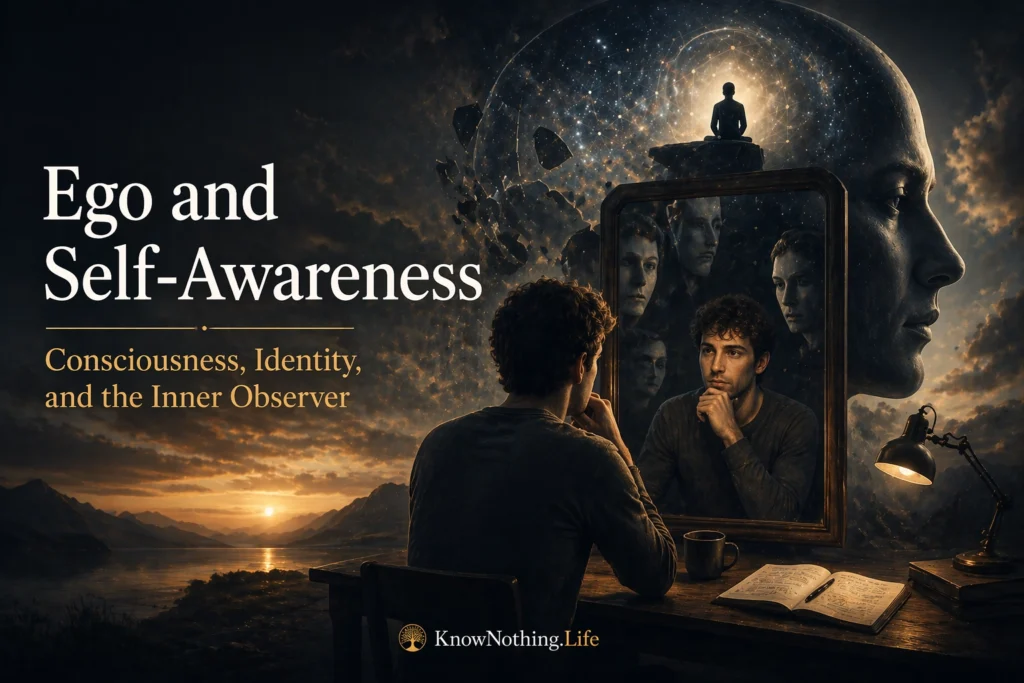
The concepts of ego and self-awareness sit at the core of human experience, shaping how individuals perceive themselves, interpret reality, and navigate the world. While often used interchangeably in everyday language, these terms refer to distinct yet deeply interconnected aspects of the mind. The ego is commonly understood as the sense of self—an organizing structure that maintains identity and mediates between internal desires and external demands. Self-awareness, by contrast, is the capacity to reflect on one’s own thoughts, emotions, and actions, creating a layer of observation that allows the mind to examine itself.
Philosophically, the relationship between ego and self-awareness raises fundamental questions about consciousness and identity. Is the ego the true self, or merely a constructed image? Does self-awareness reveal reality, or does it introduce distortion through interpretation? These questions have been explored across philosophical traditions, from ancient introspection to modern psychology and neuroscience. Understanding ego and self-awareness is not only an intellectual pursuit—it has practical implications for personal growth, ethical responsibility, and the search for meaning.
Historical Foundations of Ego and Self-Awareness
The roots of ego and self-awareness can be traced back to early philosophical inquiries into the nature of the self. In ancient Greece, Socrates emphasized the importance of self-examination, famously asserting that “the unexamined life is not worth living.” This idea positioned self-awareness as a moral and intellectual necessity, suggesting that understanding oneself is the foundation of wisdom. Plato expanded on this by linking self-awareness to the rational soul, which he believed should guide human behavior above impulses and desires.
In Eastern traditions, the relationship between ego and self-awareness was approached differently. Buddhist philosophy, for example, challenges the very existence of a stable ego, proposing that what we perceive as the self is an illusion. Instead, self-awareness is seen as a path to recognizing this illusion, leading to a deeper understanding of reality. This perspective contrasts with many Western views that treat the ego as a central and necessary component of identity.
During the early modern period, René Descartes placed self-awareness at the foundation of knowledge. His famous assertion that thinking proves existence positioned consciousness as the undeniable core of the self. However, later philosophers questioned whether this reflective awareness truly captures the essence of identity, or whether it merely represents one layer of a more complex mental structure.
The Ego as Structure and Identity
The concept of the ego gained particular prominence in modern psychology, especially through the work of Sigmund Freud. Freud described the ego as the rational component of the mind that mediates between instinctual desires (the id) and moral constraints (the superego). In this framework, the ego is not the entirety of the self but a functional system that maintains balance and coherence. It constructs a sense of identity by organizing experiences, regulating impulses, and interacting with reality.
From a philosophical perspective, the ego can be understood as both necessary and limiting. On one hand, it provides a stable sense of self that allows individuals to function in the world. Without it, there would be no continuity, no sense of “I” that persists over time. On the other hand, the ego can create illusions of permanence and control, leading individuals to identify too strongly with their thoughts, roles, or social status. This attachment can distort perception, making it difficult to see reality as it is.
Thinkers like Friedrich Nietzsche challenged traditional notions of the ego, suggesting that the self is not a unified entity but a dynamic interplay of forces and drives. Rather than being a fixed center, the ego may be better understood as a constantly shifting construct, shaped by internal conflicts and external influences. This view aligns with contemporary perspectives that see identity as fluid and multifaceted.
Self-Awareness and Reflective Consciousness
Self-awareness introduces a unique dimension to human consciousness—the ability to step back and observe one’s own mental processes. This reflective capacity allows individuals to analyze their thoughts, question their beliefs, and regulate their behavior. It creates a distinction between the experiencing self and the observing self, enabling a level of introspection that is central to both philosophy and psychology.
Philosophers such as Immanuel Kant emphasized the role of self-awareness in shaping experience. Kant argued that the mind actively organizes sensory input, and that the unity of consciousness—the sense that experiences belong to a single self—is a fundamental condition for knowledge. Without this unifying awareness, perception would be fragmented and incoherent.
However, self-awareness is not always straightforward or reliable. The act of observing one’s own thoughts can introduce bias and distortion, as individuals interpret their experiences through existing beliefs and assumptions. This raises questions about the limits of introspection: Can we truly know ourselves, or are we always interpreting a constructed version of our own minds? Despite these challenges, self-awareness remains a powerful tool for understanding and transformation.
The Tension Between Ego and Awareness
The relationship between ego and self-awareness is often characterized by tension. The ego seeks stability, coherence, and affirmation, while self-awareness introduces the possibility of questioning and change. When individuals become more self-aware, they may begin to recognize the limitations and illusions created by the ego, leading to a shift in how they perceive themselves.
This tension is central to many philosophical and spiritual traditions. In existentialist thought, figures like Jean-Paul Sartre argued that self-awareness reveals the absence of a fixed essence, forcing individuals to confront their own freedom and responsibility. The ego, in this context, can act as a defense mechanism, creating a sense of identity that masks the underlying uncertainty of existence.
Similarly, Eastern philosophies often emphasize the importance of transcending the ego through heightened awareness. By observing thoughts and emotions without attachment, individuals can loosen the grip of the ego and experience a more direct form of consciousness. This does not necessarily mean eliminating the ego, but rather understanding its role and limitations. The balance between ego and awareness becomes a dynamic process, requiring ongoing reflection and adjustment.
Ego, Self-Awareness, and Modern Thought
In contemporary philosophy and science, the study of ego and self-awareness has expanded to include insights from neuroscience and cognitive psychology. Research suggests that the sense of self arises from complex interactions within the brain, rather than from a single unified center. This aligns with philosophical views that question the existence of a stable ego, instead describing the self as an emergent phenomenon.
At the same time, modern life presents new challenges for self-awareness. The constant flow of information, social media, and external validation can reinforce the ego, encouraging individuals to construct and maintain curated identities. This environment can make it more difficult to engage in genuine self-reflection, as attention is often directed outward rather than inward.
Despite these challenges, the importance of self-awareness remains widely recognized. Practices such as mindfulness and introspection are increasingly valued for their ability to enhance clarity and reduce the influence of unconscious patterns. These approaches reflect a growing understanding that while the ego plays a necessary role in organizing experience, self-awareness is essential for navigating its limitations.
Conclusion
Ego and self-awareness represent two fundamental aspects of human consciousness, each playing a distinct yet interconnected role in shaping identity and experience. The ego provides structure and continuity, allowing individuals to function within the world, while self-awareness offers the capacity for reflection, insight, and transformation. Together, they form a dynamic relationship that defines how individuals understand themselves and their place in reality.
Philosophical exploration reveals that neither the ego nor self-awareness can be fully understood in isolation. The ego without awareness risks becoming rigid and illusory, while awareness without structure may lack coherence and direction. The challenge lies in balancing these forces, recognizing the value of the ego while remaining open to the insights that self-awareness can provide.
Ultimately, the study of ego and self-awareness invites a deeper engagement with the nature of consciousness itself. It encourages individuals to question assumptions, examine their inner lives, and explore the boundaries of identity. In doing so, it offers not definitive answers, but a pathway toward greater understanding and self-knowledge.