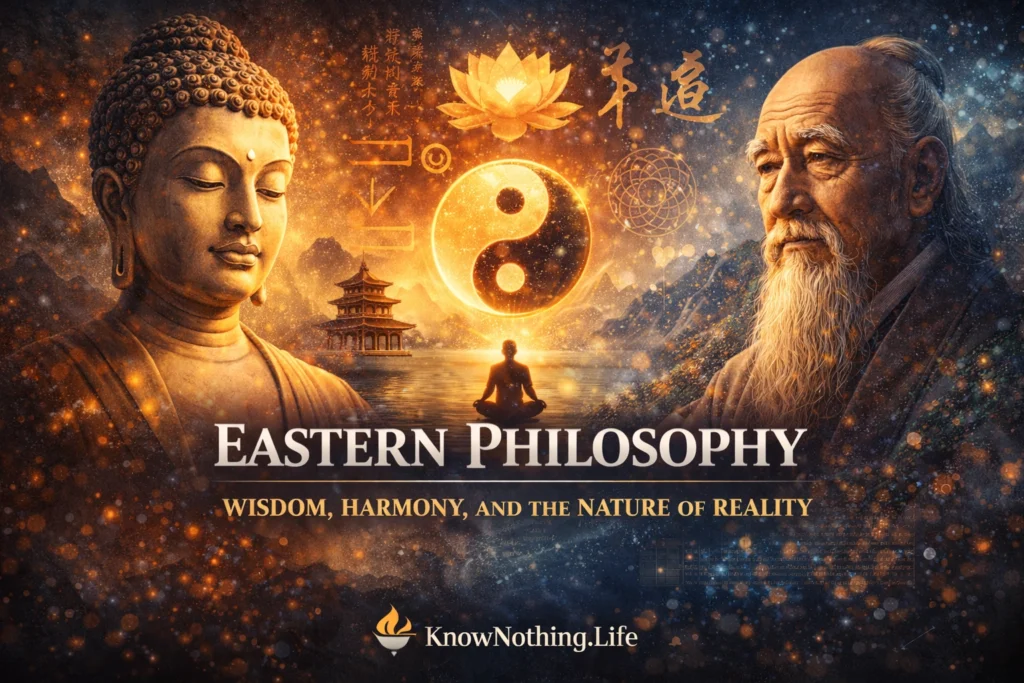
Eastern philosophy encompasses a vast and diverse set of traditions originating primarily in Asia, including the philosophical systems of India, China, Japan, and beyond. Rather than forming a single unified doctrine, it represents a constellation of approaches to understanding reality, knowledge, ethics, and human existence. What unites these traditions is a shared emphasis on harmony, balance, and the integration of thought with lived experience. While Western philosophy has often prioritized abstraction and systematic argument, Eastern philosophy tends to focus on practical wisdom—how one ought to live, act, and cultivate awareness within the world.
At its core, Eastern philosophy is deeply concerned with the nature of reality and the human condition, but it approaches these questions through introspection, meditation, and ethical practice rather than purely analytical reasoning. Concepts such as impermanence, interconnectedness, and the illusion of a fixed self recur across multiple traditions, suggesting a worldview in which reality is dynamic and relational rather than static and independent. This orientation has influenced not only philosophical inquiry but also religion, art, medicine, and daily life across Eastern cultures, shaping entire civilizations through its enduring insights.
Indian Philosophy and the Search for Liberation
Indian philosophy is among the oldest continuous philosophical traditions in the world, rooted in sacred texts such as the Vedas and the Upanishads. These texts explore profound questions about the nature of existence, the self, and ultimate reality, often framed in terms of the relationship between the individual soul (Atman) and the universal principle (Brahman). The Upanishads famously declare, “Tat Tvam Asi” (“That Thou Art”), expressing the idea that the individual self is fundamentally identical with the ultimate reality. This insight forms the basis of many Indian philosophical systems, which seek liberation (moksha) from the cycle of birth and rebirth (samsara).
One of the most influential figures in Indian philosophy is Siddhartha Gautama, whose teachings gave rise to Buddhism. In texts such as the Dhammapada, the Buddha emphasized the impermanent and unsatisfactory nature of worldly existence, as well as the absence of a permanent self (anatta). He taught that suffering arises from attachment and ignorance, and that liberation can be achieved through ethical conduct, meditation, and wisdom. His famous statement, “All conditioned things are impermanent,” encapsulates a central tenet of Buddhist thought.
Another major figure is Adi Shankaracharya, a proponent of Advaita Vedanta, who argued for a non-dualistic understanding of reality. In his commentaries on the Upanishads and the Brahma Sutras, Shankaracharya asserted that the apparent multiplicity of the world is ultimately an illusion (maya), and that true knowledge reveals the unity of Atman and Brahman. Indian philosophy thus offers a deeply introspective approach to understanding reality, one that seeks not only intellectual clarity but spiritual transformation.
Chinese Philosophy and the Way of Harmony
Chinese philosophy is characterized by its focus on social harmony, ethical conduct, and alignment with the natural order. Two of its most influential traditions are Confucianism and Daoism, each offering distinct but complementary perspectives on how to live well. Confucius, whose teachings are recorded in the Analects, emphasized the importance of virtue, proper conduct, and the cultivation of moral character. He believed that a harmonious society arises from individuals fulfilling their roles with integrity and respect.
Confucius famously stated, “The superior man is modest in his speech, but exceeds in his actions,” highlighting the importance of ethical behavior over mere words. His philosophy places great emphasis on relationships, particularly within the family and society, and on the cultivation of virtues such as benevolence (ren) and righteousness (yi). Confucianism has had a profound and lasting impact on Chinese culture, shaping its educational systems, political structures, and social values.
In contrast, Laozi, the legendary author of the Dao De Jing, advocated a more mystical and naturalistic approach. Daoism emphasizes living in accordance with the Dao, or “the Way,” which represents the fundamental principle underlying the universe. Laozi wrote, “The Dao that can be spoken is not the eternal Dao,” suggesting that ultimate reality transcends language and conceptualization. Daoist philosophy encourages simplicity, spontaneity, and non-action (wu wei), advocating a way of life that flows with the natural rhythms of existence rather than resisting them.
Together, Confucianism and Daoism offer complementary visions of harmony—one grounded in social order and ethical responsibility, the other in alignment with the natural world. Their interplay has shaped Chinese thought for centuries, providing a rich framework for understanding both individual conduct and the broader patterns of life.
Japanese Philosophy and the Aesthetics of Impermanence
Japanese philosophy draws on both indigenous traditions and influences from Chinese and Indian thought, particularly Buddhism and Confucianism. One of its defining features is an acute sensitivity to impermanence and the transient nature of existence. This sensibility is reflected in aesthetic concepts such as mono no aware, which refers to the poignant awareness of the fleeting nature of things, and wabi-sabi, which finds beauty in simplicity, imperfection, and decay.
Zen Buddhism, which developed in China as Chan Buddhism and later flourished in Japan, plays a central role in Japanese philosophy. Influenced by the teachings of Siddhartha Gautama, Zen emphasizes direct experience and intuitive insight over doctrinal study. Practitioners engage in meditation (zazen) and the contemplation of paradoxical statements known as koans to transcend ordinary patterns of thought. A famous Zen saying declares, “Before enlightenment, chop wood, carry water. After enlightenment, chop wood, carry water,” illustrating the idea that enlightenment is not separate from everyday life.
Japanese thinkers have also contributed to modern philosophy, blending Eastern and Western ideas in innovative ways. Nishida Kitaro, founder of the Kyoto School, developed a philosophy of “pure experience” that sought to overcome the dualism between subject and object. His work reflects a broader trend in Japanese philosophy toward integrating traditional insights with contemporary philosophical concerns, demonstrating the adaptability and ongoing relevance of Eastern thought.
Key Themes and Philosophical Approaches
Despite its diversity, Eastern philosophy shares several recurring themes that distinguish it from many Western traditions. One of the most prominent is the emphasis on interconnectedness—the idea that all things are interdependent and cannot be fully understood in isolation. This perspective challenges the notion of a separate, independent self, instead presenting the individual as part of a larger web of relationships and processes.
Another key theme is the focus on practice as a means of philosophical inquiry. In many Eastern traditions, philosophy is not merely an intellectual exercise but a way of life that involves ethical discipline, meditation, and self-cultivation. Knowledge is not something to be possessed but something to be realized through direct experience and transformation. This practical orientation gives Eastern philosophy a distinctive character, bridging the gap between thought and action.
Eastern philosophy also tends to embrace paradox and ambiguity, recognizing the limitations of language and conceptual thought. Rather than seeking definitive answers, it often invites reflection and openness, encouraging individuals to engage with the complexity of reality in a flexible and adaptive manner. As the Dao De Jing suggests, “Knowing others is intelligence; knowing yourself is true wisdom,” pointing to the importance of self-awareness as a foundation for understanding the world.
Contemporary Relevance of Eastern Philosophy
In the modern world, Eastern philosophy continues to exert a significant influence, both within its regions of origin and globally. Its insights into mindfulness, balance, and interconnectedness have found resonance in fields such as psychology, environmental ethics, and healthcare. Practices derived from Eastern traditions, such as meditation and yoga, have become widely adopted as tools for managing stress and enhancing well-being.
At the same time, Eastern philosophy has contributed to contemporary philosophical debates by offering alternative perspectives on issues such as identity, consciousness, and the nature of reality. Its emphasis on relationality and process has informed developments in systems theory and ecological thinking, challenging more individualistic and mechanistic models of understanding.
As global cultures become increasingly interconnected, the dialogue between Eastern and Western philosophy has grown more dynamic and fruitful. Thinkers from both traditions are engaging with each other’s ideas, leading to new syntheses and approaches that transcend traditional boundaries. This ongoing exchange highlights the enduring relevance of Eastern philosophy as a source of insight and inspiration in a rapidly changing world.
Final Reflections on Eastern Philosophy
Eastern philosophy offers a profound and multifaceted exploration of the human condition, grounded in a deep awareness of the interconnected and impermanent nature of reality. Its emphasis on harmony, self-cultivation, and lived experience provides a powerful counterbalance to more abstract and analytical approaches, reminding us that philosophy is not only about understanding the world but about transforming our relationship to it.
As Confucius observed, “It does not matter how slowly you go as long as you do not stop.” This simple yet profound insight reflects the spirit of Eastern philosophy, which values steady progress, reflection, and the continuous cultivation of wisdom. By embracing both the complexity and simplicity of existence, Eastern philosophy invites us to live more consciously, more compassionately, and more fully within the ever-changing flow of life.